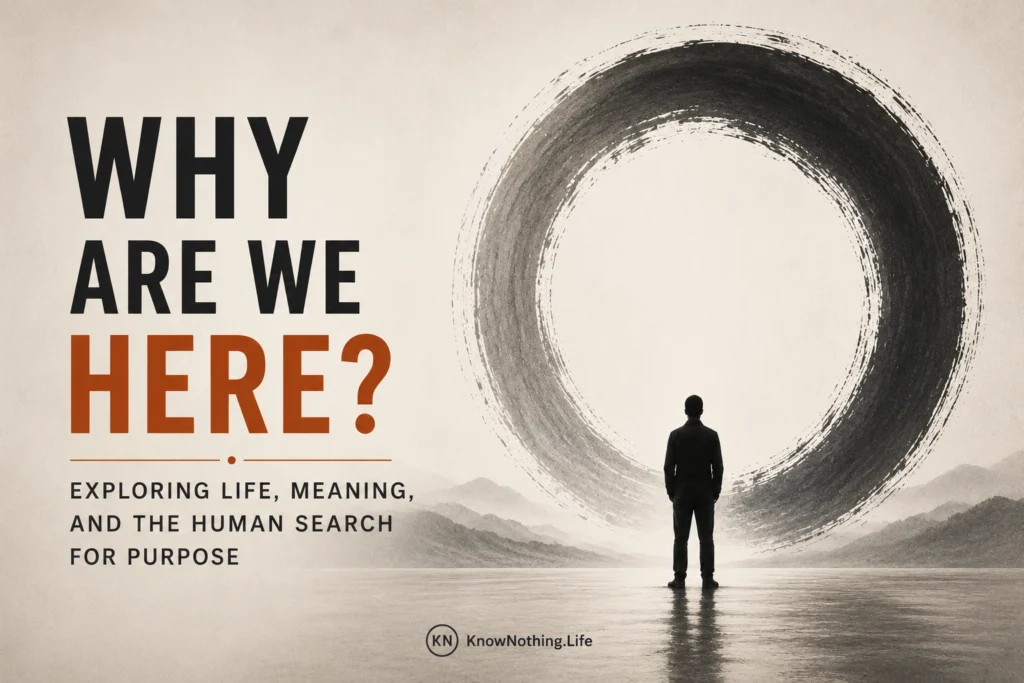
Few questions in human history are as profound, unsettling, and universal as a simple one: Why are we here? Every civilization, religion, philosopher, scientist, and individual eventually confronts it. The question reaches beyond biology and survival. It is not asking merely how humans came into existence, but why existence exists at all. Why is there consciousness instead of nothing? Why does life emerge in a vast universe filled mostly with empty space? Why do human beings possess self-awareness powerful enough to ask questions about their own existence?
Unlike many scientific questions, this one has never produced a universally accepted answer. Science can explain the mechanisms that produced stars, planets, chemistry, and biological evolution. Religion often offers narratives of divine purpose and creation. Philosophy examines whether meaning is discovered or created. Psychology studies how humans construct purpose internally. Yet none fully settle the matter. The question remains alive because it touches the deepest mystery imaginable: whether existence itself has intention, or whether human beings are simply conscious creatures trying to create meaning in an indifferent universe.
The Religious Answer: Created for Purpose
For most of human history, the dominant answer came through religion. In Judaism, Christianity, and Islam, human beings are understood as intentionally created by God. Life is not accidental but purposeful. Humanity exists to know God, live morally, steward creation, and participate in a divine plan larger than individual existence. In the Hebrew Bible, Genesis describes humanity as created “in the image of God,” suggesting that human consciousness reflects something sacred and unique about creation itself.
Religious traditions across the world offer variations of this idea. Hindu philosophy describes existence through dharma, the cosmic order that gives life structure and duty. Buddhism approaches the question differently, suggesting that suffering arises through attachment and ignorance, and the purpose of life lies in awakening rather than serving an external creator. Christian theologian Saint Augustine wrote in Confessions, “You have made us for yourself, O Lord, and our hearts are restless until they rest in you.” The religious worldview assumes that existence has objective meaning built into the structure of reality itself. Humans do not invent purpose. They discover the purpose already given to them.
The Scientific Answer: Evolution Without Intention
Modern science radically changed how humans understand existence. Charles Darwin’s theory of evolution by natural selection offered an explanation for life without requiring divine intervention. Species did not appear fully formed with predetermined purpose. They evolved gradually through mutation, environmental pressure, adaptation, and survival. Human beings emerged through the same process governing every living organism on Earth. In this framework, biology explains how we got here without addressing why.
Many scientists argue that nature itself has no larger intention. The universe is not designed around humanity. Physicist Carl Sagan famously wrote, “We are a way for the cosmos to know itself.” This idea preserves wonder without assuming cosmic purpose. The atoms in human bodies were forged inside ancient stars billions of years before Earth existed. Through evolution, matter eventually organized itself into nervous systems capable of awareness. Consciousness emerged, and suddenly the universe became capable of reflecting upon itself.
Yet science creates an uncomfortable tension. If evolution is blind and undirected, then human life may have no predetermined purpose beyond survival and reproduction. Richard Dawkins famously argued in The Selfish Gene that organisms function largely as vehicles through which genes preserve themselves. For many people, this explanation feels incomplete. It explains the machinery of existence but leaves the deeper existential question untouched.
Existentialism: Meaning Must Be Created
Twentieth-century existentialist philosophers argued that searching for built-in meaning may be a mistake. Jean-Paul Sartre famously declared that “existence precedes essence.” Human beings are not born with predetermined purpose. They simply exist first, and then must create meaning through choices, actions, commitments, and responsibility. Unlike a hammer, which is designed for a function, a human being arrives without instruction manual or assigned destiny.
Albert Camus explored this tension in The Myth of Sisyphus. He described the absurd condition of human life: people desperately seek meaning in a universe that offers no obvious answer. Yet Camus did not conclude that life is hopeless. Instead, he argued that rebellion itself creates dignity. His famous line remains one of philosophy’s most enduring statements: “The struggle itself toward the heights is enough to fill a man’s heart.” Existentialism shifts the question entirely. Instead of asking why we are here objectively, it asks what we choose to make of being here.
Psychology and the Human Need for Meaning
Psychology reveals that meaning itself is essential for human well-being. Austrian psychiatrist Viktor Frankl, a Holocaust survivor and founder of logotherapy, argued that humanity’s deepest drive is not pleasure or power but meaning. In Man’s Search for Meaning, Frankl wrote, “Those who have a why to live can bear almost any how,” borrowing from Friedrich Nietzsche. Frankl observed that people who maintained a sense of purpose often survived immense suffering more successfully than those who lost hope.
Modern psychology strongly supports this insight. Studies consistently show that people with a strong sense of meaning tend to experience greater resilience, better mental health, stronger motivation, and improved life satisfaction. Purpose organizes human behavior. It provides coherence between suffering and future hope. Even if the universe offers no objective answer, the mind appears structured in such a way that humans need purpose psychologically. Meaning may not be optional. It may be part of how consciousness sustains itself.
Consciousness: The Strange Exception
One reason the question persists is consciousness itself. Human beings are not merely alive; they are aware that they are alive. A tree grows toward sunlight. A wolf hunts prey. But humans ask abstract questions about morality, death, infinity, identity, and existence. Philosopher David Chalmers calls consciousness “the hard problem” because science can describe brain activity but struggles to explain why subjective experience exists at all. Why does matter arranged as a brain generate an inner world?
Some thinkers argue that consciousness itself suggests deeper purpose. Physicist John Wheeler proposed the participatory universe theory, suggesting that observation may play a fundamental role in reality itself. Others, including philosophers interested in panpsychism, speculate that consciousness may be a fundamental feature of existence rather than an accidental product of matter. If awareness is woven deeply into the fabric of reality, then humanity’s existence may not be as accidental as strict materialism suggests.
Why Humans Seek Meaning at All
Evolutionary psychology asks an interesting question: why do humans care about purpose so deeply? Survival alone does not fully explain art, philosophy, religion, music, sacrifice, or the search for transcendence. Humans consistently move beyond biological necessity. They create civilizations, moral systems, spiritual traditions, mathematics, literature, and rituals around death. The need for meaning appears universal across cultures and historical eras.
Psychologist Abraham Maslow argued that once basic survival needs are met, humans naturally seek self-actualization: the fulfillment of deeper psychological potential. We do not merely want food and safety. We want significance. This suggests that the search for meaning may itself be a defining characteristic of humanity. Perhaps the reason humans ask why they are here is because questioning itself is part of what makes humans human.
The Cosmic Perspective
Astronomy makes the question even stranger. The observable universe contains perhaps two trillion galaxies, each containing billions of stars. Earth exists on the edge of one ordinary galaxy among incomprehensible cosmic scale. Seen from this perspective, human existence appears tiny and fragile. Blaise Pascal captured this beautifully in the seventeenth century when he wrote, “The eternal silence of these infinite spaces terrifies me.”
Yet there is another way to interpret cosmic scale. Against overwhelming odds, life emerged. From chemistry came biology. From biology came nervous systems. From nervous systems came consciousness capable of understanding black holes, quantum physics, and distant galaxies. Humans may be physically insignificant, but intellectually remarkable. Carl Jung believed humanity participates in something psychologically profound, writing that “Who looks outside, dreams; who looks inside, awakes.” Perhaps our significance lies not in size but in awareness itself.
Final Thoughts: The Question May Be the Answer
So why are we here? Religion says for divine purpose. Science says through natural processes. Existentialism says we create our own meaning. Psychology says meaning is necessary for human flourishing. Philosophy reminds us that consciousness itself remains mysterious. None fully resolve the question because existence itself may be more complex than any single framework can explain.
Perhaps the most important insight is this: humanity may not exist to find a simple answer, but to participate in the search itself. The fact that human beings can question existence may be one of the strangest facts in the universe. We are matter capable of wondering why matter exists. We are temporary creatures asking eternal questions.
Maybe that is the closest answer we can reach. We are here to experience, to learn, to suffer, to love, to build, to question, and to search for meaning in a reality far larger than ourselves. As philosopher Søren Kierkegaard wrote, “Life can only be understood backwards; but it must be lived forwards.” The mystery may never disappear. But perhaps the search itself is part of why we are here at all.