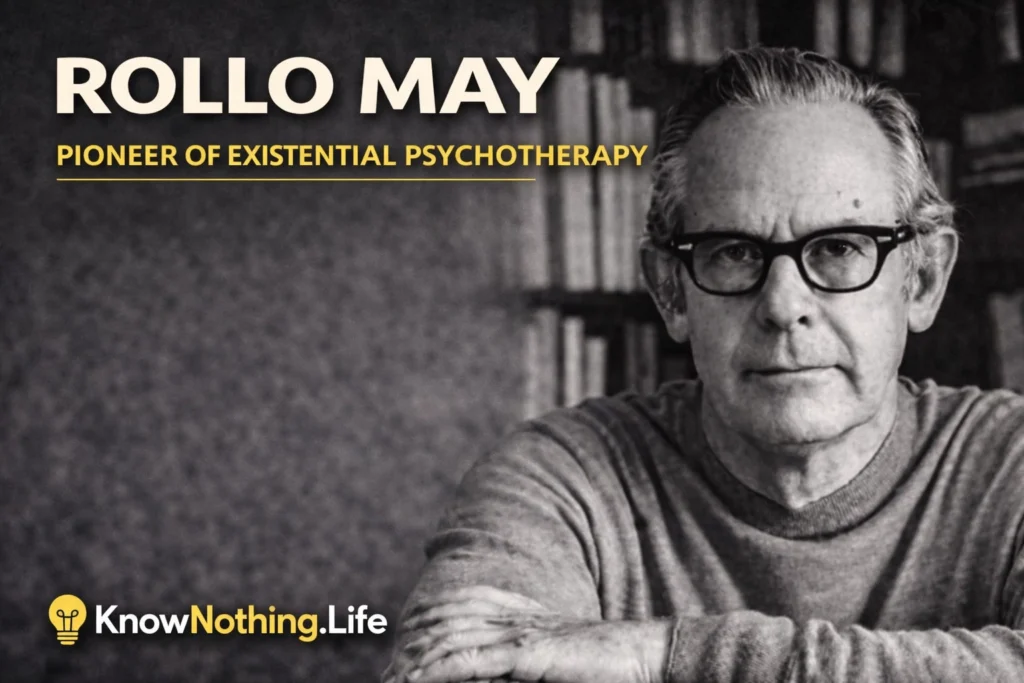
Among the most intellectually daring figures in twentieth-century psychology, Rollo May occupies a unique place as the thinker who introduced existential philosophy into modern psychotherapy. At a time when psychology was dominated by behaviorism, psychoanalysis, and emerging humanistic theory, May argued that many of humanity’s deepest struggles could not be understood through mechanical theories of behavior or purely unconscious drives. Instead, he believed psychology needed to grapple with the fundamental realities of existence itself: anxiety, freedom, responsibility, isolation, suffering, and the search for meaning.
May’s work fundamentally changed how psychologists approached emotional distress by framing many forms of suffering not as pathology alone, but as inevitable parts of the human condition. He argued that anxiety, uncertainty, and internal conflict are not necessarily signs of illness but often evidence that an individual is confronting life’s deepest questions. His writings helped establish existential psychology as an influential force in psychotherapy, bridging philosophy and clinical practice in ways that continue shaping mental health treatment, self-development, and modern discussions about purpose and identity.
Early Life and Intellectual Formation
Rollo Reese May was born on April 21, 1909, in Ada, Ohio, and grew up in a deeply unstable household marked by family conflict and emotional turbulence. His parents divorced when he was young, and May later described his early family life as psychologically chaotic. These formative experiences contributed significantly to his later fascination with emotional suffering, identity formation, and the psychological consequences of alienation. Unlike many psychologists whose theories emerged primarily from academic research, May’s intellectual interests were deeply rooted in personal experience.
May attended Michigan State College but was asked to leave after becoming involved with a radical student publication. He later completed his undergraduate studies at Oberlin College before spending several years traveling and teaching abroad in Greece. During this period, he encountered classical philosophy, literature, and European intellectual traditions that would eventually become central influences on his thinking. His exposure to existential philosophy planted early seeds that would later define his entire career.
After returning to the United States, May studied theology at Union Theological Seminary in New York, where he encountered philosopher and theologian Paul Tillich. Tillich’s work on courage, anxiety, and existential meaning profoundly influenced May’s psychological worldview. Unlike many psychologists of his era, May believed understanding the human mind required engagement not only with science but with philosophy, spirituality, literature, and the deeper questions of existence itself.
Illness, Crisis, and Personal Transformation
One of the defining turning points in May’s life came when he contracted tuberculosis during the 1940s, at a time when the disease was often life-threatening. He spent nearly three years confined to a sanatorium, isolated from ordinary life and forced to confront his own mortality on a daily basis. Rather than simply enduring the illness physically, May later described this period as one of profound psychological transformation.
The experience forced him into direct confrontation with fear, helplessness, uncertainty, and existential vulnerability. Watching other patients struggle with despair and death gave him firsthand insight into the psychological dimensions of suffering. It was during this period that he began deeply studying existential philosophers such as Søren Kierkegaard, Friedrich Nietzsche, and Martin Heidegger, whose writings helped him frame suffering not simply as pain to be avoided but as an unavoidable dimension of being human.
This period fundamentally reshaped his understanding of psychology. Rather than viewing anxiety solely as a symptom requiring elimination, May came to believe anxiety often signals profound confrontation with life’s most essential realities. He later argued that modern society had become increasingly uncomfortable with uncertainty, causing people to avoid precisely the struggles necessary for authentic psychological growth.
Existential Psychology and the Meaning of Anxiety
Rollo May’s central contribution was introducing existential philosophy into psychotherapy. Traditional psychology often treated anxiety as a disorder, something pathological to be managed or cured. May radically challenged this assumption. He believed anxiety is inseparable from freedom itself. The more freedom individuals possess, the more responsibility they face, and responsibility inevitably generates anxiety.
According to May, healthy anxiety differs from neurotic anxiety. Normal anxiety arises when individuals confront genuine uncertainty, major life decisions, mortality, or questions of identity. Neurotic anxiety emerges when people avoid these realities and become trapped in fear-driven patterns of avoidance. Rather than helping people eliminate anxiety entirely, psychotherapy should help individuals develop the courage to engage with life despite uncertainty.
May famously wrote, “Anxiety is the dizziness of freedom.” Borrowing heavily from Kierkegaard, he argued that anxiety reflects the unsettling realization that human beings are free to shape their lives. Freedom brings possibility, but possibility brings uncertainty. This perspective transformed therapeutic approaches by reframing anxiety not simply as pathology but often as evidence of profound psychological awakening.
Freedom, Responsibility, and Authentic Living
Central to May’s philosophy was the belief that human beings are fundamentally free creatures responsible for shaping their own existence. Unlike deterministic psychological models advanced by figures such as Sigmund Freud or B. F. Skinner, May argued that individuals cannot escape responsibility for their choices, even when external circumstances create limitations.
He believed modern society increasingly encourages people to surrender personal responsibility by conforming to social expectations, consumer culture, and institutional structures that discourage authentic self-examination. Many psychological struggles, in his view, arise when individuals abandon their own agency and begin living according to external definitions of success rather than internal values.
One of May’s most enduring statements captures this worldview: “Freedom is man’s capacity to take a hand in his own development. It is our capacity to mold ourselves.” For May, psychological health did not mean comfort or stability. It meant embracing uncertainty while actively participating in the creation of one’s own life.
Love, Creativity, and Human Connection
Unlike existential thinkers who focused exclusively on suffering and isolation, May also devoted enormous attention to love and creativity as essential dimensions of human existence. He believed love is far more complex than romantic attachment or emotional dependency. Genuine love requires courage because intimacy demands vulnerability, honesty, and the willingness to encounter another person authentically.
His influential book Love and Will (1969) explored how modern society increasingly separates love from commitment, meaning, and responsibility. May argued that technological progress and cultural individualism had weakened authentic connection, leaving many people feeling emotionally fragmented despite greater social freedom. Love, in his view, requires active engagement rather than passive emotional dependency.
Creativity held similar importance in his philosophy. May believed creating—whether through art, relationships, ideas, or personal transformation—is one of humanity’s deepest expressions of freedom. He famously wrote, “Creativity requires courage.” The statement reflected his conviction that all meaningful acts of self-expression involve risk because creation demands stepping into uncertainty without guarantees of success.
Major Works and Intellectual Contributions
May’s ideas reached broad audiences through a series of influential books that helped establish existential psychology as a legitimate therapeutic tradition. The Meaning of Anxiety (1950) introduced his groundbreaking reinterpretation of anxiety as a natural consequence of freedom and existence rather than simple pathology. The book remains one of the foundational texts of existential psychotherapy.
In Love and Will (1969), May explored the psychological relationship between intimacy, personal agency, sexuality, and emotional commitment. The work became one of his most widely read books because it addressed cultural shifts surrounding relationships and individual identity during the social upheavals of the 1960s. He argued that modern freedom often leaves people emotionally disconnected when responsibility fails to develop alongside autonomy.
Later, The Courage to Create (1975) expanded his philosophy beyond therapy into creativity, innovation, and human development. Here May argued that creativity is not reserved for artists alone but represents the fundamental act of bringing something new into existence, whether ideas, relationships, identity, or cultural change.
Criticism and Scientific Debate
May’s work has often been criticized for lacking the empirical rigor favored by more experimental branches of psychology. Behaviorists argued his concepts—freedom, existential anxiety, authenticity, courage, meaning—were philosophically compelling but difficult to measure scientifically. Some researchers viewed existential psychology as too abstract compared to more data-driven therapeutic models.
Others argued May focused heavily on philosophical suffering while underestimating biological and neurological influences on mental health disorders. Severe depression, psychosis, trauma disorders, and anxiety disorders often involve physiological components beyond existential conflict alone. Critics suggested existential therapy may be valuable philosophically but insufficient for certain clinical conditions.
Yet many therapists argued these criticisms misunderstood May’s purpose entirely. He never claimed biological or behavioral factors were irrelevant. Rather, he believed psychology had neglected the deeper human realities surrounding identity, mortality, freedom, and meaning. His work expanded psychology’s scope rather than attempting to replace existing approaches altogether.
Legacy and Lasting Influence
Rollo May fundamentally transformed psychotherapy by integrating existential philosophy into psychological practice. He helped establish existential therapy as a legitimate approach focused not simply on symptom reduction but on helping individuals confront life’s deepest realities with courage and authenticity. His ideas strongly influenced later therapists working in trauma, identity development, grief counseling, and personal transformation.
His work also intersected naturally with humanistic psychologists such as Carl Rogers and Abraham Maslow, though May often focused more directly on suffering, uncertainty, and existential conflict than either thinker. Together, they helped shift psychology toward a more holistic understanding of human experience.
May once wrote, “The opposite of courage in our society is not cowardice, it is conformity.” Few statements better summarize his philosophy. He believed many people sacrifice authenticity in exchange for comfort and approval, often losing themselves in the process.
Final Thoughts
To study Rollo May is to encounter one of psychology’s deepest philosophical thinkers. He refused to reduce human beings to conditioned behaviors, unconscious impulses, or biological machines. Instead, he insisted psychology must engage directly with the profound realities every person eventually faces: anxiety, freedom, responsibility, mortality, love, creativity, and meaning.
His legacy endures because modern life continues to generate precisely the existential struggles he spent his career exploring. In a world increasingly obsessed with comfort, distraction, and external validation, May reminds us that growth often emerges through confrontation with uncertainty itself. His work remains a powerful argument that psychological health is not the absence of struggle, but the courage to face life honestly and create meaning despite its uncertainty.