Hermeticism is one of the most influential esoteric traditions in Western history. It is a philosophy of hidden wisdom, spiritual ascent, cosmic order, and the deep relationship between the human mind and the universe. At its center stands the mysterious figure Hermes Trismegistus, a legendary teacher whose name means “Hermes the Thrice-Great.” Hermes Trismegistus was understood as a fusion of the Greek god Hermes, messenger of the gods, and the Egyptian god Thoth, patron of writing, knowledge, measurement, and sacred wisdom. Through this symbolic figure, Greek, Egyptian, Jewish, Christian, and later Islamic and Renaissance ideas flowed into one of the great currents of mystical philosophy.
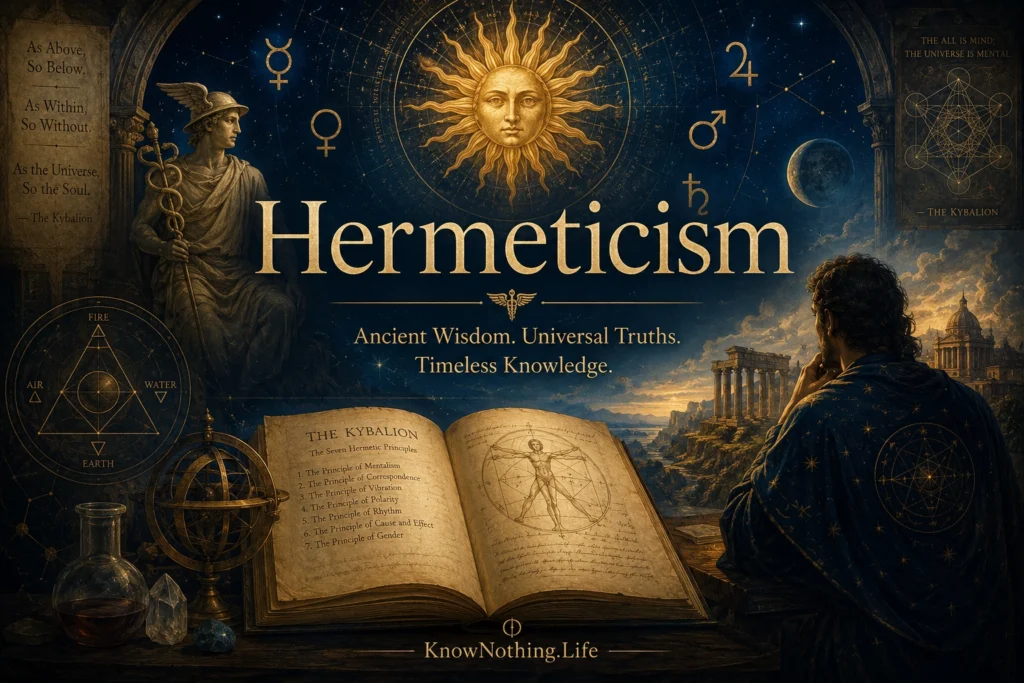
Hermeticism is not a single church, creed, or doctrine. It is better understood as a family of writings and ideas concerned with divine mind, nature, transformation, astrology, alchemy, magic, spiritual rebirth, and the hidden unity of all things. Its most famous phrase, “as above, so below,” expresses the Hermetic belief that the human being and the cosmos mirror one another. The universe is not dead matter. It is alive with intelligence, pattern, correspondence, and meaning. To know the universe is also to know oneself; to awaken the self is to participate more consciously in the order of the cosmos.
Hermes Trismegistus and the Hermetic Writings
The historical origins of Hermeticism are complex. The writings attributed to Hermes Trismegistus were most likely produced in the Hellenistic and Roman periods, especially in Egypt, where Greek and Egyptian religious ideas mixed in cities such as Alexandria. These texts were written in Greek and later translated into Latin, Arabic, and other languages. They present Hermes not as a mythological character in the ordinary sense, but as a divine sage who reveals wisdom about God, the cosmos, the soul, and spiritual liberation.
The most important Hermetic collection is the Corpus Hermeticum, a group of philosophical and theological dialogues. In these texts, Hermes teaches students such as Tat and Asclepius about the divine intellect, the creation of the world, the nature of the human being, and the path of spiritual awakening. Another important Hermetic work is the Asclepius, a Latin text that discusses the living cosmos, divine powers, ritual, and the relationship between humanity and the gods. These works shaped later mystical philosophy because they offered an alternative to purely dogmatic religion and purely material explanations of nature. They described reality as spiritual, intelligible, and internally connected.
The Divine Mind and the Living Cosmos
A central Hermetic idea is that reality begins in divine mind. The Greek term nous, often translated as mind or intellect, is essential to Hermetic thought. The highest reality is not a physical object but a divine intelligence from which the cosmos proceeds. In the Corpus Hermeticum, God is described as both beyond all things and present within all things. The world is not separate from divinity in a crude mechanical sense; it is an ordered expression of divine creativity.
This idea gives Hermeticism its spiritual optimism. The cosmos is not a prison of meaningless matter, though the material world can trap the ignorant soul. Nature is a living book filled with signs. Stars, elements, plants, animals, numbers, and human faculties all participate in a larger order. The human being is special because humanity contains both earthly and divine qualities. We belong to nature, but we can also know nature. We are embodied, but we can awaken to mind. Hermeticism therefore sees the human being as a microcosm: a small world reflecting the greater world.
“As Above, So Below”
The phrase “as above, so below” is associated especially with the Emerald Tablet, a short and mysterious text attributed to Hermes Trismegistus. Its famous line is often rendered as: “That which is below is like that which is above, and that which is above is like that which is below.” This became one of the most powerful principles in Western esotericism. It suggests that different levels of reality correspond to one another. The heavens mirror the earth. The body mirrors the cosmos. The soul mirrors divine order.
This principle shaped astrology, alchemy, magic, medicine, and mystical symbolism. If the macrocosm and microcosm are connected, then studying one can reveal the other. The movement of planets could be interpreted as corresponding to human temperaments and earthly events. Metals, organs, colors, virtues, and spiritual states could be arranged into symbolic systems. Modern science does not accept these correspondences as empirical laws in the way Renaissance occultists did, but historically they formed a powerful worldview. Hermeticism taught that reality is not random but patterned, and that hidden relationships bind the visible and invisible worlds.
Hermeticism and Alchemy
Hermeticism became deeply connected with alchemy. Alchemy is often remembered as the attempt to turn base metals into gold, but in Hermetic tradition it also became a symbol of spiritual transformation. The alchemist’s laboratory was both a physical and inner space. The purification of metals could represent the purification of the soul. The transformation of lead into gold could symbolize the movement from ignorance to illumination, from fragmentation to unity, from ordinary consciousness to awakened being.
The Emerald Tablet became a foundational text for alchemical symbolism. Its cryptic language suggested that nature contains a hidden process by which lower things are raised and perfected. Later alchemists interpreted this process in many ways: chemical, spiritual, psychological, and cosmological. In the twentieth century, Carl Jung famously explored alchemy in works such as Psychology and Alchemy, interpreting alchemical imagery as symbolic expressions of individuation, the process by which the psyche moves toward wholeness. Jung’s reading was not the same as historical alchemy, but it shows how Hermetic symbolism continued to influence modern psychology.
Hermeticism, Magic, and Occult Philosophy
Hermeticism also shaped the Western tradition of magic. In Renaissance occult philosophy, magic did not always mean superstition or stage illusion. It meant knowledge of hidden sympathies and correspondences in nature. A learned magician sought to understand how divine, celestial, and earthly forces interacted. Marsilio Ficino, Giovanni Pico della Mirandola, and Heinrich Cornelius Agrippa all drew from Hermetic, Neoplatonic, and Kabbalistic ideas to develop systems of spiritual and natural magic.
Agrippa’s Three Books of Occult Philosophy became one of the most important works in this tradition. It organized magic into natural, celestial, and ceremonial levels, reflecting the Hermetic idea that reality is structured in layers. Natural magic studied hidden properties in plants, stones, and animals. Celestial magic explored astrology and planetary influence. Ceremonial magic involved divine names, spirits, and ritual. For these thinkers, magic was not merely a way to get power. At its highest, it was a path toward understanding the divine order of creation.
The Renaissance Revival
Hermeticism became especially influential during the Renaissance. In the fifteenth century, the philosopher Marsilio Ficino translated the Corpus Hermeticum into Latin under the patronage of Cosimo de’ Medici in Florence. At the time, many European scholars believed the Hermetic writings were extremely ancient, perhaps older than Plato and Moses. This gave them enormous authority. Hermes Trismegistus was seen as a pagan prophet of divine wisdom, a figure whose teachings anticipated Christian truth.
Modern scholarship later showed that the Hermetic texts were not as ancient as Renaissance thinkers believed. They were products of the early centuries of the Common Era, not primordial Egyptian scripture. Yet the Renaissance misunderstanding had historical power. It helped inspire a renewed interest in ancient wisdom, comparative religion, symbolism, magic, astrology, and the dignity of the human mind. Hermeticism contributed to a worldview in which the human being was not merely fallen or passive, but capable of ascent, knowledge, and transformation.
Hermeticism and Christianity
The relationship between Hermeticism and Christianity has always been complicated. Some Christian thinkers saw Hermetic writings as compatible with Christian theology because they spoke of one supreme God, divine word, creation, rebirth, and spiritual purification. Renaissance Christian Hermeticists interpreted Hermes as a wise pagan who glimpsed truths later fulfilled in Christianity. Ficino and Pico treated Hermeticism as part of a larger ancient theology, or prisca theologia, a primordial wisdom tradition given to humanity in fragments.
Other Christian authorities were suspicious of Hermeticism because of its association with magic, astrology, pagan gods, and ritual power. The Asclepius, in particular, contains passages about ensouled statues and divine rites that troubled orthodox theologians. This tension remained central to Western esotericism. Hermeticism could be interpreted as spiritual philosophy, mystical theology, or dangerous occultism depending on who was reading it and why.
Hermeticism in Modern Esotericism
Hermeticism did not disappear after the Renaissance. It continued through alchemy, Rosicrucianism, Freemasonry, ceremonial magic, Theosophy, and modern occult movements. The Hermetic Order of the Golden Dawn, founded in the late nineteenth century, drew heavily from Hermetic symbolism, Kabbalah, astrology, tarot, alchemy, and ritual magic. Figures such as Samuel Liddell MacGregor Mathers, W. B. Yeats, Dion Fortune, and Aleister Crowley were shaped by this broader Hermetic revival, even when they developed very different systems.
The popular book The Kybalion, published in 1908 under the name “Three Initiates,” also helped spread modern Hermetic language. It presents seven “Hermetic principles,” including mentalism, correspondence, vibration, polarity, rhythm, cause and effect, and gender. Although often marketed as ancient Hermetic wisdom, The Kybalion is more accurately a modern New Thought-era interpretation of Hermetic themes. Still, it became influential because it translated Hermetic ideas into simple metaphysical principles for a modern audience.
Criticism and Historical Limits
Hermeticism must be understood critically. Some claims associated with Hermetic tradition, especially astrology, ritual magic, and hidden correspondences, are not accepted by modern science as empirical facts. The Renaissance belief that the Corpus Hermeticum came from the dawn of Egyptian civilization was historically mistaken. Later occult movements sometimes treated Hermeticism as a universal key to all religion and science, often stretching evidence beyond what scholarship supports.
Yet criticism does not erase Hermeticism’s importance. It shaped Western ideas of the soul, imagination, symbolic nature, spiritual transformation, and the unity of knowledge. It influenced philosophy, magic, alchemy, psychology, literature, art, and modern alternative spirituality. Even when its cosmology is no longer accepted literally, its central questions remain powerful: Is nature meaningful? Does the human mind mirror the universe? Can knowledge transform the knower? Is reality more layered than ordinary perception suggests?
Final Thoughts
Hermeticism is a tradition of divine wisdom, hidden correspondence, and spiritual transformation. Through Hermes Trismegistus, the Corpus Hermeticum, the Asclepius, the Emerald Tablet, Renaissance translations, alchemical symbolism, occult philosophy, and modern esotericism, it has carried one persistent idea: the universe is alive with mind and meaning, and the human being can awaken to that deeper order.
Its historical claims must be separated from myth, and its esoteric claims should be examined carefully. But Hermeticism remains one of the great imaginative systems of Western thought. It offers a vision of reality in which knowledge is not merely information, but transformation. To know the cosmos is to know the self. To purify the self is to read the cosmos more clearly. The Hermetic path begins with wonder and ends with a challenge: the visible world may be only the surface of a deeper wisdom waiting to be understood.