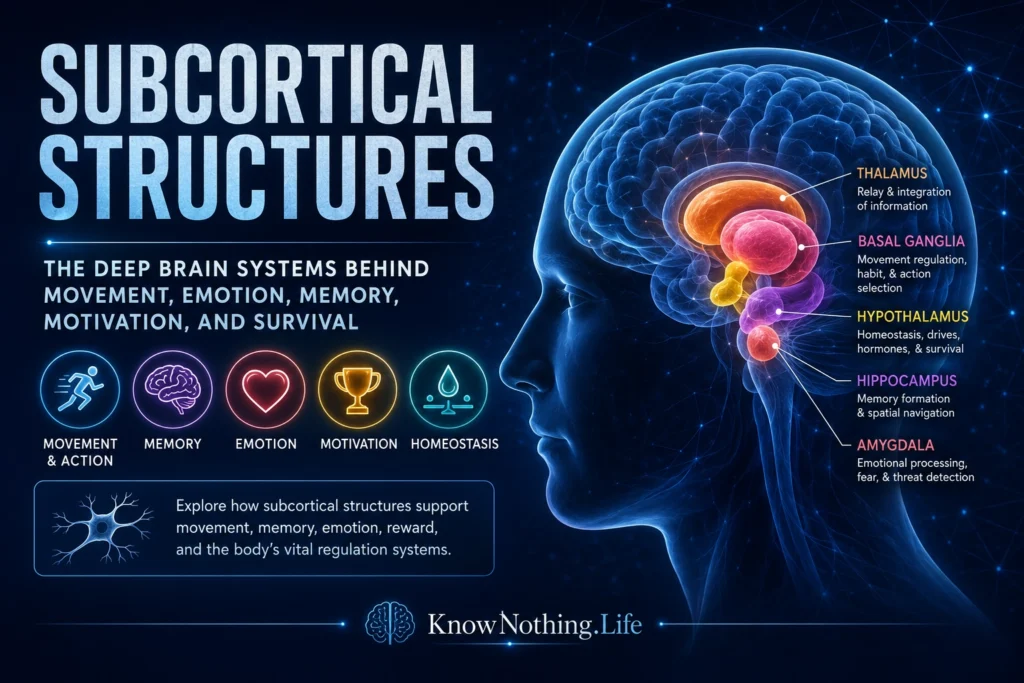
Subcortical structures are the deep brain regions located beneath the cerebral cortex. While the cortex is often associated with conscious thought, language, perception, and voluntary planning, subcortical systems provide many of the foundations that make those abilities possible. They help regulate movement, emotion, motivation, memory, sleep, arousal, reward, hormone control, autonomic function, sensory relay, and survival behavior. The term “subcortical” does not refer to one single organ. It includes a collection of interconnected structures such as the thalamus, hypothalamus, basal ganglia, hippocampus, amygdala, nucleus accumbens, and parts of the limbic system.
These structures are sometimes described as older or more primitive than the cortex, but that wording can be misleading. Subcortical systems are not crude leftovers from evolution. They are highly organized, deeply connected networks that work constantly with the cortex. The thalamus helps regulate information flow to the cortex. The basal ganglia help select and shape action. The hypothalamus links the nervous system to hormones and bodily regulation. The hippocampus supports memory formation. The amygdala helps evaluate emotional significance. Together, these systems show that the mind is not only built from surface-level cortical thinking, but from deep biological machinery that keeps the organism moving, learning, feeling, remembering, and surviving.
The Thalamus: Relay, Gatekeeper, and Regulator
The thalamus is often described as the brain’s major relay station because most sensory information, except smell, passes through thalamic nuclei before reaching the cerebral cortex. But the thalamus is more than a passive switchboard. It helps regulate attention, sleep-wake states, motor signals, and cortical communication. Different thalamic nuclei connect with different cortical regions, allowing the thalamus to participate in vision, hearing, touch, movement, cognition, and emotion. Modern neuroscience increasingly treats the thalamus as an active partner in cortical processing rather than a simple forwarding device.
This role matters because the brain is not merely flooded with raw information. Information must be selected, timed, filtered, and coordinated. The thalamus helps determine which signals gain access to cortical processing and how cortical regions communicate with one another. This is especially important for attention and consciousness. When thalamic function is disrupted, the effects can include sensory problems, movement disorders, sleep disturbances, cognitive changes, or impaired awareness. The thalamus is therefore one of the brain’s great integrators: a deep structure that helps organize the flow of experience before it becomes fully conscious.
The Hypothalamus: Homeostasis and the Body’s Internal Balance
The hypothalamus is a small but essential structure located below the thalamus. Despite its size, it is one of the brain’s most important regulators of internal balance. It helps control body temperature, hunger, thirst, sleep rhythms, stress responses, sexual behavior, autonomic function, and hormone release through its relationship with the pituitary gland. The hypothalamus is a high-level sensory integration and motor output region that maintains homeostasis by controlling endocrine, autonomic, and somatic behavior.
The hypothalamus reveals that the brain is not only an organ of thought; it is also an organ of bodily regulation. It monitors internal signals and helps coordinate responses that keep the body alive and stable. When body temperature rises, the hypothalamus contributes to cooling responses. When the body needs food or water, hypothalamic circuits help drive hunger and thirst. When stress appears, it participates in hormonal pathways that prepare the body for action. Functional anatomy reviews note that although the hypothalamus makes up only a small fraction of total brain volume, it is a key regulator of pituitary function and homeostatic balance.
The Basal Ganglia: Movement, Action Selection, and Reward
The basal ganglia are a group of deep nuclei involved in movement, habit, reward, motivation, and action selection. Major components include the caudate nucleus, putamen, globus pallidus, substantia nigra, and subthalamic nucleus. The striatum, made up largely of the caudate and putamen, receives input from wide areas of the cortex and helps process signals related to action and reward. A medical overview describes the basal ganglia as clusters of nuclei deep beneath the neocortex, primarily involved in motor control but also associated with reward and cognition.
The basal ganglia do not simply “cause movement.” They help determine which actions should be promoted and which should be inhibited. This is why they are central to conditions such as Parkinson’s disease, Huntington’s disease, dystonia, Tourette syndrome, and some compulsive or habit-related behaviors. In 1986, Garrett Alexander, Mahlon DeLong, and Peter Strick proposed an influential model of parallel, functionally segregated circuits linking the basal ganglia and cortex. Later research has continued to emphasize basal ganglia loops in motor control, cognitive control, reward learning, and behavioral selection. These circuits help explain how desire, habit, movement, and decision-making become linked in the brain.
The Hippocampus: Memory, Place, and Experience
The hippocampus is a curved structure in the medial temporal lobe that is essential for forming many kinds of new declarative memory, including memories of facts, events, places, and personal experiences. It helps bind details into episodes: where something happened, when it happened, who was there, and how it fits into a larger story. The hippocampus is also involved in spatial navigation, allowing the brain to build maps of environments and remember routes through the world.
One of the most important memory studies in neuroscience was William Scoville and Brenda Milner’s work on patient H.M., who developed profound difficulty forming new long-term memories after bilateral medial temporal-lobe surgery involving the hippocampal region. Their findings showed that damage extending into the anterior hippocampus and hippocampal gyrus produced severe recent-memory impairment. This case helped overturn the idea that memory was spread evenly across the entire brain. Instead, it showed that specific subcortical and medial temporal systems are necessary for forming new conscious memories. The hippocampus does not store every memory by itself, but it is crucial for turning experience into lasting memory.
The Amygdala: Emotion, Threat, and Salience
The amygdala is an almond-shaped structure in the medial temporal lobe, best known for its role in emotion, threat detection, fear learning, and emotional memory. It helps the brain evaluate whether something is dangerous, important, rewarding, socially meaningful, or emotionally charged. The amygdala is often oversimplified as the brain’s “fear center,” but its real function is broader. It helps attach emotional significance to experience and influences attention, memory, bodily arousal, and defensive behavior.
Joseph LeDoux’s research on fear conditioning helped make the amygdala central to modern affective neuroscience. In a major review, LeDoux concluded that fear-conditioning studies show the amygdala plays a critical role in linking external stimuli to defense responses. This does not mean the amygdala creates all fear by itself. Emotional experience depends on wider networks involving the cortex, hippocampus, hypothalamus, brainstem, and body. The amygdala’s importance is that it helps mark events as emotionally significant, making certain memories stronger, certain stimuli more attention-grabbing, and certain bodily responses faster.
The Limbic System and the Deep Architecture of Emotion
Many subcortical structures are discussed as part of the limbic system, a broad network associated with emotion, motivation, memory, and survival behavior. The limbic system includes structures such as the hippocampus, amygdala, cingulate cortex, hypothalamus, mammillary bodies, and related pathways. In 1937, James Papez proposed that specific brain circuits were devoted to emotional experience and expression, helping create one of the earliest influential circuit-based models of emotion. Later, Paul MacLean popularized the term “limbic system,” although modern neuroscience treats the concept more cautiously than older textbook diagrams did.
The value of the limbic-system idea is that it shows emotion is not located in one small brain area. Emotion involves memory, bodily arousal, motivation, perception, attention, and action. The hypothalamus may help coordinate bodily responses, the amygdala may evaluate emotional significance, the hippocampus may provide context, and cortical regions may interpret meaning and regulate response. Subcortical structures therefore help explain why emotion is not just a feeling in the mind, but a whole-body state shaped by deep brain circuits.
Why Subcortical Structures Matter
Subcortical structures matter because they reveal the hidden architecture beneath conscious life. The cortex may support language, planning, symbolic thought, and reflective awareness, but those functions depend on deeper systems that regulate the body, select actions, shape motivation, filter information, attach emotion to experience, and convert events into memory. A person’s ability to move, focus, sleep, learn, feel fear, pursue rewards, form habits, remember places, and maintain internal balance all depends on subcortical function.
These structures also challenge the simple division between “higher” and “lower” brain. The deep brain is not merely automatic, and the cortex is not purely rational. Human behavior emerges from loops between cortical and subcortical systems. A decision may involve frontal planning, basal ganglia action selection, amygdala emotion, hippocampal memory, thalamic gating, and hypothalamic bodily state. To understand subcortical structures is to understand that thought, feeling, movement, and survival are inseparable. The mind is not built only on the surface of the brain. It is rooted in the deep systems that keep life organized from moment to moment.