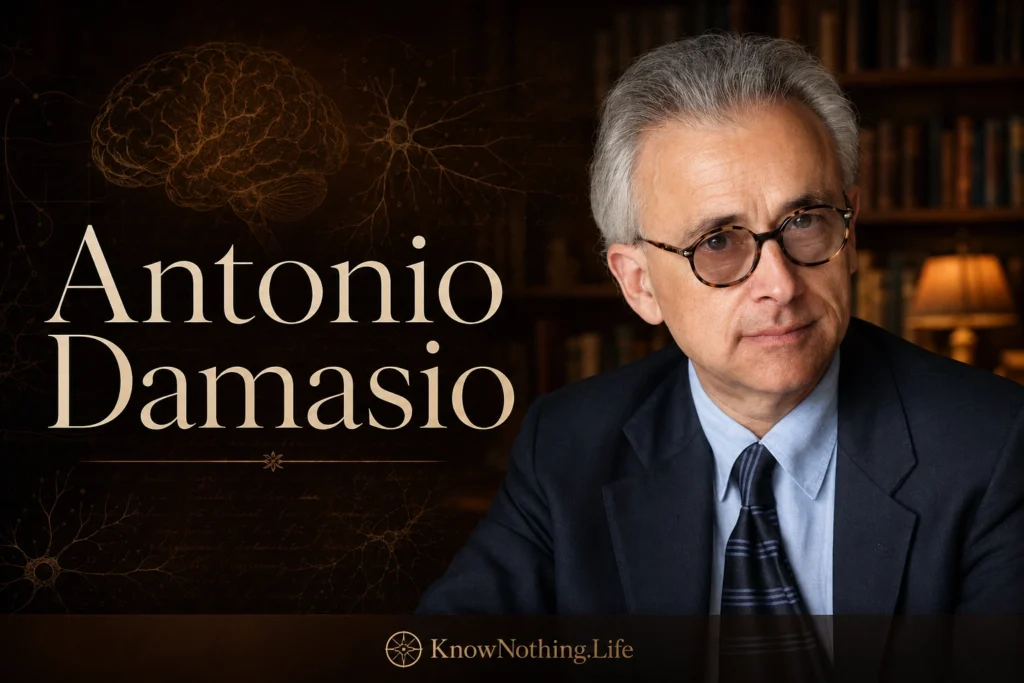
Antonio Damasio was born on February 25, 1944, in Lisbon, Portugal, and became one of the most influential neuroscientists of the modern era. His intellectual formation began in medicine rather than abstract philosophy, but the questions that would define his career were philosophical in the deepest sense: What is the mind? How does consciousness arise? Why do feelings matter? How do bodies, brains, emotions, and decisions belong together? Damasio’s career would become a sustained challenge to the old habit of separating reason from emotion and mind from body.
He studied at the University of Lisbon Medical School, where he received medical training and later completed doctoral work in neurology and neuroscience. His early interests included language, memory, and the neurological basis of behavior, but the central pattern of his thought was already visible. Damasio did not treat the brain as an isolated calculating machine. He saw it as part of a living organism, inseparable from body regulation, feeling, survival, and action. That biological orientation would eventually make his work important not only to neuroscience, but to psychology, philosophy, artificial intelligence, ethics, and theories of culture.
From Lisbon to Iowa
Damasio moved to the United States and developed much of his career at the University of Iowa, where he became a major figure in behavioral neurology and cognitive neuroscience. At Iowa, he worked with neurological patients whose injuries revealed how particular brain systems contribute to emotion, judgment, memory, language, and social conduct. This clinical grounding gave his work unusual force. His theories did not begin from speculation alone; they grew from detailed observation of people whose lives had been altered by damage to specific brain regions.
His wife and long-term collaborator, Hanna Damasio, also became an important neuroscientist, especially known for neuroanatomy and brain imaging. Together, they helped build a research program that connected clinical neurology, experimental psychology, neuroimaging, and philosophical interpretation. The Iowa years were especially important because they gave Damasio the cases and evidence that would later shape his best-known book, Descartes’ Error. He became interested in patients who could reason abstractly in some settings but failed disastrously in real-life decision-making because emotional signals had been disrupted.
Descartes’ Error and the Return of the Body
Damasio’s breakthrough public work was Descartes’ Error: Emotion, Reason, and the Human Brain, published in 1994. The title challenged the Cartesian legacy of mind-body separation. René Descartes is often associated with the idea that the thinking mind is distinct from the body. Damasio’s answer was that human reason is not purified by being separated from emotion and bodily feeling. It is damaged by that separation. Rationality, in real life, requires signals from the body and emotions that mark significance, danger, reward, loss, and value.
One of Damasio’s most quoted lines from the book is: “Emotions bring the body into the loop of reason.” The sentence summarizes the revolution he helped bring about. Emotions are not primitive intrusions into otherwise pure thought. They help the organism evaluate options, narrow possibilities, and act in complex, uncertain situations. Without emotion, reasoning may become strangely empty: formally intact, but practically lost. This claim changed how many scientists, philosophers, and general readers understood decision-making.
The Somatic Marker Hypothesis
Damasio’s most famous scientific idea is the somatic marker hypothesis. “Somatic” refers to the body, and a somatic marker is a bodily-based emotional signal associated with a possible choice, memory, danger, or outcome. These markers do not replace reasoning. They guide it by assigning emotional weight to possible actions. A person facing a decision does not consciously calculate every consequence from scratch. Past experience, bodily feeling, and emotional memory help highlight some options and warn against others.
The hypothesis became especially influential through studies of decision-making under uncertainty, including work associated with the Iowa Gambling Task. Patients with damage to regions such as the ventromedial prefrontal cortex often performed poorly in such tasks, failing to develop the anticipatory emotional signals that guide healthy participants away from bad choices. Damasio’s broader point was not that feelings are always wise or that “gut instinct” should rule life. It was that reason without feeling is biologically unrealistic and often practically impaired. Human intelligence is embodied intelligence.
The Feeling of What Happens
In 1999, Damasio published The Feeling of What Happens: Body and Emotion in the Making of Consciousness, a major work on the biological basis of consciousness. Here he moved from emotion and decision-making to the problem of how the self becomes present to itself. The title itself gives the core idea: consciousness is not merely information processing. It is the feeling of an organism being affected by what happens. The mind becomes conscious when the brain represents not only objects and events, but the organism’s own changing state in relation to them.
Damasio distinguished between core consciousness and extended consciousness. Core consciousness gives the organism a momentary sense of self in the here and now. Extended consciousness involves memory, identity, past, future, autobiography, and the richer self humans recognize as personal life. This account made feeling central to consciousness. To be conscious is not simply to compute, classify, or respond. It is to have a felt perspective rooted in a living body. In this sense, Damasio’s neuroscience became a modern biological answer to an ancient philosophical problem.
Looking for Spinoza
In Looking for Spinoza: Joy, Sorrow, and the Feeling Brain, published in 2003, Damasio turned toward the philosopher Baruch Spinoza, whom he saw as a deep precursor to modern embodied accounts of mind. Spinoza rejected a sharp division between mind and body and treated emotion as central to human life. Damasio found in Spinoza a philosophical ally: a thinker who understood that feeling, desire, bodily condition, and self-preservation belong at the heart of human nature.
The book also helped clarify Damasio’s distinction between emotion and feeling. Emotions are largely public, bodily, and action-oriented patterns; feelings are the inward mental experience of those bodily changes. Fear may involve posture, heart rate, endocrine response, facial expression, and readiness for action. The feeling of fear is the organism’s inner experience of that state. This distinction allowed Damasio to connect biology with subjectivity without reducing one crudely to the other. Feelings are biological, but they are also the way life becomes mentally known to itself.
Self Comes to Mind and Consciousness
Damasio continued his theory of consciousness in Self Comes to Mind: Constructing the Conscious Brain, published in 2010. The book argued that selfhood is not an abstract ghost inside the head, but a biological construction grounded in the body’s regulation of life. The brain continuously maps the organism’s internal state, and those maps help produce the felt sense of being a living subject. The self, in Damasio’s account, is not a fixed substance. It is a dynamic process, repeatedly rebuilt from body, brain, memory, feeling, and relation to the world.
This view challenged both simple materialism and romantic mystery. Damasio did not deny the biological basis of mind; he insisted on it. But he also refused to describe mind as mere computation detached from the living organism. Consciousness serves life. It helps organisms manage danger, opportunity, memory, social interaction, imagination, and culture. The conscious self is therefore not a luxury added to biology after the fact. It is part of the organism’s expanded capacity to regulate its life.
Culture, Homeostasis, and Feeling
In The Strange Order of Things: Life, Feeling, and the Making of Cultures, published in 2018, Damasio expanded his theory beyond individual consciousness into culture. He argued that feelings and homeostasis, the regulation of life processes, lie behind not only personal survival but also the development of morality, art, religion, law, politics, and science. Culture is not separate from biology in his account. It is an extension of life regulation into social and symbolic forms.
This was an ambitious claim. Damasio did not reduce culture to biology, but he argued that cultural achievements are motivated by felt needs: pain, pleasure, fear, grief, compassion, longing, imbalance, and the search for better conditions of life. Human beings build cultures because they are vulnerable organisms capable of feeling their vulnerability. The arts, sciences, laws, and moral systems are not detached ornaments of intelligence. They are ways of managing life, suffering, cooperation, memory, and hope.
USC, Brain and Creativity, and Later Work
Damasio later moved to the University of Southern California, where he became University Professor, Professor of Psychology, Philosophy and Neurology, and David Dornsife Chair in Neuroscience. He also directs the Brain and Creativity Institute, founded with Hanna Damasio. The institute studies consciousness, feeling, decision-making, music, education, embodied cognition, social behavior, artificial intelligence, and the biological roots of culture. This setting reflects the breadth of Damasio’s career: he has always worked across disciplines rather than inside one narrow laboratory problem.
His later books include Feeling & Knowing: Making Minds Conscious and work connected to natural intelligence and the logic of consciousness. In recent research, he has continued to explore homeostatic feelings, interoception, vulnerable robots, and the differences between biological and artificial intelligence. These questions matter more than ever in an age of AI. Damasio’s work asks whether intelligence without life, feeling, body regulation, and vulnerability can truly resemble human consciousness. His answer remains cautious but provocative: minds like ours are made by living bodies.
Legacy and Lasting Importance
Antonio Damasio’s major works include Descartes’ Error, The Feeling of What Happens, Looking for Spinoza, Self Comes to Mind, The Strange Order of Things, and Feeling & Knowing. Across these books and hundreds of scientific articles, he has reshaped debates about emotion, decision-making, consciousness, selfhood, and culture. He has received major honors, including the Prince of Asturias Prize, the Honda Prize, the Grawemeyer Award, the Pessoa Prize, and many honorary doctorates.
Damasio remains essential because he changed the place of feeling in modern thought. He showed that emotion is not the enemy of reason, that consciousness is rooted in the living body, and that culture itself may grow from the biological regulation of life. His work matters because it reconnects what modern thinking often separates: body and mind, feeling and judgment, life and consciousness, science and human meaning. Antonio Damasio’s central lesson is both scientific and philosophical: to understand the mind, we must begin with the living organism that feels.