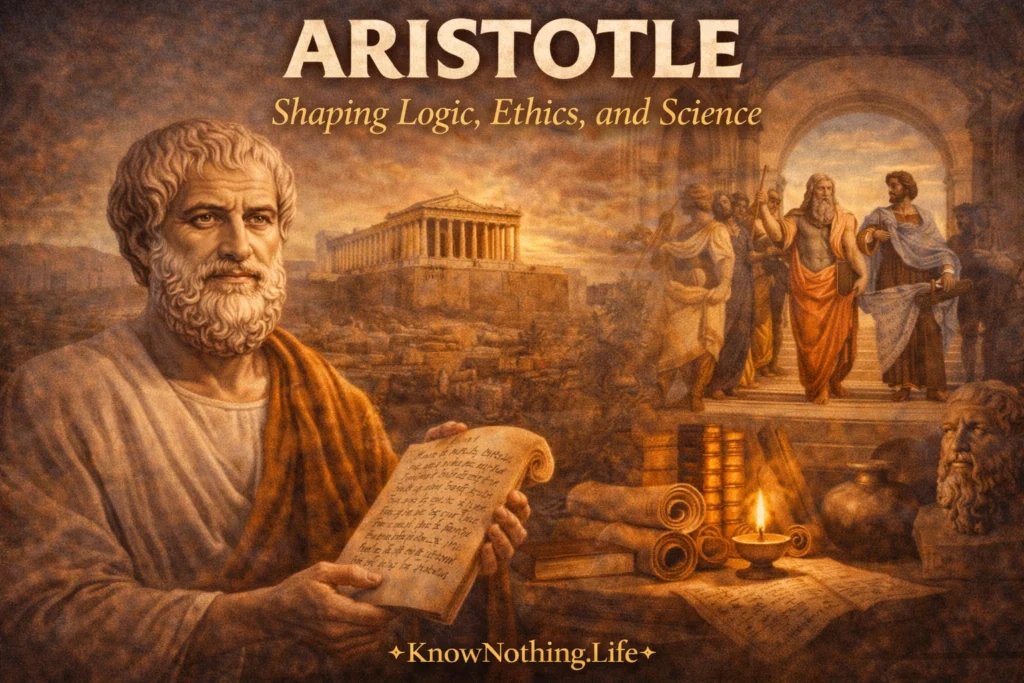
The intellectual legacy of Aristotle is so vast that it forms one of the central pillars of Western thought. A student of Plato and tutor to Alexander the Great, Aristotle combined philosophical depth with empirical observation, creating a system of knowledge that extended across logic, biology, ethics, politics, and metaphysics. Unlike his teacher Plato, who emphasized abstract forms, Aristotle grounded his philosophy in the observable world, seeking to understand reality through careful study and classification.
Born in 384 BCE in Stagira, Aristotle lived during a period of expanding political and intellectual horizons. His work reflects a commitment to understanding not just what exists, but how and why it exists. Through rigorous analysis and a methodical approach, he laid the foundations for disciplines that would evolve into modern science and philosophy. His influence persisted for centuries, shaping intellectual traditions in both the Islamic world and medieval Europe.
Early Life and Education
Aristotle’s early life was shaped by his father, Nicomachus, who served as a court physician. This background likely influenced Aristotle’s later interest in biology and the natural sciences. At the age of 17, he traveled to Athens to study at Plato’s Academy, where he remained for nearly two decades. During this time, he absorbed and engaged with Platonic philosophy, developing both admiration and critical distance from his teacher’s ideas.
Although Aristotle was deeply influenced by Plato, he did not fully accept the Theory of Forms. He questioned the separation between the world of forms and the material world, arguing instead that form and substance are inseparable. This divergence marked the beginning of his independent philosophical path, one that would prioritize empirical investigation over abstract speculation.
After Plato’s death, Aristotle left Athens and spent several years traveling and conducting research. He eventually became tutor to Alexander the Great, a role that placed him at the center of political power. Despite this connection, Aristotle’s primary focus remained intellectual rather than political, and he later returned to Athens to establish his own school.
The Lyceum and Method of Inquiry
Upon returning to Athens, Aristotle founded the Lyceum, a school that became a major center of learning. Unlike the Academy, which emphasized mathematical and philosophical abstraction, the Lyceum was characterized by its empirical approach. Aristotle and his students collected data, observed natural phenomena, and developed systematic classifications across various fields of study.
His method of inquiry was both analytical and observational. Aristotle believed that knowledge begins with sensory experience, but must be organized through reason. He developed a framework for understanding causes, distinguishing between material, formal, efficient, and final causes. This approach allowed him to explain not only how things happen, but why they happen—a question central to his philosophy.
The Lyceum also became known for its peripatetic style of teaching, in which Aristotle would walk with his students while engaging in discussion. This dynamic environment reflected his belief that philosophy is an active pursuit, grounded in dialogue and observation rather than passive reception.
Major Works and Contributions
Aristotle’s writings cover an extraordinary range of subjects, many of which laid the groundwork for entire disciplines. In logic, his work compiled in the Organon established the principles of syllogistic reasoning, which remained central to logical theory for centuries. His emphasis on structured argument and deductive reasoning continues to influence modern philosophy and science.
In ethics, Aristotle’s Nicomachean Ethics explores the nature of the good life, introducing the concept of virtue as a balance between extremes. In Politics, he examines different forms of government and the role of the state in promoting human flourishing. These works reflect his belief that ethics and politics are interconnected, both aimed at achieving the highest good.
Aristotle also made significant contributions to natural science, particularly in biology. His observations of animals and plants, though sometimes inaccurate by modern standards, demonstrate a commitment to empirical study. In metaphysics, his work Metaphysics investigates the nature of being, substance, and causality, introducing concepts that continue to shape philosophical inquiry.
Metaphysics and the Nature of Reality
Aristotle’s metaphysics centers on the concept of substance, which he defines as the fundamental reality underlying all things. Unlike Plato, who posited a separate realm of forms, Aristotle argued that form exists within objects themselves. This view, known as hylomorphism, holds that everything is composed of matter (hyle) and form (morphe).
He also introduced the idea of potentiality and actuality to explain change and development. An acorn, for example, has the potential to become an oak tree, and this transformation represents the realization of its form. This framework allows Aristotle to account for both stability and change within the natural world.
Central to his metaphysical system is the concept of the “unmoved mover,” a necessary being that initiates motion without itself being moved. This idea reflects his attempt to explain the ultimate cause of motion and existence, bridging philosophy and theology in a way that would influence later religious thought.
Ethics and the Pursuit of Happiness
Aristotle’s ethical philosophy is grounded in the concept of eudaimonia, often translated as “happiness” or “flourishing.” For Aristotle, happiness is not a fleeting emotion, but a state of living well and fulfilling one’s potential. It is achieved through the cultivation of virtue and the exercise of reason.
Virtue, in Aristotle’s view, lies in the “golden mean”—the balance between excess and deficiency. Courage, for example, is the mean between recklessness and cowardice. This approach emphasizes moderation and practical wisdom, guiding individuals toward ethical behavior through experience and reflection.
Unlike moral systems based on rules or consequences, Aristotle’s ethics focus on character. The goal is not simply to perform good actions, but to become a good person. This perspective has had a lasting impact on moral philosophy, influencing contemporary discussions of virtue ethics.
Quotes and Key Ideas
Aristotle’s writings contain numerous insights that continue to resonate across disciplines. Among his most notable quotes:
- “We are what we repeatedly do. Excellence, then, is not an act, but a habit.”
- “Knowing yourself is the beginning of all wisdom.”
- “Happiness depends upon ourselves.”
- “The whole is greater than the sum of its parts.”
These statements reflect the core themes of his philosophy: the importance of habit, self-knowledge, personal responsibility, and holistic understanding. They capture his belief that human life is shaped by both individual effort and broader structures.
His key ideas—logic, causality, virtue, and the integration of form and matter—have influenced fields ranging from philosophy and science to psychology and political theory. They remain foundational concepts in the study of human knowledge.
Later Life and Legacy
Aristotle’s later life was marked by both success and controversy. After the death of Alexander the Great, anti-Macedonian sentiment in Athens led to charges against Aristotle, prompting him to leave the city. He reportedly stated that he would not allow Athens to “sin twice against philosophy,” referencing the execution of Socrates.
He spent his final years in Chalcis, where he died in 322 BCE. Despite his departure from Athens, his intellectual legacy continued through his students and writings. The Lyceum remained an important center of learning, and his works were preserved and studied across generations.
Aristotle’s influence reached far beyond ancient Greece, shaping medieval Islamic and Christian philosophy. Thinkers such as Thomas Aquinas integrated his ideas into religious frameworks, demonstrating their adaptability and enduring relevance.
Conclusion
Aristotle stands as one of the most comprehensive thinkers in human history, bridging the gap between philosophy and science. His commitment to observation, analysis, and systematic inquiry established a model for understanding the world that continues to guide intellectual exploration. Through his work, he provided a framework for addressing fundamental questions about reality, knowledge, and human purpose.
His emphasis on reason, virtue, and the pursuit of happiness offers a vision of life that is both practical and profound. To engage with Aristotle is to encounter a philosophy that seeks not only to understand the world, but to live well within it. His legacy endures as a testament to the power of inquiry and the enduring quest for knowledge.
ARISTOTLE WORKS