The philosophy of Heraclitus stands among the most enigmatic and influential in the history of Western thought. Known as the “Weeping Philosopher” and often described as obscure, Heraclitus developed a vision of reality defined not by stability, but by constant change. His fragments—brief, poetic statements preserved by later writers—continue to challenge readers with their depth and ambiguity.
Born around 535 BCE in Ephesus, Heraclitus lived during a time when early philosophers sought to understand the fundamental nature of the universe. Unlike many of his contemporaries, who searched for a stable underlying substance, Heraclitus emphasized transformation, tension, and unity within opposition. His philosophy presents a world in motion, governed by a hidden order that he called the Logos—a principle that remains central to philosophical inquiry.
Life and Historical Context
Little is known with certainty about Heraclitus’ life, and much of what has been passed down blends historical fact with legend. He is believed to have been born into an aristocratic family in Ephesus, yet he reportedly rejected political power, choosing instead a life of philosophical contemplation. This withdrawal from public life contributed to his reputation as a solitary and somewhat misanthropic figure.
Heraclitus lived during a period of intellectual transition, when early Greek thinkers—often called pre-Socratic philosophers—were attempting to explain the nature of reality through reason rather than myth. Figures such as Thales and Anaximander had proposed that the universe was composed of a fundamental substance, such as water or the indefinite apeiron. Heraclitus diverged sharply from this approach, focusing instead on processes and relationships rather than static elements.
His reputation for obscurity earned him the nickname “the Obscure,” as his writings were often cryptic and paradoxical. Yet this style was not merely a quirk; it reflected his belief that truth is not easily grasped and must be approached through insight rather than straightforward explanation.
The Doctrine of Flux
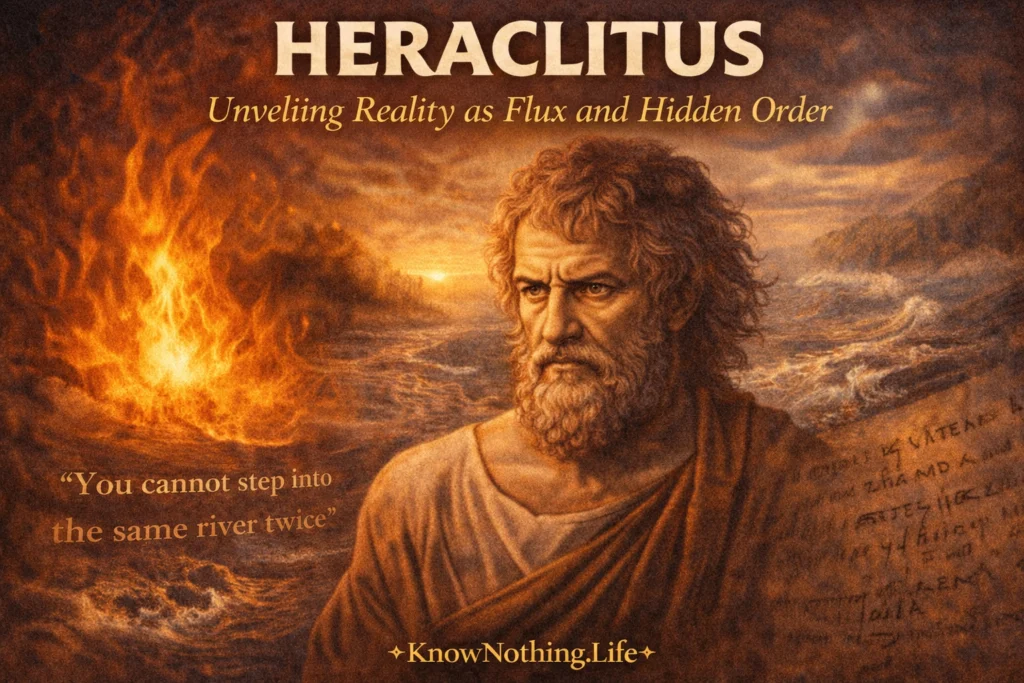
Heraclitus’ most famous idea is the doctrine of flux—the notion that everything is in a constant state of change. This idea is often summarized in the phrase, “You cannot step into the same river twice.” While the exact wording comes from later interpretations, it captures the essence of his thought: reality is not fixed, but continuously flowing.
For Heraclitus, change is not a secondary feature of the world; it is its fundamental nature. Everything that exists is in the process of becoming something else. Stability, in this view, is an illusion created by the limits of human perception. Beneath the surface of apparent permanence lies a dynamic and ever-shifting reality.
This perspective challenges the human desire for certainty and permanence. It suggests that understanding the world requires accepting its fluidity and embracing the tension inherent in change. Rather than resisting transformation, Heraclitus invites us to recognize it as the defining characteristic of existence.
The Unity of Opposites
Closely related to the doctrine of flux is Heraclitus’ concept of the unity of opposites. He argued that opposites are not separate or contradictory, but interconnected and mutually dependent. Day and night, life and death, war and peace—these are not isolated states, but aspects of a single, unified process.
Heraclitus expressed this idea through paradoxical statements such as: “The road up and the road down are one and the same.” This insight reflects a deeper understanding of reality as a system of tensions that produce harmony. Conflict, in his view, is not something to be eliminated, but a necessary condition for balance and order.
This concept has profound implications for philosophy and beyond. It suggests that apparent contradictions may reveal deeper truths, and that harmony arises not from uniformity, but from the dynamic interplay of opposing forces. Heraclitus’ vision of unity through tension continues to influence fields ranging from dialectics to modern systems theory.
Fire and the Nature of Reality
Among Heraclitus’ most distinctive ideas is his identification of fire as the fundamental element of the universe. Unlike earlier philosophers who sought a stable substance, Heraclitus chose fire precisely because of its dynamic and transformative nature. Fire is not static; it consumes, changes, and renews, making it a fitting symbol for a world defined by flux.
However, fire in Heraclitus’ philosophy is more than a physical element—it represents a process. It embodies the continuous transformation that characterizes reality. Through fire, he illustrates how change operates as both destruction and creation, a cycle that sustains the universe.
This idea aligns with his broader philosophical vision, in which stability is replaced by process and identity is understood as a function of change. The world, for Heraclitus, is not a collection of fixed objects, but a living system of transformation.
The Logos: Hidden Order in Chaos
Despite his emphasis on change, Heraclitus did not view the world as chaotic or random. At the heart of his philosophy lies the concept of the Logos, a rational principle that governs the universe. The Logos represents the underlying order that unites all things, even as they appear to be in constant flux.
Heraclitus believed that most people fail to recognize the Logos, living instead in a state of ignorance. He wrote: “Although the Logos is common, most people live as if they had their own private understanding.” This statement reflects his conviction that truth is universal, yet often overlooked.
The Logos introduces a balance to his philosophy, suggesting that change is not arbitrary, but structured. It provides a framework for understanding how opposites can coexist and how transformation can produce coherence. In this sense, Heraclitus offers a vision of reality that is both dynamic and ordered.
Works and Fragments
Unlike later philosophers, Heraclitus did not produce a systematic body of work. His ideas survive in fragments—short, often cryptic statements preserved by other authors. These fragments are typically associated with a lost work sometimes referred to as On Nature, though its original form remains uncertain. The fragmented nature of his writings contributes to their enduring fascination.
Each statement invites interpretation, encouraging readers to engage actively with his ideas. This style reflects his belief that philosophy is not merely about receiving information, but about cultivating insight. Despite their brevity, these fragments have had a lasting impact. They influenced later philosophers such as Plato and Aristotle, as well as modern thinkers who grapple with the nature of change and identity.
Quotes and Key Ideas
Heraclitus’ fragments are among the most memorable in philosophical history. Some of his most notable quotes include:
- “You cannot step into the same river twice.”
- “Everything flows.”
- “War is the father of all things.”
- “The hidden harmony is better than the obvious.”
These statements capture the essence of his philosophy: the primacy of change, the importance of conflict, and the presence of hidden order. They challenge conventional ways of thinking and encourage a deeper engagement with reality.
His key ideas—flux, the unity of opposites, fire as transformation, and the Logos—form a coherent vision of a world that is both dynamic and structured. They continue to inspire philosophical inquiry and reflection.
Legacy and Influence
Heraclitus’ influence extends far beyond his own time, shaping the development of Western philosophy in profound ways. His emphasis on change and contradiction influenced dialectical thinking, particularly in the work of later philosophers who sought to understand the dynamics of reality.
In contrast to thinkers like Parmenides, who argued for the permanence of being, Heraclitus represents the opposite pole—a philosophy of becoming. This tension between change and stability has remained a central theme in philosophy, driving debates that continue to this day.
Modern interpretations of Heraclitus often highlight his relevance to contemporary issues, from the nature of identity to the dynamics of complex systems. His insights into change, tension, and hidden order resonate in a world characterized by constant transformation.
Conclusion
Heraclitus stands as one of the most original and challenging thinkers in the history of philosophy. His vision of a world defined by change, tension, and underlying order offers a powerful alternative to static conceptions of reality. Through his fragments, he invites readers to engage with the complexities of existence and to recognize the unity within diversity.
To understand Heraclitus is to embrace the idea that reality is not fixed, but fluid—that stability is an illusion and change is the only constant. His philosophy does not provide easy answers, but it offers a framework for navigating a world in motion.
In an age where uncertainty and transformation are ever-present, the insights of Heraclitus remain as relevant as ever. They remind us that within the flow of change lies not chaos, but a deeper, hidden harmony waiting to be understood.