The philosophy of Saul Kripke represents one of the most significant developments in analytic philosophy during the 20th century. With remarkable clarity and originality, Kripke reshaped debates in logic, language, and metaphysics, challenging long-standing assumptions about meaning, reference, and necessity. His work bridged technical logic and philosophical inquiry, offering insights that continue to influence contemporary thought.
Born in 1940 in Bay Shore New York, Kripke demonstrated extraordinary intellectual ability from a young age. Unlike many philosophers who gradually developed their ideas over decades, Kripke made groundbreaking contributions early in his career. His work on modal logic and the philosophy of language introduced concepts that have become foundational, redefining how philosophers understand the relationship between words and the world.
Early Life and Intellectual Development
Kripke’s early life was marked by an unusual level of intellectual precocity. Growing up in a family that valued education, he displayed a deep interest in mathematics and logic during childhood. By the time he was a teenager, he had already developed formal systems of logic that would later gain recognition in academic circles.
While still in high school, Kripke wrote a paper on modal logic that attracted the attention of professional logicians. This work introduced what are now known as Kripke semantics, a framework for understanding modal concepts such as possibility and necessity. His early achievements set the stage for a career defined by innovation and rigor.
Kripke later studied at Harvard University, though his intellectual independence remained evident. He was less concerned with following established traditions than with addressing fundamental questions in new ways. This approach allowed him to challenge dominant theories and propose alternatives that would reshape entire fields.
Naming and Necessity
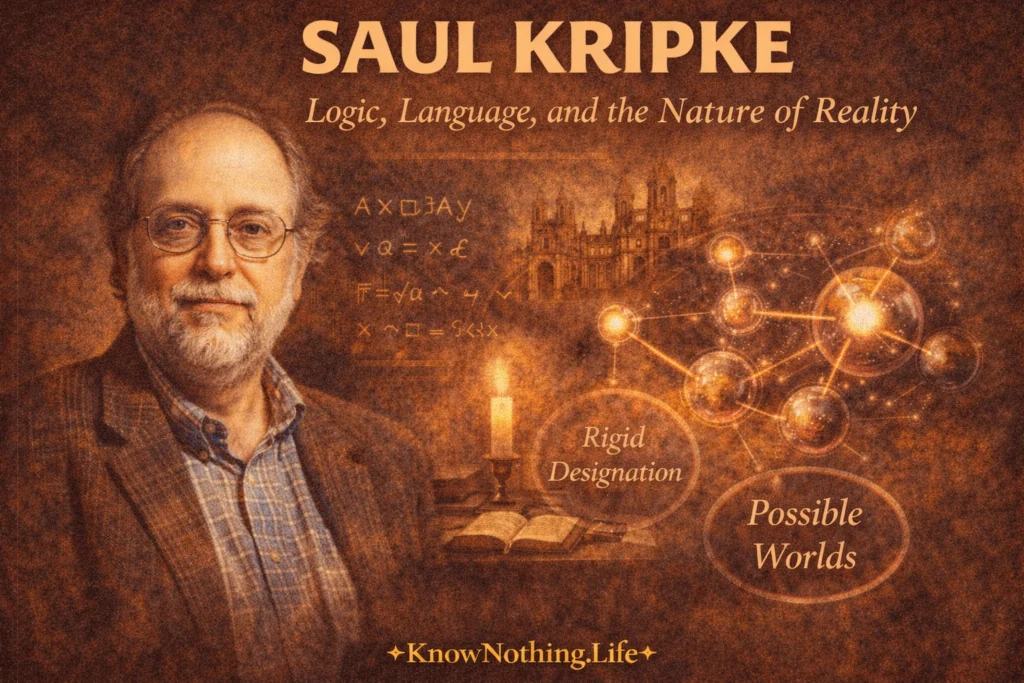
Kripke’s most famous work, Naming and Necessity, originated as a series of lectures delivered in 1970. In this work, he challenges the prevailing view that names are simply shorthand descriptions. According to earlier theories, a name refers to an object because it is associated with a set of descriptive properties. Kripke rejects this idea, arguing that names are “rigid designators” that refer to the same object in all possible worlds.
This concept has profound implications for understanding language and reference. If names do not depend on descriptions, then meaning is not determined solely by the properties we associate with an object. Instead, reference is established through a causal chain, beginning with an initial act of naming and continuing through linguistic usage.
Kripke also introduces the idea of necessary truths that are known a posteriori—truths that are necessarily true but discovered through experience. For example, the statement “water is H₂O” is necessarily true, yet it was discovered empirically. This distinction challenges traditional assumptions about the relationship between necessity and knowledge.
Modal Logic and Possible Worlds
Kripke’s contributions to modal logic revolutionized the field by providing a formal framework for analyzing concepts such as possibility, necessity, and contingency. His development of possible worlds semantics allows philosophers to evaluate statements in terms of different hypothetical scenarios, offering a powerful tool for understanding modal reasoning.
In this framework, a statement is considered necessary if it is true in all possible worlds, and possible if it is true in at least one. This approach clarifies the meaning of modal concepts and provides a systematic way to analyze them. Kripke’s work made modal logic more accessible and applicable to philosophical questions.
The introduction of possible worlds also has implications beyond logic. It provides a way to think about counterfactuals, identity, and the nature of reality. By expanding the scope of philosophical analysis, Kripke opened new avenues for inquiry in metaphysics and epistemology.
Identity and Essentialism
Kripke’s work also revived interest in essentialism, the idea that objects have essential properties that define their identity. He argues that certain characteristics are necessary to an object’s existence, and that these properties remain constant across all possible worlds.
For example, if a particular person exists, they could not have been a completely different individual. This perspective challenges earlier views that emphasized the contingency of identity, suggesting instead that some aspects of existence are fixed and necessary.
Kripke’s approach to identity has implications for a wide range of philosophical issues, including personal identity, the nature of objects, and the limits of change. By reintroducing essentialism, he reshaped debates in metaphysics and encouraged a reevaluation of fundamental assumptions.
Wittgenstein and Rule-Following
In addition to his work on language and logic, Kripke made significant contributions to the interpretation of Ludwig Wittgenstein. His book Wittgenstein on Rules and Private Language presents a controversial reading of Wittgenstein’s ideas, often referred to as the “skeptical paradox.”
According to this interpretation, there is no objective fact about what a rule requires, since any action can be interpreted in multiple ways. This raises questions about meaning, understanding, and the possibility of objective language. Kripke’s analysis suggests that meaning is not grounded in individual mental states, but in social practices and shared conventions.
This work sparked significant debate and has become a central text in discussions of language and meaning. It demonstrates Kripke’s ability to engage with complex philosophical traditions and offer interpretations that provoke further inquiry.
Quotes and Key Ideas
Kripke’s writings and lectures include statements that reflect the precision and depth of his thought. Among his notable ideas and formulations:
- Names are “rigid designators” that refer to the same object in all possible worlds.
- Some truths are “necessary a posteriori.”
- Meaning is not determined solely by descriptions.
- Identity is grounded in essential properties.
While Kripke is not as widely quoted as some philosophers, his concepts have become integral to philosophical discourse. They provide tools for analyzing language, logic, and reality with greater clarity. His key ideas—rigid designation, possible worlds semantics, necessary a posteriori truths, and essentialism—have had a lasting impact on analytic philosophy. They continue to shape contemporary debates and research.
Later Career and Influence
Kripke held academic positions at several institutions, including Princeton University, where he became one of the most respected figures in philosophy. Despite his influence, he maintained a relatively low public profile, focusing on teaching and research rather than self-promotion.
His work has influenced a wide range of philosophers, contributing to developments in logic, metaphysics, and the philosophy of language. Kripke’s ideas have also found applications in fields such as computer science and linguistics, demonstrating their broader relevance.
In recognition of his contributions, Kripke received numerous awards and honors, including the Rolf Schock Prize in Logic and Philosophy. His work remains a cornerstone of modern analytic philosophy, studied and debated by scholars worldwide.
Conclusion
Saul Kripke stands as one of the most important philosophers of the modern era, redefining key concepts in logic, language, and metaphysics. His work challenges assumptions and introduces new ways of thinking about fundamental questions, offering insights that continue to shape philosophical inquiry.
Through concepts such as rigid designation and possible worlds, Kripke provides a framework for understanding the relationship between language and reality. His emphasis on necessity, identity, and meaning reflects a commitment to clarity and precision that defines his approach.
In a field often characterized by abstraction, Kripke’s ideas offer concrete tools for analysis and understanding. His legacy is one of intellectual innovation and enduring influence, ensuring his place among the great thinkers of philosophy.