Motivation is the set of processes that gives behavior direction, energy, and persistence. It helps determine what a person notices, which goals seem valuable, how much effort they are willing to expend, and whether they continue when obstacles appear. Hunger motivates eating, curiosity encourages exploration, fear promotes protection, and long-term ambitions can sustain years of practice. Motivation is therefore not a single feeling or chemical signal. It is a coordinated process through which the brain evaluates needs, rewards, costs, opportunities, and possible actions.
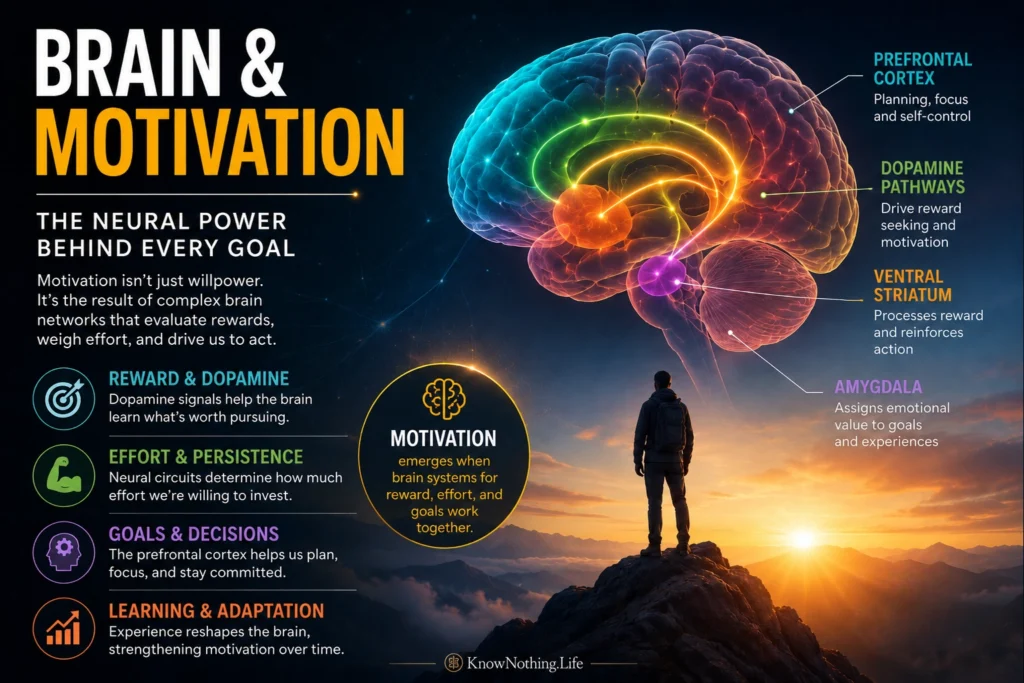
The brain does not contain one isolated motivation center. Motivated behavior emerges from communication among the hypothalamus, brainstem, amygdala, hippocampus, basal ganglia, ventral striatum, prefrontal cortex, and dopamine-producing regions of the midbrain. These systems connect bodily needs with memory, emotion, learning, and decision-making. A person may desire an outcome but decide that the required effort is excessive, or they may pursue something that no longer provides much pleasure because cues associated with it continue to trigger powerful wanting. Modern neuroscience therefore separates motivation into interacting components rather than treating it as a single internal force.
Early Discoveries About Reward and Reinforcement
A major turning point came in 1954, when James Olds and Peter Milner published “Positive Reinforcement Produced by Electrical Stimulation of Septal Area and Other Regions of Rat Brain.” Rats repeatedly pressed a lever that delivered electrical stimulation to particular neural pathways, sometimes continuing at extremely high rates. The experiment demonstrated that activity within the brain could itself reinforce behavior, helping establish the scientific study of neural reward systems.
The experiment was initially described as the discovery of a pleasure center, but later research produced a more complex picture. Electrical stimulation can activate fibers and networks extending through several regions, including portions of the lateral hypothalamus and pathways connected with the midbrain and forebrain. These systems do not merely create pleasure. They can increase attention to rewards, promote approach, reinforce actions, and strengthen learning about cues that predict desirable outcomes. Reward is therefore best understood as a collection of psychological and neural processes rather than a single pleasurable sensation.
Dopamine, Prediction, and Learning
Dopamine is frequently called the brain’s pleasure chemical, but this description is misleading. Dopamine contributes to movement, attention, learning, behavioral activation, effort, and the pursuit of rewards. In a landmark 1997 paper, Wolfram Schultz, Peter Dayan, and P. Read Montague showed that many dopamine neurons respond according to differences between expected and received rewards. An unexpected reward produces increased activity, a fully predicted reward produces less response at the moment of delivery, and the omission of an expected reward can reduce activity.
This pattern is known as a reward-prediction error. It allows the brain to update expectations when outcomes are better or worse than predicted. Once a cue reliably predicts a reward, dopamine activity may shift from the reward itself to the predictive cue. The sight of a restaurant sign, notification, casino machine, or familiar package can therefore acquire motivational power before the reward is received. Dopamine helps organisms learn where valuable outcomes are likely to occur and which actions should be repeated.
Wanting Is Not the Same as Liking
Kent Berridge and Terry Robinson distinguished the motivational process of wanting from the pleasurable experience of liking. Wanting refers to incentive salience: the process by which a reward or reward-related cue becomes attention-grabbing, attractive, and capable of provoking pursuit. Liking refers more specifically to the hedonic pleasure produced when the reward is consumed. Their research and theoretical work indicate that dopamine is more strongly involved in incentive wanting than in the pleasure of liking.
This distinction helps explain why people sometimes pursue things that provide less pleasure than expected. Someone may compulsively check a phone, seek another purchase, gamble, or use a drug without experiencing the same satisfaction that initially encouraged the behavior. In addiction, sensitized motivational systems can assign excessive importance to drug-related cues, producing intense wanting even when pleasure has weakened and negative consequences have increased. The incentive-sensitization theory, first developed by Robinson and Berridge, describes how compulsive motivation can become separated from conscious enjoyment.
Effort, Persistence, and Behavioral Activation
Motivation is not only about identifying rewards. It also determines whether a reward seems worth the required work. John Salamone and colleagues have shown that dopamine within mesolimbic circuits, especially pathways involving the nucleus accumbens, contributes to effort-related choice. Reducing dopamine activity does not necessarily eliminate appetite or the ability to enjoy food. Instead, animals become less willing to work for a preferred reward and may choose an easier but less valuable alternative.
These findings challenge the idea that low motivation simply means a person does not value an outcome. The outcome may still be attractive, but the brain may represent the effort, delay, uncertainty, or physical demand as too costly. Motivated action depends on systems that energize behavior and sustain engagement when rewards are separated from the individual by obstacles. Salamone describes dopamine as part of a broader network regulating behavioral activation, exertion of effort, task engagement, and persistence rather than as a chemical that merely produces happiness.
Hunger, Homeostasis, and Bodily Needs
Some forms of motivation begin with physiological regulation. The brain monitors temperature, energy availability, hydration, hormonal signals, and other conditions necessary for survival. Hypothalamic and brainstem circuits help coordinate hunger and satiety, while reward networks determine how attractive particular foods appear. Homeostatic need and reward are closely connected: food becomes more motivating when energy is low, but highly palatable food can also be pursued when immediate nutritional need is limited.
Neurons producing agouti-related peptide, or AgRP, in the hypothalamus respond to energy deficiency and contribute to feeding behavior. These cells integrate internal signals with sensory information about food and can promote actions aimed at obtaining nourishment. Hormones such as leptin communicate information about stored energy and influence both hypothalamic regulation and reward-seeking pathways. Experiments have shown that leptin can reduce motivation for highly palatable food through circuits connecting energy regulation with dopamine-related systems.
Goals, Planning, and the Prefrontal Cortex
Human motivation frequently extends beyond immediate rewards. People study for qualifications, save for retirement, train for competitions, or tolerate short-term discomfort to achieve distant goals. These behaviors require the brain to represent future outcomes, compare alternatives, maintain goals in working memory, and resist competing impulses. The prefrontal cortex interacts with reward, memory, and motor systems to organize behavior around plans rather than immediate opportunities.
Motivation changes as the brain evaluates progress. A large goal may initially seem valuable but too distant to guide daily behavior. Dividing it into smaller actions creates more immediate feedback and reduces uncertainty. Habits can eventually transfer some control from deliberate prefrontal planning to more automatic basal ganglia systems. This can conserve mental effort, but it also explains why established behavior may continue after a person’s goals have changed. Effective motivation requires both stable routines and the flexibility to revise them.
Intrinsic and Extrinsic Motivation
Not all motivated behavior is driven by food, money, status, or other external rewards. Intrinsic motivation arises when an activity is pursued because it is interesting, satisfying, or meaningful in itself. Learning, creativity, exploration, and play can become rewarding through feelings of competence, curiosity, control, and progress. Neural systems involved in reward and valuation also respond during intrinsically engaging activities, showing that intrinsic and extrinsic motivation are not produced by completely separate brains.
External incentives can strengthen behavior, but they can sometimes weaken preexisting intrinsic interest. In a 2010 study, Kou Murayama and colleagues found that performance-based monetary rewards reduced later voluntary engagement in an initially interesting task after the payments were removed. This behavioral decline was accompanied by reduced activity in the anterior striatum and prefrontal regions involved in valuation. The study did not show that rewards are always harmful; rather, it demonstrated that the meaning and structure of an incentive can change how the brain values an activity.
Motivation in Mental and Neurological Disorders
Altered motivation appears in depression, addiction, schizophrenia, attention disorders, Parkinson’s disease, and other conditions. A person may experience anhedonia, reduced pleasure, but they may instead or additionally experience avolition, a reduced ability to initiate and sustain goal-directed behavior. These symptoms are not identical. Someone may still enjoy an activity once it begins but struggle to overcome the effort required to start it. Distinguishing pleasure, wanting, effort, and learning can lead to more precise explanations of motivational impairment.
Motivational systems can also become excessively focused. Addiction, compulsive gambling, and some repetitive behaviors involve powerful cue-triggered pursuit despite growing costs. Treatment must therefore address more than pleasure or willpower. Medication may influence neurotransmission, while psychotherapy can modify expectations, habits, coping responses, and the value assigned to long-term outcomes. Sleep, stress, physical health, social support, and environmental opportunity also shape the brain’s willingness to act.
Understanding the Motivated Brain
The brain generates motivation by combining information about bodily needs, expected rewards, previous experience, effort, risk, emotional state, and future goals. Dopamine helps update predictions and energize pursuit, but it does not operate alone. The hypothalamus represents physiological conditions, the amygdala assigns emotional significance, the hippocampus supplies context and memory, the basal ganglia help select actions, and the prefrontal cortex supports planning and self-control.
Motivation is therefore neither a fixed personality trait nor a simple reserve of mental energy. It is a changing relationship among the person, the brain, the body, and the available environment. People become motivated when outcomes feel valuable, actions appear possible, progress can be detected, and the expected benefits justify the costs. Understanding these mechanisms replaces the vague idea of motivation as pure willpower with a more accurate account of how neural systems turn needs, incentives, and intentions into sustained behavior.