Recovery after brain injury is not a single event or a simple return to the condition that existed before the injury. It is a prolonged biological and behavioral process involving tissue stabilization, spontaneous neurological improvement, relearning, compensation, and adaptation. Brain injuries differ greatly in cause and severity. A stroke may destroy tissue within a particular vascular territory, while traumatic brain injury can produce contusions, bleeding, inflammation, and widespread damage to axons connecting distant regions. The resulting difficulties may affect movement, language, memory, attention, emotion, perception, fatigue, and social behavior.
Improvement can occur because temporarily disrupted tissue resumes functioning, swelling decreases, surviving networks reorganize, and people learn new ways to accomplish familiar tasks. These mechanisms do not operate on identical schedules. Some changes are most active during the first days and months, while meaningful gains can continue much later through focused rehabilitation. Longitudinal studies of severe traumatic brain injury have documented changing white-matter measurements during recovery, illustrating that the injured brain remains biologically dynamic after the immediate crisis has passed.
Early Biological Recovery
The earliest phase of recovery is influenced by processes that are not the same as learning. Cells surrounding an injury may be structurally intact but function poorly because of reduced blood flow, inflammation, chemical imbalance, pressure, or disrupted input from connected regions. As these conditions improve, some abilities can return without the person having fully relearned them. This spontaneous recovery is often most visible during the first weeks and months after stroke, although its timing and extent differ among individuals and neurological functions.
Researchers have attempted to identify regular patterns in early stroke recovery, including the proposed “proportional recovery” relationship between initial impairment and later improvement. Subsequent investigations have shown that this pattern describes some groups better than others and can be distorted by measurement limits, severe pathway damage, and statistical assumptions. It should not be treated as a fixed biological law or used to place a ceiling on an individual’s potential. People with apparently similar injuries can follow substantially different recovery trajectories.
Neuroplasticity and Cortical Reorganization
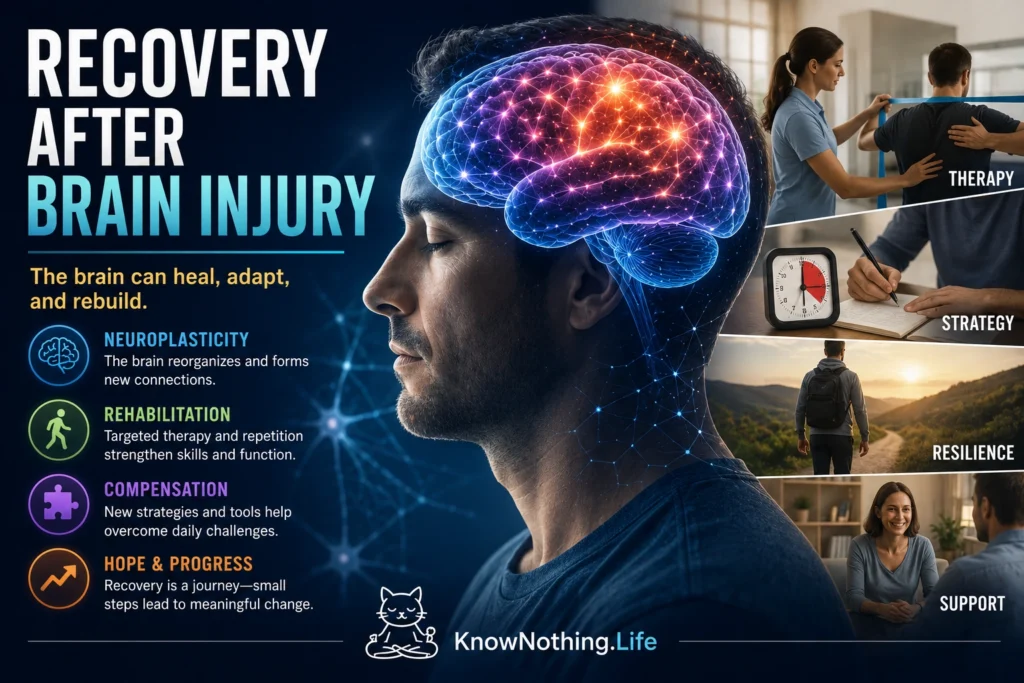
After the acute phase, recovery increasingly depends on neuroplasticity: the capacity of surviving neural systems to change their connections, activity, and organization. Synapses may strengthen or weaken, dendritic structures may be remodeled, and intact areas may alter their contribution to movement or cognition. Reorganization does not mean that an undamaged region simply becomes an exact replacement for destroyed tissue. More often, recovery emerges from changed cooperation among remaining components of a distributed network.
Randy Nudo and colleagues demonstrated the importance of experience in a landmark 1996 experiment involving monkeys with small ischemic injuries to the motor cortex. Without focused retraining, representation of the affected hand declined in nearby surviving cortex. Animals trained intensively on skilled hand movements preserved more of that cortical territory and recovered better use of the hand. Later experiments found that remote motor regions can also reorganize after focal injury. These studies showed that post-injury plasticity is shaped by behavior: surviving tissue reorganizes according to how it is repeatedly used.
Rehabilitation as Guided Relearning
Rehabilitation attempts to direct plasticity toward useful abilities. Physical therapy can address walking, balance, strength, and coordinated movement. Occupational therapy focuses on daily activities and environmental adaptation, while speech-language therapy may address communication, swallowing, attention, and cognitive skills. Neuropsychological and cognitive rehabilitation can help people understand impairments, develop strategies, and manage tasks involving memory, planning, or emotional regulation. Effective programs often combine restoration with compensation rather than assuming that every damaged function can be rebuilt in its original form.
Practice is most valuable when it is specific, progressively challenging, meaningful, and connected to real behavior. Repetition alone is not enough if the person repeatedly completes a task through an inefficient movement or receives no useful feedback. Rehabilitation must also account for fatigue, pain, sleep, mood, medical stability, and the person’s capacity to participate. Recovery is therefore not produced by maximum effort at every moment. It depends on an appropriate relationship among challenge, repetition, rest, feedback, and safety.
Motor Recovery and Learned Nonuse
A person who struggles to move an affected arm may gradually stop using it, even after some neurological capacity returns. Reliance on the less-affected limb can reinforce this pattern, producing what Edward Taub described as learned nonuse. Constraint-induced movement therapy was developed to counter it by limiting use of the less-affected arm while providing intensive, task-oriented practice with the affected arm. The therapy does not repair dead tissue; it encourages the nervous system and the person’s behavior to make fuller use of surviving capacity.
The multicenter EXCITE trial, led by Steven Wolf and colleagues, tested constraint-induced therapy in people three to nine months after stroke. Participants receiving the intervention improved arm function and use in daily life more than those receiving usual care during the initial comparison period. Other controlled studies have reported durable improvements in selected participants with chronic stroke. The method is not suitable for everyone, particularly when voluntary movement is extremely limited, but it demonstrates that structured use can produce functional gains beyond the earliest stage of recovery.
Recovering Language and Cognitive Abilities
Language recovery after injury involves both spontaneous change and repeated communication practice. Aphasia therapy may train word retrieval, sentence production, comprehension, reading, writing, or alternative methods of communication. In a randomized trial published in 2017, Caterina Breitenstein and colleagues found that three weeks of intensive speech and language therapy improved everyday verbal communication in people with chronic post-stroke aphasia. The study showed that clinically meaningful language improvement can remain possible months or years after the injury.
Cognitive recovery after traumatic brain injury is often less visible than motor recovery. A person may walk and speak clearly while continuing to experience slowed processing, poor concentration, memory difficulty, impulsivity, or reduced awareness of errors. Cognitive rehabilitation can include direct exercises, environmental modifications, written routines, electronic reminders, problem-solving methods, and family education. Evidence is mixed across programs. In a randomized trial of people with moderate-to-severe traumatic brain injury, Salazar and colleagues found no overall employment advantage for intensive inpatient cognitive rehabilitation over a structured home program, although outcomes varied among subgroups. Another randomized pediatric study supported organizing interventions around daily routines with extensive family involvement.
Timing and Intensity of Rehabilitation
The period soon after an injury may offer heightened biological responsiveness, but earlier and more intensive treatment is not automatically better in every circumstance. The AVERT trial investigated high-dose mobilization beginning within 24 hours after stroke. Contrary to the expectation that more immediate activity would necessarily improve recovery, the intervention was associated with lower odds of a favorable three-month outcome than usual care. Later analysis suggested that shorter, more frequent sessions may be preferable to prolonged early mobilization. These findings underline the importance of carefully matching rehabilitation dose to medical stability and recovery stage.
The existence of an early sensitive period also does not mean that recovery ends after six months or one year. Analysis of people with mild-to-moderate arm weakness found treatment-related improvement even in chronic stages, with enhanced responsiveness extending beyond twelve months in some participants. Chronic aphasia trials have similarly demonstrated gains after intensive treatment. The probability, speed, and biological basis of improvement may change over time, but the injured nervous system does not suddenly become incapable of learning on a particular anniversary.
Compensation Is Part of Recovery
Recovery is often described as restoration, but successful outcomes may also depend on compensation. A person with memory impairment may use an external calendar, alarms, written routines, and environmental cues. Someone with persistent weakness may adopt adaptive equipment or modify the organization of the home. Communication may be supported through gestures, writing, or electronic devices. These strategies are not evidence that rehabilitation has failed. They can reduce cognitive demands, increase independence, and allow a person to participate in meaningful activities while restorative work continues.
Compensation becomes less helpful when it unnecessarily suppresses use of an ability that could still improve, as can occur with learned nonuse. Rehabilitation therefore requires a balance. Clinicians must identify which functions have realistic potential for restoration, which require temporary support, and which may benefit from long-term adaptation. That balance can change as the person improves, returns home, encounters new demands, or develops greater awareness of the injury’s effects.
The Limits and Possibilities of Recovery
Recovery depends on the location and extent of damage, the integrity of important pathways, age, previous health, complications, rehabilitation access, social support, and the demands of the person’s environment. Diffuse axonal injury can disrupt communication between brain regions even when conventional imaging does not reveal one large lesion. In longitudinal research, different cognitive abilities after traumatic brain injury have followed different recovery patterns, with factors such as age influencing some domains more strongly than others. No single test or scan can fully predict a person’s long-term outcome.
The central lesson of brain-injury research is neither that complete recovery is always possible nor that progress has a strict expiration date. Injured neural systems possess genuine but constrained capacities for repair, reorganization, and learning. Rehabilitation works by engaging those capacities while helping the person function within the limits that remain. Recovery may involve restored movement, improved communication, new cognitive strategies, greater independence, or a changed understanding of what a meaningful life looks like. The brain does not simply rebuild its former organization; it constructs the most workable future available from the networks that survive.