Neurological disorders are conditions that affect the brain, spinal cord, peripheral nerves, muscles, or the communication systems connecting them. They include common conditions such as migraine, epilepsy, stroke, dementia, and neuropathy, as well as less common diseases such as amyotrophic lateral sclerosis, Huntington’s disease, and certain inherited ataxias. Some disorders develop suddenly, as occurs during a stroke or traumatic brain injury, while others progress gradually over years. Their effects can involve movement, sensation, memory, language, consciousness, mood, sleep, balance, breathing, and the ability to perform ordinary activities independently.
The scale of neurological illness is enormous. An analysis from the Global Burden of Disease Study 2021 estimated that conditions affecting the nervous system were collectively the world’s leading cause of disability-adjusted life years. The study examined 37 conditions and estimated that approximately 3.4 billion people experienced at least one nervous-system condition in 2021. The category included not only traditionally defined neurological diseases but also stroke, neurodevelopmental conditions, infections, injuries, and other illnesses capable of damaging the nervous system. The findings demonstrate that neurological health is not a specialized concern affecting a small population; it is a central global public-health issue.
Major Categories and Disease Mechanisms
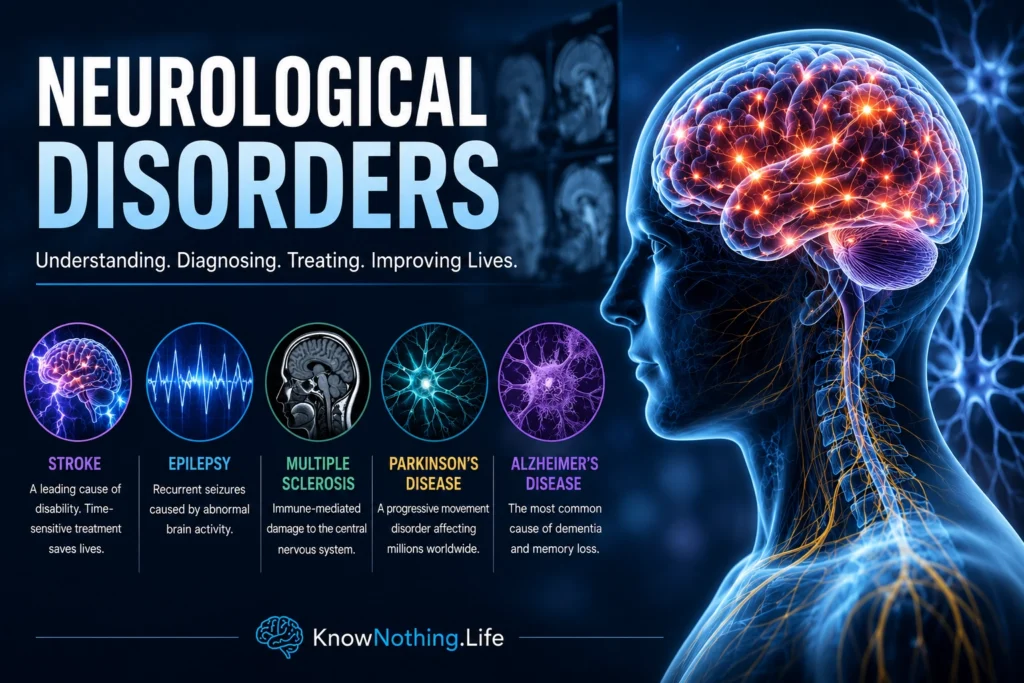
Neurological disorders can be grouped according to their underlying causes, although the categories often overlap. Vascular disorders such as ischemic stroke result from disrupted blood flow, while hemorrhagic stroke involves bleeding into or around the brain. Neurodegenerative diseases, including Alzheimer’s disease, Parkinson’s disease, and amyotrophic lateral sclerosis, involve the progressive dysfunction and loss of particular neuronal populations. Epilepsy is defined by a persistent tendency to experience seizures produced by abnormal electrical activity. Multiple sclerosis involves immune-mediated injury to myelin and other nervous-system structures, whereas peripheral neuropathies may arise from diabetes, toxins, autoimmune activity, infections, nutritional deficiencies, or inherited abnormalities.
Modern research has shown that apparently separate neurological syndromes can share biological mechanisms. Two landmark studies published in 2011 identified an expanded sequence in the C9ORF72 gene as a major cause of both amyotrophic lateral sclerosis and frontotemporal dementia. The discovery helped establish that a disorder primarily associated with motor-neuron degeneration and one associated with behavior, personality, and language could exist along a connected disease spectrum. Similar overlaps appear throughout neurology, where abnormal proteins, mitochondrial dysfunction, inflammation, impaired cellular transport, excitotoxicity, and altered gene expression may contribute to more than one diagnostic category.
Symptoms, Localization, and Clinical Diagnosis
Neurological diagnosis begins with the pattern of symptoms and the neurological examination. Muscle weakness affecting one side of the body may suggest injury to a different pathway than symmetrical weakness beginning in the feet. Language loss, visual-field changes, tremor, rigidity, numbness, involuntary movements, memory impairment, or altered reflexes can help clinicians determine which structures or networks are affected. The timing of symptoms is equally important. A deficit reaching maximum severity within minutes may indicate a vascular event, whereas gradual progression over months or years can suggest degeneration, a slow-growing tumor, or another chronic process.
The history of neuroscience shows how carefully studied patients can reveal the organization of the human brain. In their influential 1957 paper “Loss of Recent Memory After Bilateral Hippocampal Lesions,” William Scoville and Brenda Milner described profound memory impairment following extensive medial temporal lobe surgery. Their work, which included the patient later widely known as H.M., demonstrated that hippocampal and surrounding structures are essential for forming new lasting memories. The findings also showed that memory is not a single undivided ability, because some forms of learning and older memories remained relatively preserved. This combination of clinical observation and experimental testing became a model for neurological research.
Imaging, Biomarkers, and Earlier Detection
Clinical examination is now supported by magnetic resonance imaging, computed tomography, electroencephalography, nerve-conduction studies, genetic testing, cerebrospinal-fluid analysis, and molecular imaging. These methods can reveal structural damage, abnormal electrical activity, inflammation, protein accumulation, vascular obstruction, or inherited risk. Diagnosis nevertheless requires interpretation. An abnormal scan may not explain every symptom, and some people can have significant neurological dysfunction before conventional imaging shows a clear lesion. Effective diagnosis therefore depends on combining test results with the patient’s history, examination, functional changes, and disease progression.
Research into Alzheimer’s disease demonstrates why biomarkers have become so important. Randall Bateman and colleagues studied families affected by dominantly inherited Alzheimer’s disease and reported that changes in cerebrospinal-fluid proteins, amyloid deposition, brain metabolism, and cognition appeared in a sequence extending across decades. Later longitudinal work found that amyloid-related changes could begin approximately 25 years before anticipated symptom onset, while measurable cognitive decline and accelerated hippocampal atrophy appeared closer to the clinical stage. These findings helped shift Alzheimer’s research toward identifying disease processes before severe memory loss becomes visible, although inherited Alzheimer’s disease represents only a small proportion of all cases and does not perfectly model the more common late-onset form.
Treatment From Medication to Neurosurgery
Treatment varies according to the cause and stage of the disorder. Some infections can be treated with antimicrobial drugs, immune-mediated diseases may respond to immunotherapy, and seizures can often be reduced with antiseizure medications. Other therapies manage symptoms without eliminating the underlying disease. Levodopa can improve movement in Parkinson’s disease, while riluzole produces a modest survival benefit for some people with amyotrophic lateral sclerosis. Rehabilitation, speech therapy, occupational therapy, mobility support, pain management, psychological care, and assistance for caregivers are often as important as medication because neurological illness commonly affects several dimensions of daily life.
Some of the most dramatic advances have involved procedures designed for carefully selected patients. The MR CLEAN trial established that endovascular treatment could improve functional outcomes in patients with acute ischemic stroke caused by a large intracranial artery blockage when performed within an appropriate treatment window. In drug-resistant temporal-lobe epilepsy, a randomized trial led by Samuel Wiebe found that 58 percent of patients assigned to surgery were free from seizures impairing awareness at one year, compared with 8 percent receiving continued medical therapy. These studies illustrate a defining principle of modern neurology: identifying the correct mechanism, anatomical target, and treatment timing can substantially change outcomes.
Targeted Therapies and Neural Modulation
Neurological treatments are becoming increasingly connected to specific cells, molecules, and circuits. Multiple sclerosis provides an important example. In the ORATORIO trial, ocrelizumab, an antibody targeting CD20-positive B cells, reduced the proportion of patients experiencing confirmed disability progression compared with placebo in primary progressive multiple sclerosis. The study strengthened evidence that B cells contribute to the inflammatory and degenerative processes of the disease. It also represented an important advance for a form of multiple sclerosis that had historically been difficult to treat, although benefits must be weighed against infection risks and other potential complications.
Deep-brain stimulation demonstrates how neurological symptoms can be treated by modifying circuit activity. In a randomized trial involving patients with advanced Parkinson’s disease, Günther Deuschl and colleagues found that stimulation of the subthalamic nucleus produced greater improvements in motor function and quality of life than medical management alone over six months. The treatment does not stop the underlying neurodegeneration and is not appropriate for every patient, but it can reduce disabling motor fluctuations and dyskinesias in selected individuals. Migraine research has similarly produced therapies directed at calcitonin gene-related peptide, or CGRP, showing how understanding a signaling pathway can lead to new preventive and acute treatments.
Living With Neurological Illness
The consequences of neurological disorders extend beyond symptoms documented during an examination. A person may face loss of employment, reduced mobility, communication difficulties, social isolation, caregiver dependence, financial pressure, or uncertainty about future decline. Conditions such as epilepsy and migraine may be episodic, leaving people outwardly well between attacks while still affecting education, work, driving, relationships, and emotional security. Progressive disorders can require families to adapt repeatedly as cognitive, behavioral, motor, or respiratory abilities change.
For this reason, successful neurological care cannot be measured only by changes on a scan or laboratory test. Quality of life, independence, pain, fatigue, emotional well-being, communication, participation in meaningful activities, and caregiver health are also essential outcomes. Multidisciplinary care recognizes that a person with a neurological disorder may need neurologists, nurses, therapists, psychologists, social workers, rehabilitation specialists, and primary-care clinicians working together. Even when no cure exists, symptom control, assistive technology, environmental adaptations, and coordinated support can preserve autonomy and dignity.
The Future of Neurological Medicine
Future progress will depend increasingly on early detection and biological precision. Broad diagnoses may eventually be divided into subgroups based on genetic variants, abnormal proteins, immune activity, circuit dysfunction, and patterns of progression. Blood-based biomarkers, wearable sensors, advanced imaging, brain-responsive devices, gene therapies, and RNA-targeting treatments may allow clinicians to identify disease earlier and select therapies more accurately. The discovery of C9ORF72 expansions and the identification of presymptomatic Alzheimer’s biomarkers show how genetic and molecular findings can redefine the boundaries of disease.
Yet greater technical power also creates difficult questions. Predictive tests may reveal risk years before symptoms appear, sometimes when no proven preventive treatment exists. Genetic findings can affect entire families, and implantable devices generate sensitive information about brain activity and behavior. Neurological medicine must therefore combine innovation with informed consent, privacy protection, realistic communication, and equitable access. The nervous system supports memory, movement, identity, language, and awareness. Treating its disorders requires not only scientific precision but sustained attention to the life and values of the person behind the diagnosis.