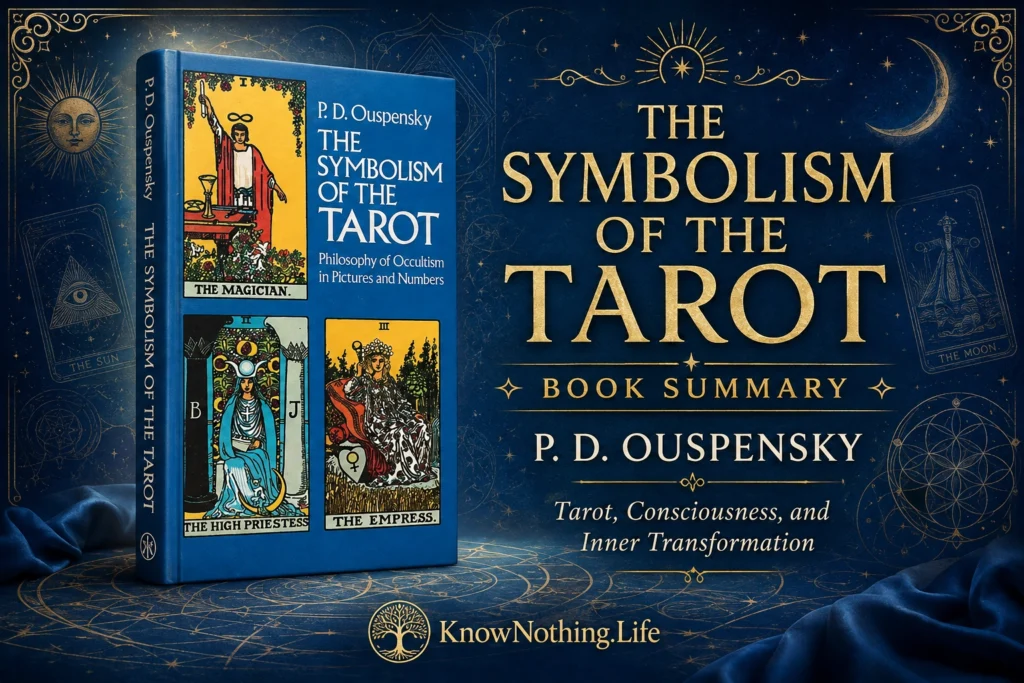
P. D. Ouspensky’s The Symbolism of the Tarot, first published in 1913, is not a conventional guide to card reading. It is a compact work of symbolic philosophy in which the twenty-two Major Arcana become images of consciousness, nature, spiritual knowledge, and human transformation. Ouspensky approaches the deck as a visual language whose meaning cannot be exhausted by fixed definitions. The cards are not primarily devices for predicting events; they are an “alphabet” through which metaphysical and psychological relationships may be contemplated. His method is imaginative rather than historical, presenting each card through a visionary “pen picture” intended to awaken associations in the reader.
The book anticipates themes that would define Ouspensky’s later writing: the contrast between ordinary and higher consciousness, the limitations of literal thought, and the need to discover truth inwardly. Its Tarot is less a fortune-telling system than a map of human possibility. The central question is not what the cards foretell, but what forms of perception they make imaginable.
The Tarot as Book, Method, and Symbolic System
Ouspensky divides the seventy-eight cards into three symbolic regions: twenty-one numbered trumps, the Fool, and the fifty-six suit cards. He arranges them conceptually as a triangle, a central point, and a surrounding square. The triangle represents the spiritual or noumenal world, the point represents the human soul, and the square represents the visible world of phenomena and the four elements. This diagram expresses one of the book’s governing ideas: consciousness stands between the world of ideas and the material world while potentially containing both.
For Ouspensky, the Tarot can be interpreted simultaneously as a doctrine and a method. It presents recurring principles, yet its images remain fluid enough to generate different systems of meaning. He acknowledges the subjectivity of some interpretations and argues that genuine symbolism cannot be reduced to a dictionary in which each image has one permanent translation. The reader is therefore asked to synthesize images rather than decode them mechanically.
The Magician and the Fool
The opening pair establishes the psychological drama of the book. The Magician represents developed consciousness, creative power, and the ability to unite spiritual intention with material action. Before him lie the sceptre, cup, sword, and pentacle—the four suit symbols and elemental powers. His gestures connect heaven and earth, suggesting that mature consciousness does not escape the world but organizes it. Ouspensky’s Magician is an image of integrated human potential: knowledge, will, emotion, and action brought into relationship.
The Fool is presented as the same human being in an undeveloped state. He carries the four symbols but has forgotten their meaning and does not know how to use them. Absorbed in repetitive fantasies, he moves toward danger without recognizing it. The contrast anticipates Ouspensky’s later distinction between possible capacities and actual development. People may possess intelligence, imagination, and choice in principle while living largely through habit and distraction.
Wisdom, Nature, and the Inner Temple
The High Priestess introduces another central theme: real knowledge cannot be transferred merely as information. She sits between light and dark pillars, holding keys and an open book, but her mystery must grow within the seeker. Ouspensky treats initiation as an inward transformation of perception rather than admission into an external organization. The card’s veils and opposites suggest that wisdom requires distinguishing appearance from reality while tolerating ambiguity. The High Priestess represents receptive understanding rather than the Magician’s active power.
The Empress represents nature in its fertile, continually renewing form, while Judgment reveals life emerging through death. Ouspensky pairs cards so that one completes or reverses the other: growth contains decay, death contains renewal, and visible nature points toward an invisible process. His approach recalls Plotinus’s Enneads, in which the sensible world expresses a deeper intelligible order. It also resembles Jung’s later idea that symbolic images can unite psychological opposites. Jung’s The Archetypes and the Collective Unconscious describes recurring mythic figures as forms through which inaccessible psychic material becomes imaginable, although Jung’s psychology and Ouspensky’s esotericism are not identical.
Conflict, Time, and Transformation
The middle cards explore the instability of development. The Lovers represent the reconciliation of division; the Hermit seeks an inner light; the Hanged Man depicts higher consciousness constrained by ordinary personality; and the Devil represents separation, hatred, and confinement within a limited self. Ouspensky does not arrange these images as a simple ladder. They coexist as possibilities within one person, making the Major Arcana less a linear biography than a gallery of psychological conditions.
The Wheel, Death, and Temperance develop his philosophy of time. The Wheel depicts ceaseless change within an enduring pattern, Death completes a cycle rather than merely terminating it, and Temperance is associated with higher space and the “eternal now.” These interpretations connect with the arguments Ouspensky later developed in Tertium Organum and The Fourth Dimension: temporal succession may reflect the limits of ordinary consciousness rather than the complete structure of reality. As metaphysics, this is speculative; psychologically, it captures how identity is shaped by cycles, memory, and repeated patterns.
The Tower, Star, and Moon
The Tower is among Ouspensky’s strongest social symbols. A structure built to remind people that the true temple must be created within the soul becomes an institution claiming holiness and power for itself. Its builders forget the meaning of the symbol and begin worshiping the structure. The lightning that destroys it represents the collapse of rigid dogma and external forms that have replaced living understanding. The card warns that institutions may preserve a teaching’s vocabulary after losing its purpose.
The Star and Moon distinguish illumination from distorted imitation. The Star represents a perception of previously hidden relationships, in which separate facts form a new pattern. The Moon represents fear, deceptive appearances, and pseudo-mysticism—the tendency to mistake emotionally compelling images for knowledge. Ouspensky values imagination, but he does not regard every vision as true. Imagination must reveal coherent relationships rather than merely intensify fantasy.
Symbolism and Modern Psychology
Ouspensky’s cards can be compared with psychological responses to ambiguous images. A suggestive picture invites an observer to select details, construct a narrative, and connect the image with personal concerns. Projective methods were built on the assumption that responses to ambiguous material may reveal aspects of personality or conflict. A recent systematic review notes that such methods continue to elicit narratives about thoughts and emotions, although their interpretation depends heavily on method, context, and evidence.
That comparison requires caution. Research testing popular claims about ambiguous pictures found little support for the idea that the first image someone sees reliably reveals broad personality traits. The Barnum effect also shows that people may accept vague, widely applicable statements as uniquely accurate descriptions of themselves. Tarot imagery can therefore support reflection without functioning as a validated diagnostic instrument or proof of supernatural prediction. Its plausible psychological value lies in prompting association, reframing problems, and creating distance from habitual assumptions.
Historical Limits and Lasting Meaning
Ouspensky accepted occult traditions connecting Tarot with Egypt, Kabbalah, Hermeticism, and ancient initiation. Modern historical scholarship does not support those origin claims. The earliest documented tarot decks appeared in fifteenth-century northern Italy as cards for a trick-taking game, with twenty-one trumps and a Fool added to ordinary suits. Their association with occultism and fortune-telling developed centuries later. This does not invalidate Ouspensky’s symbolic interpretations, but it makes them creative esoteric readings rather than recoveries of a proven ancient code.
The Symbolism of the Tarot endures because it treats images as instruments for thinking beyond literal categories. Its cards dramatize movement between unconsciousness and awareness, fragmentation and integration, external authority and inner knowledge, illusion and insight. Readers need not accept divination or Ouspensky’s historical assumptions to appreciate the book as an experiment in symbolic consciousness. Its deepest claim is that a symbol does not merely conceal an answer; properly contemplated, it changes the quality of the mind asking the question.