Among the most influential figures in the history of Western thought, Augustine of Hippo stands as a bridge between the ancient world and the emerging intellectual traditions of Christianity. A philosopher, theologian, and bishop, Augustine shaped the development of Christian doctrine in ways that continue to resonate across centuries. His writings explore the nature of God, the problem of evil, the structure of the soul, and the meaning of human existence with a depth and intensity that few thinkers have matched.
What makes Augustine particularly compelling is the personal dimension of his philosophy. Unlike purely abstract thinkers, he grounded his reflections in his own experiences—his struggles with desire, doubt, ambition, and faith. Through this introspective approach, he pioneered a form of philosophical writing that blends autobiography with theological inquiry. His work invites readers not only to think, but to examine themselves, making his legacy both intellectually profound and deeply human.
Early Life and Intellectual Formation
Augustine was born in 354 CE in Thagaste, a town in North Africa within the Roman Empire. His father was a pagan, while his mother, Monica, was a devout Christian whose influence would play a crucial role in his life. From an early age, Augustine demonstrated exceptional intellectual ability, receiving a classical education in rhetoric, grammar, and philosophy.
As a young man, he pursued a career in rhetoric, seeking success and recognition in the cultural centers of the empire. However, his intellectual curiosity led him beyond conventional education. He became deeply engaged with philosophical questions, particularly those concerning truth, knowledge, and the nature of reality. During this period, he was drawn to Manichaeism, a religious movement that offered a dualistic explanation of good and evil.
Despite his initial enthusiasm, Augustine grew dissatisfied with Manichaean teachings. He found their explanations lacking in philosophical rigor and began searching for a more coherent understanding of the world. His exposure to Neoplatonism marked a turning point, providing him with a framework for thinking about immaterial reality and the nature of the divine. This intellectual journey set the stage for his eventual conversion to Christianity.
Conversion and Spiritual Transformation
Augustine’s conversion to Christianity is one of the most famous episodes in intellectual history. Living in Milan, he encountered the teachings of Ambrose of Milan, whose eloquence and philosophical depth challenged Augustine’s assumptions about the faith. At the same time, Augustine was engaged in an intense internal struggle, torn between his intellectual convictions and his attachment to worldly desires.
This conflict reached a climax in a moment of profound emotional and spiritual clarity. According to his account, he heard a child’s voice saying, “Take and read,” prompting him to open a passage from the writings of the Apostle Paul. The text spoke directly to his condition, urging him to abandon indulgence and embrace a life of discipline and faith. This experience led to his conversion, marking a decisive break from his previous way of life.
Following his conversion, Augustine was baptized and began to devote himself fully to the study and teaching of Christianity. He returned to North Africa, where he eventually became the bishop of Hippo. In this role, he combined pastoral duties with intellectual work, producing writings that would shape Christian theology for generations.
The Confessions and the Exploration of the Self
One of Augustine’s most enduring works is the Confessions, a text that blends autobiography, philosophy, and theology. Written as a prayer addressed to God, the Confessions recount Augustine’s life from his early years to his conversion, offering a detailed account of his inner struggles and transformation.
What sets this work apart is its focus on the interior life. Augustine examines his thoughts, desires, and motivations with remarkable honesty, exploring the complexity of human psychology. He reflects on the nature of memory, the experience of time, and the restless search for meaning. In doing so, he creates a model for introspective writing that has influenced countless thinkers.
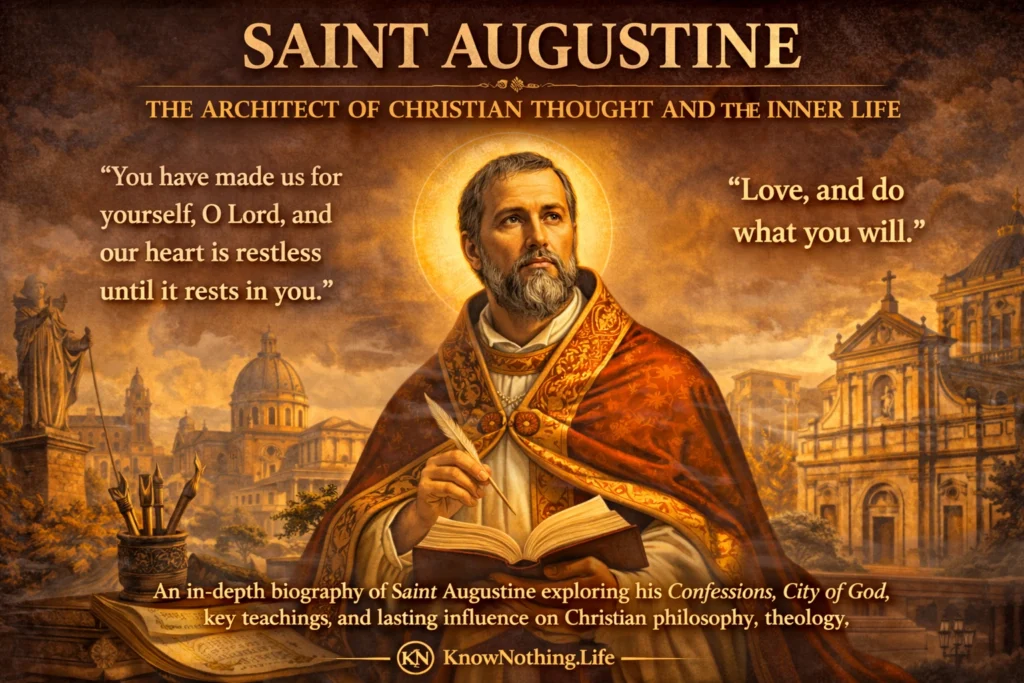
One of the most famous lines from the Confessions captures the essence of his philosophy: “You have made us for yourself, O Lord, and our heart is restless until it rests in you.” This statement expresses Augustine’s belief that true fulfillment can only be found in a relationship with the divine. It highlights the tension between human desire and spiritual longing, a theme that runs throughout his work.
The City of God and the Nature of History
Another major contribution of Augustine is the The City of God, written in response to the sack of Rome in 410 CE. In this work, Augustine addresses the question of how to understand historical events in light of Christian faith. He challenges the idea that the fall of Rome represents a failure of Christianity, offering instead a broader perspective on the nature of history.
Augustine introduces the concept of two “cities”: the City of God and the City of Man. These are not physical locations, but symbolic representations of two ways of life. The City of God is characterized by love of God and the pursuit of eternal truth, while the City of Man is defined by self-love and the pursuit of temporal power. Throughout history, these two cities coexist and interact, shaping human experience.
This framework allows Augustine to reinterpret history as a moral and spiritual narrative rather than a purely political one. He emphasizes that earthly kingdoms are transient, while the City of God represents an eternal reality. This perspective had a profound influence on medieval thought, shaping the way history, politics, and theology were understood.
Core Philosophy: Time, Evil, and the Human Will
Augustine’s philosophical contributions extend beyond theology into fundamental questions about existence. One of his most significant insights concerns the nature of time. He famously asked: “What then is time? If no one asks me, I know; if I wish to explain it, I do not know.” This reflection highlights the difficulty of defining time, while also exploring its subjective and experiential dimensions.
He also addressed the problem of evil, rejecting the idea that evil is a substance or independent force. Instead, Augustine argued that evil is a privation of good—a lack or corruption rather than a positive reality. This view allows for the existence of evil without attributing it to God, preserving the idea of a benevolent creator.
Central to his thought is the concept of free will. Augustine believed that humans possess the capacity to choose between good and evil, and that this freedom is essential to moral responsibility. However, he also recognized the limitations of human will, emphasizing the need for divine grace. This tension between freedom and dependence became a defining feature of his theology.
Key Teachings and Quotes
Augustine’s writings are rich with insights that continue to resonate. One of his most quoted statements is: “Love, and do what you will.” This phrase reflects his belief that genuine love, properly understood, aligns human action with divine will. When love is rightly directed, it becomes the guiding principle for ethical behavior.
Another important teaching is: “The world is a book, and those who do not travel read only one page.” While often interpreted in a literal sense, this statement also reflects Augustine’s broader view of learning and experience. He believed that understanding requires engagement with the world, both externally and internally.
He also observed: “Faith is to believe what you do not see; the reward of this faith is to see what you believe.” This captures his understanding of faith as a process that leads to deeper knowledge. Rather than opposing reason, faith opens the way for a more complete understanding of reality.
Influence and Legacy
The influence of Augustine extends across theology, philosophy, and literature. His ideas shaped the development of Christian doctrine, particularly in areas such as original sin, grace, and the nature of the church. His work provided a foundation for medieval thinkers, including Thomas Aquinas, and continues to be studied in both religious and secular contexts.
Beyond theology, Augustine’s emphasis on introspection and the inner life has had a lasting impact on philosophy and psychology. His exploration of memory, identity, and self-awareness anticipates later developments in these fields. He is often regarded as one of the first thinkers to articulate a fully developed concept of the self.
In modern times, Augustine’s writings continue to inspire readers seeking to understand the relationship between faith, reason, and human experience. His ability to combine intellectual rigor with personal reflection ensures that his work remains relevant in a wide range of contexts.
Conclusion
Saint Augustine’s life and thought represent a profound engagement with the deepest questions of human existence. Through his writings, he explored the nature of truth, the structure of the soul, and the meaning of history with unparalleled depth. His work stands as a testament to the power of introspection and the enduring search for understanding.
Rather than offering simple answers, Augustine invites readers into a process of reflection and transformation. His philosophy challenges individuals to examine their own lives, to confront their desires and beliefs, and to seek a deeper connection with the divine. In doing so, he provides a path that is both intellectually rigorous and spiritually meaningful.
In a world marked by uncertainty and change, Augustine’s insights continue to offer guidance. His vision of a restless heart seeking fulfillment speaks to a universal human experience, reminding us that the search for meaning is both a personal journey and a timeless pursuit.