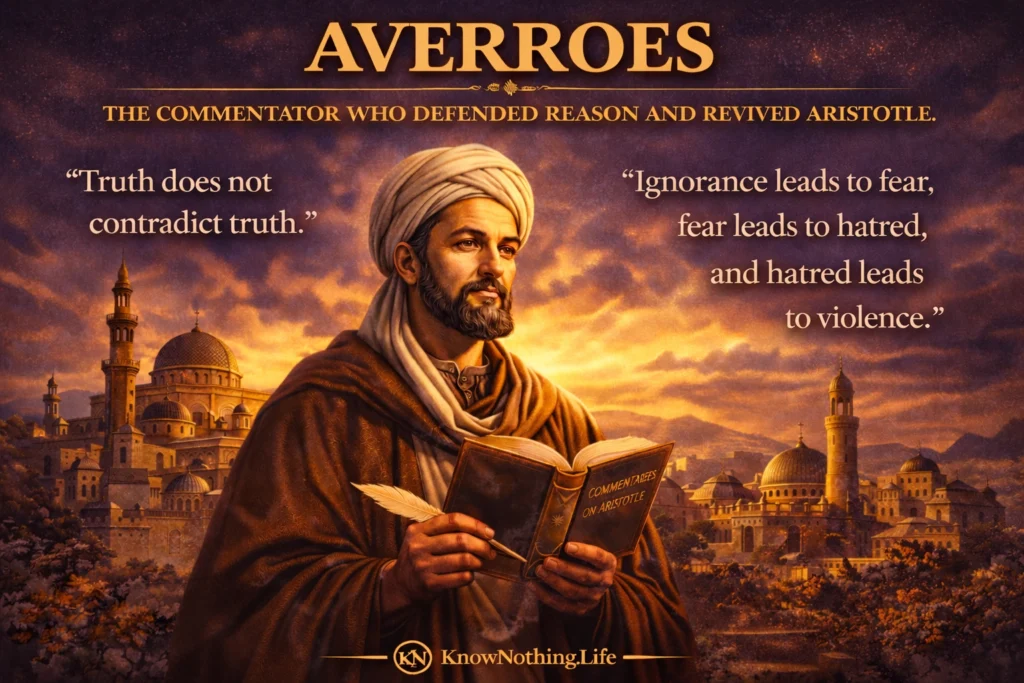
Among the most influential philosophers of the medieval world, Averroes—known in Arabic as Ibn Rushd—stands as a central figure in the transmission and defense of rational philosophy. Living in 12th-century Al-Andalus, Averroes became renowned as “The Commentator” for his extensive interpretations of Aristotle. His work not only preserved Aristotelian thought but also reintroduced it to Western Europe, shaping the development of scholastic philosophy for centuries.
What distinguishes Averroes is his unwavering commitment to reason as a path to truth. At a time when philosophical inquiry often came into tension with religious doctrine, he argued that the two were not inherently opposed. Instead, he maintained that properly understood, philosophy and religion converge. His writings represent a bold defense of intellectual freedom, logical inquiry, and the compatibility of faith and reason.
Early Life and Intellectual Formation
Averroes was born in 1126 in Córdoba, a major cultural and intellectual center of Islamic Spain. He came from a distinguished family of jurists, and his early education reflected this background. He studied Islamic law, theology, medicine, and philosophy, receiving a comprehensive education that prepared him for a life of scholarship and public service.
From an early age, Averroes demonstrated a keen interest in philosophy, particularly the works of Aristotle. However, these texts were often difficult to access and interpret, requiring careful study and commentary. Averroes devoted himself to understanding these works in their original depth, seeking to clarify their meaning and correct misunderstandings that had arisen over time.
His intellectual development was also shaped by the broader cultural environment of Al-Andalus, where scholars engaged with a wide range of traditions, including Greek, Islamic, and Jewish thought. This exchange of ideas created a fertile ground for philosophical innovation, allowing Averroes to refine his arguments and develop a distinctive perspective.
Career and Role in Society
Averroes’s career combined intellectual pursuits with public service. He held various positions as a judge (qadi) and advisor, reflecting his expertise in law and governance. These roles required him to navigate complex social and political issues, applying his knowledge to practical situations.
His reputation as a scholar eventually brought him to the attention of the Almohad rulers, who supported his work and encouraged his philosophical studies. Under their patronage, Averroes produced many of his most important writings, including detailed commentaries on Aristotle’s works.
However, his career was not without challenges. Toward the end of his life, he faced opposition from more conservative elements within society, who viewed his emphasis on philosophy with suspicion. He was temporarily exiled and his works were criticized, reflecting the tension between intellectual inquiry and religious authority. Despite these difficulties, his influence endured, and his writings continued to circulate widely.
The Commentaries on Aristotle
Averroes’s most significant contribution lies in his extensive commentaries on Aristotle, including works such as the Long Commentary on Aristotle’s Metaphysics. These commentaries were written at different levels—short, middle, and long—designed to make Aristotle’s ideas accessible to a range of audiences.
Through these writings, Averroes sought to recover what he believed to be the true meaning of Aristotle’s philosophy. He argued that many earlier interpretations had distorted Aristotle’s ideas, and he worked meticulously to clarify key concepts. His approach combined close textual analysis with logical reasoning, demonstrating both scholarly precision and philosophical insight.
These commentaries had a profound impact on both the Islamic world and medieval Europe. Translated into Latin, they became central to the study of philosophy in European universities. Averroes’s interpretations influenced thinkers such as Thomas Aquinas, even as they debated and critiqued his conclusions.
Philosophy and the Harmony of Faith and Reason
One of Averroes’s most important works is the The Decisive Treatise, in which he addresses the relationship between philosophy and religion. In this text, he argues that the study of philosophy is not only permissible but required for those capable of understanding it.
Averroes maintained that truth is unified, even if it is expressed in different forms. Religious texts, he argued, often use symbolic language to communicate with a broad audience, while philosophy seeks to uncover deeper, rational explanations. When apparent conflicts arise, they should be resolved through interpretation rather than rejection.
He expressed this view clearly: “Truth does not contradict truth.” This statement encapsulates his belief that reason and revelation ultimately lead to the same conclusions. By defending the role of philosophy, Averroes sought to preserve intellectual inquiry within a religious framework, ensuring that both could coexist and enrich one another.
The Nature of the Intellect and Knowledge
Averroes also made significant contributions to the philosophy of mind and knowledge. He developed a theory of the intellect that distinguished between individual and universal aspects of understanding. According to his view, the human intellect participates in a shared, universal intellect that enables the comprehension of abstract truths.
This idea, often referred to as the “unity of the intellect,” was controversial and sparked considerable debate. Critics argued that it undermined individual identity and responsibility, while supporters saw it as a profound insight into the nature of knowledge. Regardless of interpretation, it reflects Averroes’s commitment to exploring the limits of human understanding.
He also emphasized the importance of empirical observation and logical reasoning in the pursuit of knowledge. By integrating these elements, Averroes contributed to the development of a more systematic approach to inquiry, influencing both philosophy and science.
Key Teachings and Quotes
Averroes’s writings contain numerous insights that continue to resonate. One of his most well-known statements is: “Ignorance leads to fear, fear leads to hatred, and hatred leads to violence.” This observation highlights the social and ethical implications of knowledge, emphasizing the importance of education and understanding.
Another significant teaching is: “He who studies philosophy must begin with logic.” This reflects his belief in the foundational role of reasoning in intellectual inquiry. By mastering logical principles, individuals can approach complex questions with clarity and precision.
He also stated: “Knowledge of a thing is not complete until its causes are known.” This idea aligns with his Aristotelian approach, emphasizing the importance of understanding underlying principles rather than merely observing surface phenomena. It underscores his commitment to depth and rigor in the pursuit of truth.
Influence and Legacy
The influence of Averroes extends across cultures and centuries. In the Islamic world, his work contributed to ongoing debates about the role of philosophy and its relationship to religion. While his ideas were not universally accepted, they played a crucial role in shaping intellectual discourse.
In Europe, his impact was even more pronounced. Translations of his works introduced Aristotelian philosophy to medieval scholars, leading to the development of Averroism, a movement that emphasized the autonomy of reason. His ideas influenced universities, theological debates, and the broader intellectual landscape of the Middle Ages.
Modern scholars continue to study Averroes for his contributions to philosophy, law, and science. His defense of rational inquiry and intellectual freedom remains relevant in contemporary discussions about the relationship between knowledge, belief, and society.
Conclusion
Averroes stands as a pivotal figure in the history of philosophy, whose work bridged cultures and preserved a tradition of rational inquiry. Through his commentaries on Aristotle and his defense of philosophy, he demonstrated that reason and faith need not be in conflict. Instead, they can work together to deepen our understanding of reality.
His legacy is not confined to a single tradition or discipline. By emphasizing clarity, logic, and the pursuit of truth, Averroes provided a model for intellectual engagement that continues to inspire. His work reminds us that the search for knowledge is both a personal and collective endeavor, one that transcends boundaries and connects us across time.
In a world where questions of belief and reason remain central, Averroes’s philosophy offers a powerful example of how these dimensions can coexist. Through his writings, he invites us to think deeply, question assumptions, and seek a more complete understanding of the world and our place within it.