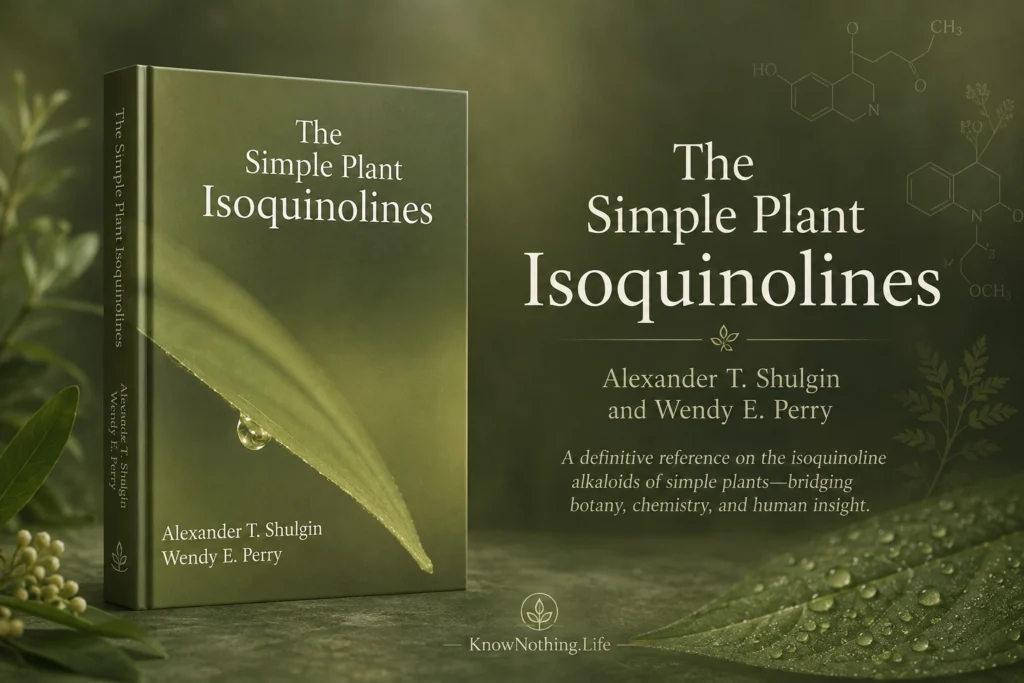
Published by Transform Press in 2002, The Simple Plant Isoquinolines is one of Alexander Shulgin’s least widely read but most revealing books. Co-written with Wendy E. Perry, the 624-page volume differs dramatically from PiHKAL and TiHKAL. There is no fictionalized autobiography, psychedelic love story, or extended discussion of personal experimentation. Instead, Shulgin and Perry created a specialized reference work devoted to naturally occurring isoquinoline and tetrahydroisoquinoline alkaloids. The book organizes compounds by their names, molecular structures, the plants in which they have been identified, and leading scientific references. It can also be approached from the opposite direction: starting with a plant, the reader can locate the isoquinolines reported within it.
That seemingly dry organizational project expresses something fundamental about Shulgin’s scientific worldview. Chemistry, for him, was not simply the manufacture of novel molecules. It was also the creation of maps connecting molecular structure, biological origin, pharmacological activity, and human knowledge. Transform Press describes The Simple Plant Isoquinolines as identifying plants containing isoquinolines while supplying the names and structural details of those compounds. In this sense, the book is best understood less as conventional narrative nonfiction than as an atlas of chemical biodiversity—a systematic attempt to make a scattered scientific literature navigable.
What Exactly Is an Isoquinoline?
Isoquinoline alkaloids constitute an enormous and chemically diverse class of naturally occurring compounds. Alkaloids themselves are nitrogen-containing natural products, many of which have powerful physiological effects. Isoquinoline-related alkaloids occur widely in higher plants, and broader families derived from this chemistry include substances with antimicrobial, cardiovascular, neurological, analgesic, and other biological activities. Modern reviews emphasize how diverse the isoquinoline family has become from both chemical and pharmacological perspectives.
The “simple” in Shulgin and Perry’s title therefore does not mean chemically unimportant. It distinguishes the comparatively uncomplicated isoquinoline and tetrahydroisoquinoline structures covered by the reference from the extraordinarily elaborate architectures found elsewhere in alkaloid chemistry. Their book makes these structures searchable alongside their botanical origins, transforming molecular classification into a way of understanding relationships among plants. This reflects one of chemistry’s deepest intellectual habits: phenomena that initially appear unrelated can become intelligible once their underlying structures are compared.
From Plants to Molecules and Back Again
The book’s unusual strength is its multidirectional organization. A researcher who encounters the name of an unfamiliar compound can locate its structure and botanical source. Someone beginning with a molecular structure can move toward its common name and the plants in which it has been reported. Someone studying a particular species can proceed in the opposite direction, identifying the simple isoquinolines associated with it. The back-cover description explicitly presents these three routes—name, structure, and plant—as interchangeable entry points into the same body of knowledge.
That design makes The Simple Plant Isoquinolines an interesting example of scientific classification as a cognitive tool. Philosopher of science Thomas Kuhn emphasized in The Structure of Scientific Revolutions that scientific practice depends not merely on accumulating facts but on possessing conceptual frameworks through which facts become meaningful. Shulgin and Perry work at a more practical level, but the principle is related. An isolated compound name tells us little. A structure connected with a species, chemical relatives, and literature citation becomes part of a network. The book converts dispersed observations into relationships, and those relationships allow new questions to be asked.
Cactus Chemistry Beyond Mescaline
Shulgin’s interest in simple isoquinolines is especially relevant to cactus chemistry. Peyote and other cacti are popularly associated with mescaline, a psychedelic phenethylamine, but these plants contain considerably more complicated mixtures of alkaloids. Modern reviews of Lophophora williamsii identify compounds including pellotine, anhalonidine, hordenine, and mescaline, while research on the Cactaceae describes numerous phenethylamines and tetrahydroisoquinoline alkaloids across the family. The Simple Plant Isoquinolines helps illuminate precisely this less famous chemistry.
That distinction matters psychologically as well as chemically. People frequently attribute the effects of a psychoactive plant to its best-known constituent, but botanical preparations are mixtures rather than single purified molecules. Mescaline’s psychedelic effects are now understood primarily through serotonergic mechanisms involving the 5-HT2A receptor, and modern controlled research has compared its subjective effects with those of LSD and psilocybin. Yet many cactus tetrahydroisoquinolines remain far less studied. A 2019 review noted that their pharmacology has received dramatically less attention than mescaline and suggested that some deserve further investigation, particularly when they occur alongside other cactus constituents. Shulgin and Perry’s catalog therefore exposes how much remains unknown behind a plant whose most famous molecule has been studied for more than a century.
Pellotine and the Difference Between Chemical Presence and Psychological Effect
Pellotine offers a useful example of why The Simple Plant Isoquinolines should not be interpreted as a catalogue of psychedelics. It is a tetrahydroisoquinoline alkaloid associated with Lophophora species, but its reported effects historically differ from mescaline’s. Modern research has revisited pellotine because of reports of sleep-inducing properties, investigating its metabolism, brain penetration, and pharmacological characteristics rather than classifying it as a conventional serotonergic psychedelic.
This illustrates an important principle of psychopharmacology: structural resemblance does not guarantee psychological equivalence. Chemistry places molecules into families according to structural relationships, but biological activity depends on how those molecules interact with receptors, enzymes, transporters, metabolism, and neural systems. Shulgin had already made structure–activity relationships central to his investigations of phenethylamines and tryptamines. The Simple Plant Isoquinolines approaches the problem from another direction. Instead of beginning primarily with human psychoactivity, it asks what molecules nature has already produced. The psychological question—what, if anything, do they do to consciousness?—often remains deliberately unanswered.
Natural Products as Evolutionary Experiments
Plant alkaloids exist because plants possess elaborate biosynthetic machinery capable of constructing specialized molecules from relatively simple biochemical precursors. Research on plant alkaloid biosynthesis has shown that these pathways involve highly regulated enzymes, cellular compartmentalization, and evolutionary diversification. Benzylisoquinoline alkaloids in particular have become important models for studying natural-product biosynthesis and metabolic engineering. From this perspective, every entry in Shulgin and Perry’s book represents more than a chemical structure—it represents the outcome of biological evolution.
That fact gives the reference book an unexpectedly philosophical dimension. Charles Darwin’s theory of evolution showed that nature generates extraordinary complexity without foresight or conscious design. Plant chemistry extends that insight into the molecular world. Evolution has produced organisms capable of synthesizing compounds that deter predators, attract ecological partners, regulate internal processes, or serve functions researchers may not yet understand. Some of those molecules happen also to interact strongly with human nervous systems. The result is a remarkable intersection between evolutionary biology and consciousness: molecules created within the ecological history of plants can alter perception, emotion, pain, arousal, or cognition in another species entirely.
Chemistry Does Not Automatically Explain Experience
Shulgin’s broader career repeatedly confronted a philosophical problem known in modern discussions of consciousness as the gap between objective description and subjective experience. A chemist can describe a molecule precisely, identify its atoms, measure receptor binding, and analyze metabolism. None of these measurements alone describes what an altered state actually feels like. William James confronted an analogous problem in The Varieties of Religious Experience, insisting that unusual states of consciousness deserved investigation partly because their subjective significance could not be dismissed merely by identifying physiological causes.
Mescaline research demonstrates the contemporary version of this tension. Controlled experiments confirm measurable pharmacological action while also recording profound changes in perception, emotion, self-experience, and consciousness. A modern randomized comparison found broad similarities among mescaline, LSD, and psilocybin when doses produced comparable subjective intensity, while also documenting substantial differences in pharmacokinetics and potency. Chemistry can therefore explain mechanisms without exhausting phenomenology. The Simple Plant Isoquinolines occupies the opposite end of this spectrum from PiHKAL: rather than starting with experience and connecting it to molecules, it begins with molecules and leaves much of their experiential significance open for future research.
Ethnobotany, Culture, and the Limits of Reductionism
Plants with psychoactive alkaloids also possess histories that cannot be understood through chemistry alone. Peyote, for example, has longstanding ceremonial significance among Indigenous communities in North America. Studies of long-term religious peyote use have found no evidence of broad psychological or neurocognitive deficits in the populations examined, although such observational findings apply to specific cultural contexts and should not be generalized indiscriminately. Contemporary reviews similarly emphasize that the effects of mescaline-containing preparations are influenced by “set and setting”—expectation, cultural meaning, ritual, and social environment—not merely pharmacology.
This is where Shulgin’s molecular catalog benefits from being read alongside anthropology and psychology. A plant can be described simultaneously as a botanical species, a collection of alkaloids, a pharmacological preparation, a sacred object, and a participant in a social ritual. None of those descriptions completely replaces the others. Philosopher William James’s pragmatic approach offers a useful analogy: understanding human experience often requires examining consequences and meanings as well as underlying causes. The molecule matters, but so does the context in which a human being encounters it.
A Book About Scientific Memory
Another important function of The Simple Plant Isoquinolines is preservation. Natural-products research is scattered through decades of journals, often under changing botanical classifications and inconsistent chemical nomenclature. Shulgin and Perry’s system links compound names, structures, plants, families, and source references so information can be recovered quickly. One example given in the book’s description shows how a compound entry can lead directly to its structure, botanical species, plant family, and an original journal reference.
Scientific knowledge depends upon this kind of organization more than popular accounts of discovery usually acknowledge. Breakthroughs are possible partly because researchers can retrieve previous observations instead of continuously rediscovering them. In this sense, The Simple Plant Isoquinolines resembles a specialized scientific memory system. Shulgin is famous for synthesizing compounds, but the book reveals another side of scientific creativity: the ability to recognize which scattered facts belong together and build a structure through which other researchers can navigate them.
How The Simple Plant Isoquinolines Fits Into Shulgin’s Larger Work
The book occupies an intriguing position between PiHKAL, TiHKAL, and the later Shulgin Index. Transform Press records that Perry began assisting Shulgin with research and publishing after PiHKAL, managed the publication of TiHKAL, and then co-authored The Simple Plant Isoquinolines following extensive research into the compound class. Shulgin’s larger bibliography consequently moves between radically different forms: autobiographical psychopharmacology, chemical reference works, legal analysis, and systematic compound indexes.
Seen in that context, The Simple Plant Isoquinolines clarifies that Shulgin’s central obsession was not simply psychedelics. It was the relationship between chemical structure and biological possibility. Some molecules profoundly change consciousness; others produce sedation or entirely different biological actions; still others remain poorly characterized. The scientist’s first obligation is therefore to know what exists. Classification precedes explanation, and explanation precedes responsible speculation.
What The Simple Plant Isoquinolines Ultimately Teaches
Unlike PiHKAL or TiHKAL, The Simple Plant Isoquinolines offers no dramatic narrative of discovery. Its achievement is quieter. Shulgin and Perry create a map of a neglected chemical territory, connecting naturally occurring molecules with the plants that produce them and the scientific literature that documents them. Later research continues to demonstrate why such work matters: isoquinoline alkaloids remain active subjects of natural-products chemistry, medicinal chemistry, pharmacology, biosynthesis, and neuroscience.
The book’s deeper lesson is epistemological. Nature contains vastly more chemical complexity than humans have psychologically or pharmacologically characterized. Naming a molecule is not the same as understanding it; identifying it in a plant is not the same as knowing its biological purpose; discovering psychoactivity is not the same as understanding consciousness. The Simple Plant Isoquinolines captures Shulgin at his most systematic, working not as psychedelic storyteller but as cartographer. Its enduring value lies in reminding readers that scientific discovery begins with careful description—and that behind every familiar plant may exist an intricate molecular world whose relationship to biology, medicine, and mind has only partly been explored.