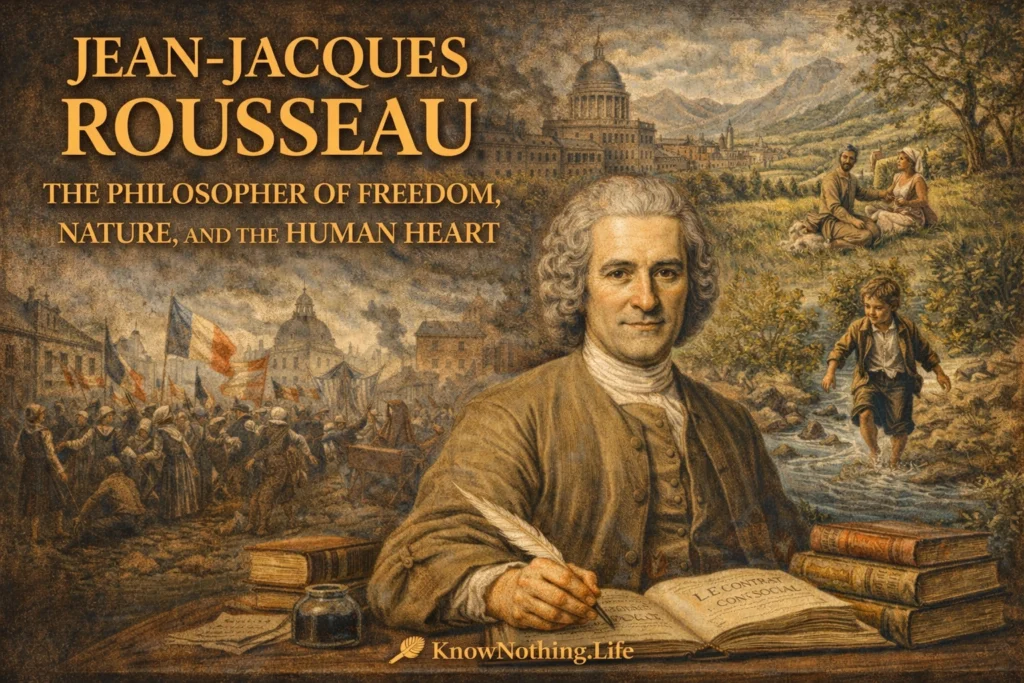
Few thinkers have influenced modern political and social thought as profoundly as Jean-Jacques Rousseau, whose writings reshaped ideas about freedom, equality, education, and the nature of society. Emerging during the Enlightenment—a period often defined by its faith in reason—Rousseau stood apart, challenging the era’s optimism by insisting that progress had corrupted humanity as much as it had elevated it. His work confronts a paradox that still resonates: how can individuals be truly free within the structures of civilization?
Rousseau’s philosophy is deeply personal, often blurring the line between intellectual argument and emotional reflection. Unlike many of his contemporaries, he did not seek to build purely abstract systems. Instead, he explored the inner life of human beings, arguing that understanding our natural instincts and moral sentiments is essential to building a just society. His writings continue to provoke debate, not only because of their radical ideas but because they address enduring tensions between individuality and collective life.
Early Life and Formative Experiences
Jean-Jacques Rousseau was born in 1712 in Geneva, a small republic known for its civic traditions and relative independence. His early life was marked by instability; his mother died shortly after his birth, and his father, a watchmaker, fled the city following a dispute. Rousseau’s upbringing lacked formal structure, yet it exposed him to literature at a young age, fostering a deep emotional connection to classical works and romantic narratives.
As a young man, Rousseau led a restless and often precarious life, moving between cities and occupations. His relationship with Madame de Warens, a benefactor and maternal figure, played a crucial role in his intellectual development. Under her influence, Rousseau was introduced to music, philosophy, and broader cultural currents, experiences that shaped his later reflections on human nature and society.
These formative years instilled in Rousseau a sense of alienation from conventional social institutions. He came to view society not as a source of stability, but as a force that distorts natural human goodness. This perspective would become a central theme in his philosophy, informing his critique of inequality and his vision of a more authentic way of living.
The Enlightenment and Rousseau’s Break from It
Rousseau is often associated with the Enlightenment, yet his relationship to the movement was complex and deeply ambivalent. While many Enlightenment thinkers celebrated reason, science, and progress, Rousseau questioned whether these developments truly improved human life. His first major work, the Discourse on the Arts and Sciences (1750), argued that the advancement of knowledge had led to moral decline rather than virtue.
This provocative claim set Rousseau apart from contemporaries such as Voltaire, with whom he had a famously contentious relationship. Where Voltaire championed reason and cultural refinement, Rousseau emphasized emotion, authenticity, and the moral dangers of artificial social norms. His critique extended beyond intellectual debates, challenging the very foundations of Enlightenment optimism.
Rousseau’s skepticism of progress was not a rejection of knowledge itself, but a warning about its consequences when divorced from moral considerations. He believed that true wisdom lies not in the accumulation of information, but in understanding the natural human condition. This perspective positioned him as both a participant in and a critic of the Enlightenment, a dual role that continues to define his legacy.
Major Works and Philosophical Contributions
Rousseau’s most influential ideas are articulated in a series of works that have become foundational texts in political and social philosophy. Among these, The Social Contract stands as his most famous and enduring contribution. In this work, Rousseau introduces the concept of the “general will,” arguing that legitimate political authority arises from the collective will of the people rather than from monarchy or tradition.
Another key text, Discourse on the Origin and Basis of Inequality Among Men, explores the development of social inequality and its roots in the emergence of private property. Rousseau contends that while humans are naturally equal, societal structures create divisions that lead to injustice and conflict. His analysis challenges readers to reconsider the origins of social hierarchies and the legitimacy of existing institutions.
In Emile, or On Education, Rousseau turns his attention to the development of the individual, proposing an educational philosophy that emphasizes natural growth and experiential learning. He argues that children should be allowed to develop according to their innate tendencies rather than being constrained by rigid societal expectations. Across these works, Rousseau consistently seeks to reconcile individual freedom with the demands of social life.
Human Nature and the Idea of the “Natural Man”
Central to Rousseau’s philosophy is his conception of human nature, particularly his idea of the “natural man.” He argued that in a pre-social state, humans were fundamentally good, guided by compassion and a basic instinct for self-preservation. This contrasts sharply with the view of Thomas Hobbes, who described the state of nature as a condition of constant conflict and insecurity.
Rousseau famously wrote, “Man is born free, and everywhere he is in chains,” a statement that encapsulates his belief that society imposes constraints that undermine natural freedom. For Rousseau, the problem is not human nature itself, but the structures of civilization that distort it. Social institutions, driven by competition and inequality, encourage individuals to seek status and recognition at the expense of authenticity.
Despite his critique of society, Rousseau did not advocate a return to a primitive state. Instead, he sought to identify ways in which social organization could align with human nature rather than oppose it. His vision of political and moral reform is rooted in the possibility of creating institutions that preserve freedom while fostering collective well-being.
The General Will and Political Philosophy
Rousseau’s concept of the general will is one of his most significant and controversial contributions to political theory. Unlike the sum of individual preferences, the general will represents the collective interest of the community as a whole. It is not simply what people want, but what they would choose if they considered the common good above personal advantage.
In The Social Contract, Rousseau argues that true freedom is achieved not by acting on individual desires, but by participating in the formation of laws that reflect the general will. This idea redefines freedom as a form of self-governance, where individuals obey laws they have collectively created. As he famously stated, individuals may be “forced to be free” when compelled to follow the general will, a phrase that has sparked extensive debate.
Rousseau’s political philosophy seeks to balance individual autonomy with collective authority, a tension that remains central to modern democratic theory. While his ideas have inspired movements for political reform and equality, they have also been criticized for their potential to justify authoritarianism. This dual legacy underscores the complexity and enduring relevance of his thought.
Education, Emotion, and the Inner Life
Beyond politics, Rousseau made significant contributions to the understanding of education and human psychology. In Emile, he presents a vision of education that prioritizes the natural development of the child, emphasizing curiosity, experience, and emotional growth. He believed that traditional education systems stifle individuality by imposing artificial standards and expectations.
Rousseau’s emphasis on emotion and authenticity also influenced the development of Romanticism, a cultural movement that celebrated individual expression and the beauty of nature. His autobiographical work, Confessions, is often regarded as one of the first modern autobiographies, offering an intimate exploration of his thoughts, feelings, and experiences. In it, he writes, “I am not made like any one I have been acquainted with, perhaps like no one in existence,” highlighting his commitment to self-examination and individuality.
This focus on the inner life distinguishes Rousseau from many of his contemporaries, who prioritized rational analysis over emotional insight. By exploring the complexities of human experience, he expanded the scope of philosophy to include not only how we think, but how we feel and live.
Legacy and Influence
Jean-Jacques Rousseau’s influence extends across philosophy, politics, education, and literature. His ideas played a crucial role in shaping the intellectual foundations of the French Revolution, inspiring calls for equality, popular sovereignty, and social reform. While his work was interpreted in various ways, his emphasis on the will of the people and the critique of inequality resonated deeply with revolutionary movements.
Rousseau’s impact can also be seen in the development of modern democratic theory, as well as in educational practices that emphasize student-centered learning. His exploration of human nature and emotion influenced not only philosophers but also writers and artists, contributing to broader cultural transformations.
Despite the controversies surrounding his ideas, Rousseau remains a central figure in the history of thought. His willingness to challenge prevailing assumptions and to explore the complexities of human existence ensures that his work continues to inspire and provoke. By confronting the tensions between freedom and society, reason and emotion, he opened new pathways for understanding what it means to live a meaningful and authentic life.
Final Thoughts
Jean-Jacques Rousseau’s philosophy is defined by its depth, its contradictions, and its enduring relevance. He invites readers to question the structures of society, to reflect on the nature of freedom, and to consider the possibility of a more just and authentic way of living. His work does not offer simple answers, but rather challenges us to engage with the complexities of human existence.
In an age still grappling with inequality, political authority, and the search for meaning, Rousseau’s ideas remain as vital as ever. His vision of a world in which individuals can be both free and connected continues to inspire those who seek to understand—and improve—the human condition.