John Dewey was born on October 20, 1859, in Burlington, Vermont, into a modest New England family whose values reflected the civic-minded and democratic spirit of the region. Unlike many of his philosophical contemporaries, Dewey did not emerge from aristocratic or elite intellectual circles. His early environment was grounded in practicality, community life, and moral responsibility, elements that would later shape his philosophical outlook. Dewey’s formative years were marked by a quiet intellectual curiosity rather than early brilliance, yet this steady development would ultimately lead him to become one of the most influential thinkers in American history.
He attended the University of Vermont, where he was introduced to philosophy through the works of Immanuel Kant and G.W.F. Hegel. Initially influenced by German idealism, Dewey’s early philosophical writings reflected an attempt to reconcile scientific inquiry with metaphysical systems. However, this orientation gradually shifted as he encountered evolutionary theory and the emerging field of psychology. The intellectual climate of the late nineteenth century, shaped by scientific progress and social change, pushed Dewey toward a more empirical and pragmatic approach, laying the foundation for his later work.
From Idealism to Pragmatism
Dewey’s transition from idealism to pragmatism represents one of the most significant developments in his intellectual career. Early in his academic life, he was influenced by the Hegelian tradition, which emphasized the unity of thought and reality. However, Dewey grew increasingly dissatisfied with abstract metaphysical systems that seemed disconnected from lived experience. His engagement with the ideas of William James and Charles Sanders Peirce played a crucial role in this transformation.
Pragmatism, as Dewey came to understand it, was not merely a philosophical doctrine but a method for addressing real-world problems. He rejected the notion that philosophy should seek eternal truths detached from human activity, arguing instead that ideas must be evaluated in terms of their practical consequences. This perspective aligned with his broader commitment to experience as the foundation of knowledge. For Dewey, thought was not an isolated activity but a tool for navigating and transforming the world.
His mature philosophical position emphasized the continuity between mind and environment, rejecting dualistic distinctions that separated thought from action. Dewey argued that knowledge emerges through interaction with the world, a process he described as “inquiry.” This dynamic view of knowledge challenged traditional epistemology and positioned philosophy as an active, problem-solving discipline. In this sense, Dewey extended the pragmatist tradition, developing it into a comprehensive framework for understanding human experience.
Education and the Laboratory School
Dewey’s most enduring contributions lie in the field of education, where he revolutionized both theory and practice. At the University of Chicago, he founded the Laboratory School, an experimental institution designed to test his ideas about learning and teaching. Dewey rejected traditional models of education that emphasized rote memorization and passive absorption of information. Instead, he advocated for an experiential approach, in which students actively engage with their environment and learn through doing.
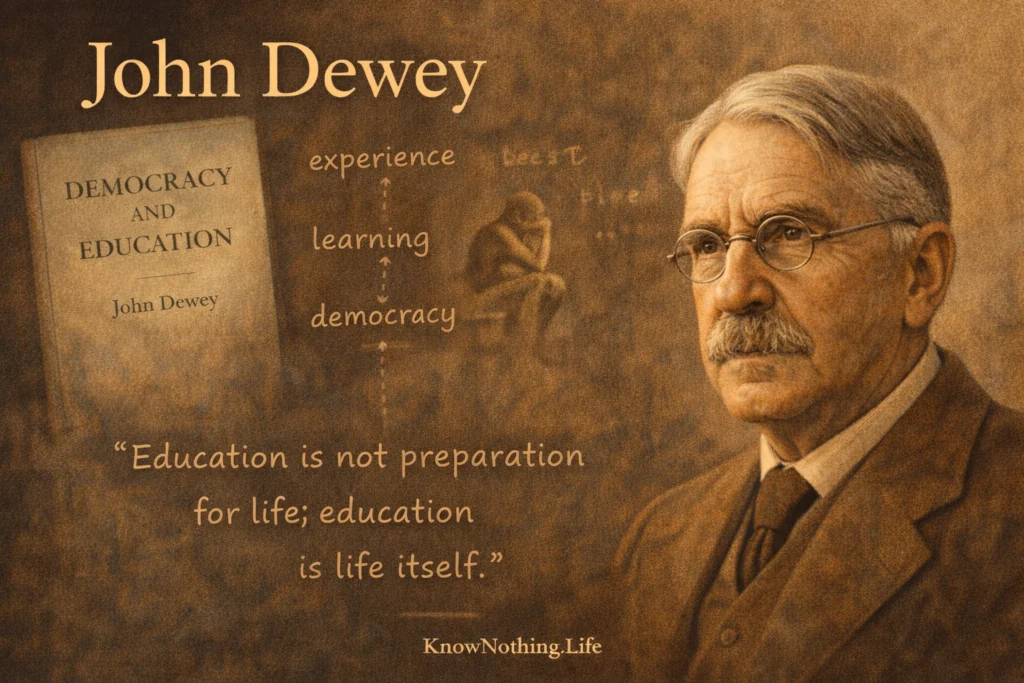
In his seminal work, Democracy and Education, Dewey articulated a vision of education as a fundamentally social process. He argued that schools should not merely transmit knowledge but cultivate the skills and habits necessary for democratic life. Education, in his view, was inseparable from democracy, as both depend on communication, participation, and shared experience. “Education is not preparation for life,” he wrote, “education is life itself,” capturing the essence of his philosophy.
Dewey’s educational theories emphasized the importance of critical thinking, creativity, and collaboration. He believed that students should be encouraged to question, experiment, and reflect, rather than simply accept established truths. This approach has had a lasting impact on educational practice, influencing progressive education movements around the world. His ideas continue to shape debates about curriculum, pedagogy, and the role of education in society.
Democracy, Society, and Public Life
Beyond education, Dewey was deeply engaged with questions of democracy and social organization. He viewed democracy not merely as a political system but as a way of life, grounded in communication, cooperation, and shared inquiry. In works such as The Public and Its Problems, Dewey explored the challenges facing modern democratic societies, including the impact of industrialization and the fragmentation of public life.
Dewey argued that democracy requires more than formal institutions; it depends on an informed and engaged citizenry capable of participating in collective decision-making. He was particularly concerned with the ways in which economic and technological changes could undermine democratic participation, creating barriers between individuals and the broader community. His response was to emphasize the role of education and communication in fostering a vibrant public sphere.
Throughout his life, Dewey was actively involved in political and social movements, advocating for labor rights, women’s suffrage, and educational reform. He believed that philosophy should not remain confined to academic discourse but should contribute to the improvement of society. This commitment to public engagement distinguishes Dewey from many of his contemporaries, reflecting his belief that philosophy must be both practical and socially relevant.
Experience, Inquiry, and Instrumentalism
Central to Dewey’s philosophy is the concept of experience, which he understood as an ongoing interaction between individuals and their environment. Unlike traditional empiricism, which often treated experience as passive observation, Dewey emphasized its active and dynamic nature. Experience, for him, is shaped by action, reflection, and adaptation, forming the basis for knowledge and understanding.
This perspective is closely linked to his theory of inquiry, which he described as a process of problem-solving that arises from situations of uncertainty. Inquiry involves identifying a problem, generating hypotheses, and testing them through experience. This method reflects Dewey’s broader commitment to scientific thinking, not as a rigid system but as a flexible approach to understanding the world. His philosophy of instrumentalism further develops this idea, suggesting that concepts and theories are tools for navigating experience rather than representations of an objective reality.
Dewey’s emphasis on inquiry and experience has had a profound influence on a wide range of disciplines, including education, psychology, and political theory. His work challenges us to rethink the relationship between knowledge and action, highlighting the importance of adaptability and creativity in a rapidly changing world. As he observed, “We do not learn from experience… we learn from reflecting on experience,” underscoring the central role of reflection in the process of learning.
Legacy and Enduring Influence
John Dewey’s legacy is vast, encompassing philosophy, education, and social theory. As one of the leading figures of pragmatism, he helped to shape a distinctly American philosophical tradition that emphasizes practicality, experience, and democratic values. His influence extends far beyond academia, affecting educational systems, public policy, and cultural discourse.
Dewey’s work remains relevant in contemporary discussions about the role of education, the nature of democracy, and the challenges of modern society. His insistence on the importance of critical thinking and active participation resonates in an era marked by rapid technological change and political uncertainty. By emphasizing the interconnectedness of knowledge, experience, and social life, Dewey offers a framework for addressing complex problems in a holistic and pragmatic manner.
He died on June 1, 1952, at the age of 92, leaving behind a body of work that continues to inspire and challenge thinkers across disciplines. His philosophy invites us to view knowledge not as a static possession but as an ongoing process of inquiry and engagement. In this sense, Dewey’s thought embodies a spirit of openness and adaptability, encouraging us to approach the world with curiosity, creativity, and a commitment to democratic ideals.
Through his writings and actions, John Dewey demonstrated that philosophy can be both intellectually rigorous and socially transformative. His vision of a society grounded in education, communication, and shared experience remains a powerful ideal, one that continues to shape the way we think about learning, democracy, and the human condition.