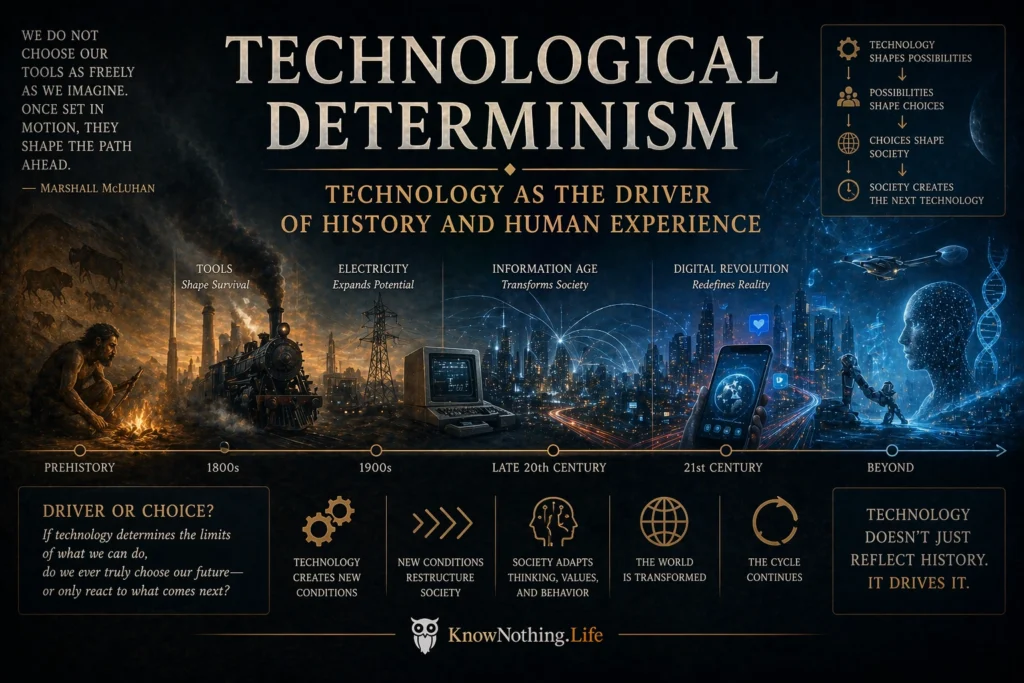
Technological determinism is the theory that technological development shapes society’s structure, values, and historical trajectory in a decisive and often inevitable way. At its strongest, it claims that technology is not merely a tool used by humans, but a force that directs human behavior, social organization, and even thought itself. From the invention of writing to the rise of artificial intelligence, technological determinism frames these shifts not as neutral innovations but as catalysts that fundamentally reorganize human life.
This perspective has long occupied a central place in discussions within philosophy, sociology, and media theory. It raises profound questions: Are humans in control of technology, or does technology ultimately control us? Does innovation arise from human needs and values, or do new tools reshape those needs and values after their emergence? Technological determinism does not offer a single answer, but rather a spectrum of positions—ranging from hard determinism, where technology dictates outcomes, to softer versions that acknowledge interaction between human agency and technological development.
Understanding technological determinism is essential in the modern era, where rapid innovation in digital systems, biotechnology, and automation is transforming every aspect of life. Whether one accepts or critiques it, the theory provides a powerful framework for interpreting how tools and systems influence the direction of civilization.
Historical Foundations of Technological Determinism
The roots of technological determinism can be traced to early reflections on tools and production in human history. One of the most influential figures associated with proto-determinist thinking is Karl Marx, who argued that the “forces of production”—including tools and technologies—shape economic systems and social relations. Although Marx emphasized human labor and class struggle, his analysis suggests that technological advancement drives transformations in societal structure, from feudalism to capitalism and beyond.
In the twentieth century, technological determinism gained prominence through thinkers like Marshall McLuhan, who famously declared that “the medium is the message.” McLuhan argued that communication technologies—print, radio, television—reshape not just what people think, but how they think. According to him, each medium creates a distinct sensory and cognitive environment, influencing perception, attention, and social interaction. The printing press, for example, encouraged linear, individualistic thinking, while electronic media fostered immediacy and interconnectedness.
Other scholars expanded on these ideas, examining how infrastructure systems—such as transportation networks, industrial machinery, and later digital platforms—structure daily life. These perspectives collectively contributed to the development of technological determinism as a framework for understanding history, emphasizing that shifts in technology often precede and condition broader cultural and institutional change.
Hard vs. Soft Technological Determinism
Technological determinism exists along a spectrum, with “hard” and “soft” versions representing its two main poles. Hard determinism posits that technology develops according to its own internal logic and inevitably shapes society in predictable ways. In this view, once a technology emerges, its consequences unfold regardless of human intention. For example, the invention of the internet inevitably leads to globalization, information abundance, and changes in political power structures.
This strong version often portrays humans as largely passive recipients of technological change. It suggests that societal adaptation is reactive rather than proactive, and that resistance to technological progress is ultimately futile. Critics argue that this view oversimplifies the complex interplay between technology and society, ignoring cultural, political, and economic factors that influence how technologies are adopted and used.
Soft technological determinism, by contrast, acknowledges that while technology exerts significant influence, human choices and social contexts shape its development and impact. Technologies open possibilities and constraints, but they do not dictate a single outcome. For instance, social media platforms can foster both democratic engagement and misinformation, depending on how they are designed, regulated, and used. This more nuanced perspective allows for agency, recognizing that societies can guide technological trajectories through policy, ethics, and collective decision-making.
Technology and Social Change
Technological determinism offers a compelling lens for understanding major transformations in human history. The Agricultural Revolution, for example, introduced tools and techniques that enabled settled communities, leading to the rise of cities, governments, and complex social hierarchies. Similarly, the Industrial Revolution brought mechanization and factory production, fundamentally altering labor, urbanization, and economic systems.
In the modern era, digital technologies have reshaped communication, work, and identity. The rise of smartphones and the internet has created a world in which information is instantly accessible, social interactions are mediated by platforms, and economic activity increasingly occurs in virtual spaces. From a determinist perspective, these changes are not incidental but are direct consequences of technological innovation.
At the same time, technological determinism highlights how new tools can disrupt existing power structures. Innovations often redistribute power, creating new elites while displacing old ones. For instance, the shift from traditional media to digital platforms has transformed who controls information and how it is disseminated. This dynamic underscores the idea that technology is not neutral; it actively shapes the conditions under which social and political life unfolds.
Critiques of Technological Determinism
Despite its explanatory power, technological determinism has been widely criticized for its reductionism. One major critique is that it neglects the role of human agency, treating individuals and societies as passive in the face of technological change. Critics argue that people actively interpret, adapt, and sometimes resist technologies, leading to outcomes that cannot be predicted solely by the technology itself.
Another critique focuses on the social construction of technology (SCOT), a framework that emphasizes how social, cultural, and political factors influence technological development. From this perspective, technologies are not inevitable products of progress but are shaped by human decisions, interests, and power dynamics. For example, the design of a platform or device reflects the priorities of its creators, as well as the economic and regulatory environment in which it emerges.
Additionally, technological determinism can obscure ethical responsibility by implying that harmful consequences are unavoidable. If technology is seen as an autonomous force, it becomes easier to absolve individuals and institutions of accountability for how it is used. Critics argue that this perspective is particularly dangerous in areas like artificial intelligence and surveillance, where human choices have profound ethical implications.
Technological Determinism in the Digital Age
In the twenty-first century, technological determinism has taken on renewed relevance as digital systems become increasingly integrated into daily life. Artificial intelligence, big data, and automation are not only transforming industries but also raising fundamental questions about human identity, autonomy, and the future of work. Determinist interpretations suggest that these technologies will inevitably lead to greater efficiency, but also to job displacement and new forms of inequality.
Social media provides another powerful example. Platforms shape how information spreads, how communities form, and how individuals perceive themselves and others. Algorithms influence what people see and engage with, subtly guiding attention and behavior. From a determinist viewpoint, these systems are not merely tools but environments that structure social reality.
However, the digital age also illustrates the limits of strict determinism. Public debates over privacy, regulation, and ethical design demonstrate that societies can influence how technologies evolve. Governments, organizations, and users all play roles in shaping technological outcomes, suggesting that while technology exerts strong pressures, it does not operate in isolation from human values and decisions.
Conclusion
Technological determinism offers a powerful framework for understanding the relationship between innovation and social change. By emphasizing the influence of technology on human life, it highlights patterns and transformations that might otherwise go unnoticed. From early tools to advanced digital systems, technology has undeniably played a central role in shaping history and human experience.
At the same time, the theory’s limitations remind us that technology is not an unstoppable force acting independently of human agency. While it creates possibilities and constraints, the ways in which it is developed, implemented, and used are deeply intertwined with social, cultural, and ethical considerations. Recognizing this interplay allows for a more balanced understanding—one that acknowledges the power of technology without surrendering the importance of human responsibility.