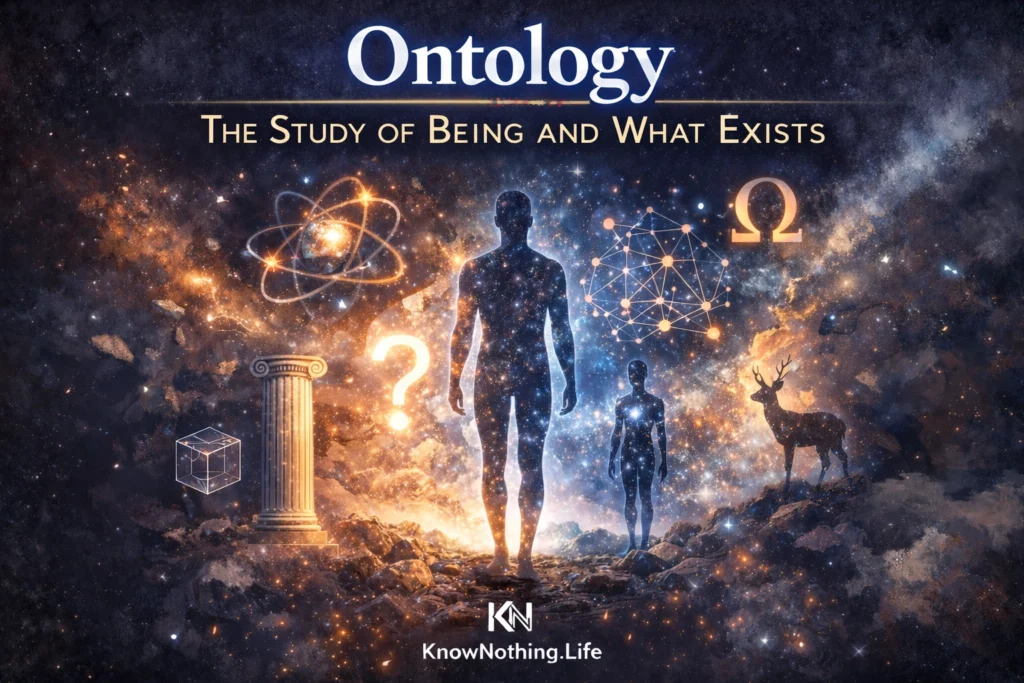
Ontology is the branch of philosophy that investigates the nature of being, existence, and reality at the most fundamental level. While metaphysics broadly explores the structure of reality, ontology focuses more specifically on what exists and how different kinds of entities can be categorized. It asks deceptively simple questions: What is there? What does it mean for something to exist? Are all things equally real, or are there different modes of being?
These questions are not merely abstract. Ontological assumptions shape how humans interpret the world, from scientific classification to personal identity. Whether one believes that only physical objects exist, or that abstract concepts like numbers and ideas have a form of reality, depends on ontological commitments. As Willard Van Orman Quine famously put it, “To be is to be the value of a variable.” This statement reflects the idea that existence is tied to what our best theories require us to acknowledge as real.
The Origins of Ontological Inquiry
Ontology traces its roots back to ancient philosophy, particularly the work of Parmenides, who argued that reality is singular, unchanging, and eternal. In his poem On Nature, Parmenides claimed that change and plurality are illusions, asserting, “What is, is; and what is not, is not.” This radical view established a foundational tension in ontology: whether reality is fundamentally static or dynamic.
In contrast, Heraclitus emphasized constant change, proposing that everything is in flux. His famous insight, “Everything flows,” suggests that stability is an illusion and that being is inseparable from becoming. These opposing perspectives laid the groundwork for centuries of ontological debate.
Later, Plato and Aristotle expanded these ideas into more systematic frameworks. Plato’s theory of Forms posited that true being belongs to abstract, eternal entities, while the physical world is a realm of imperfect copies. Aristotle, in his work Metaphysics, rejected this separation and introduced a more grounded ontology based on substances—individual entities that combine form and matter. These early contributions continue to influence how philosophers conceptualize existence.
Categories of Being
One of the central tasks of ontology is to classify different kinds of entities. Aristotle was among the first to develop a system of categories, distinguishing between substance, quantity, quality, relation, and other modes of being. Substance, for Aristotle, is primary—it refers to individual things that exist independently, such as a tree or a person.
This framework raises enduring questions: Are abstract entities like numbers or concepts real in the same way as physical objects? Plato would argue that they are even more real, existing in a higher, unchanging realm. By contrast, nominalists deny the independent existence of universals, claiming that only particular objects exist and that general terms are merely linguistic conveniences.
In modern philosophy, these debates evolved into discussions about realism and anti-realism. Realists maintain that certain entities—such as mathematical objects or moral values—exist independently of human thought. Anti-realists argue that such entities are constructed or dependent on perception. These distinctions illustrate how ontology is not just about listing what exists, but about understanding the nature and status of different kinds of existence.
Identity and Persistence
Ontology also examines how entities maintain their identity over time. What does it mean for something to remain the same despite change? This question, known as the problem of identity, has been explored through thought experiments such as the Ship of Theseus: if every part of a ship is replaced over time, is it still the same ship?
Philosophers have proposed various answers. Some argue for essentialism, the idea that objects possess core properties that define their identity. John Locke, however, offered a more psychological approach in An Essay Concerning Human Understanding, suggesting that personal identity is based on continuity of consciousness rather than physical substance. According to Locke, memory plays a crucial role in maintaining the sense of self.
In contrast, David Hume rejected the notion of a stable self altogether. He argued that what we call the “self” is merely a bundle of perceptions, constantly changing and lacking a fixed essence. Hume wrote, “I never can catch myself at any time without a perception.” This view challenges the assumption that identity is something permanent, suggesting instead that it is fluid and constructed.
Existence and Reality
A key ontological question concerns the nature of existence itself. Is existence a property that objects possess, or is it something more fundamental? Immanuel Kant famously argued that existence is not a predicate—that is, it does not add anything to the concept of a thing. In his critique of the ontological argument for God’s existence, Kant demonstrated that simply defining something as existing does not make it real.
This insight has profound implications. It suggests that existence cannot be understood in the same way as other properties like color or shape. Instead, it may be a condition for having properties at all. Martin Heidegger took this idea further, arguing that the question of being had been neglected by Western philosophy. In Being and Time, he explored the meaning of existence through the concept of Dasein, or human being, emphasizing that existence is always situated and contextual.
Heidegger’s work shifted ontology away from abstract categorization toward lived experience. Rather than asking what exists in a detached sense, he focused on how beings encounter and interpret the world. This perspective highlights the inseparability of ontology and human existence, suggesting that understanding being requires examining the conditions under which it is experienced.
Ontology in Language and Logic
In the 20th century, ontology became closely linked with language and logic. Philosophers began to analyze how linguistic structures reflect ontological commitments. Willard Van Orman Quine argued that our ontological beliefs are revealed by the entities our theories must assume in order to function. This approach shifted ontology from speculation to analysis, grounding it in formal systems.
Similarly, Bertrand Russell developed logical frameworks to clarify the nature of existence. His theory of descriptions demonstrated how language can create the illusion of referring to entities that do not actually exist, such as fictional characters. By analyzing the structure of statements, Russell showed that not all apparent references correspond to real objects.
These developments transformed ontology into a more precise discipline, integrating it with logic and semantics. They also highlighted the importance of clarity in philosophical inquiry, showing that many ontological problems arise from misunderstandings of language. In this way, ontology became not only a study of being, but also a study of how we talk about being.
Contemporary Ontology and Its Applications
Today, ontology extends beyond philosophy into fields such as computer science, artificial intelligence, and information science. In these contexts, an ontology is a structured representation of knowledge, defining categories and relationships between entities. This practical application reflects the enduring relevance of ontological thinking.
Philosophically, contemporary debates continue to explore questions about the nature of reality. Discussions about virtual worlds, digital identities, and artificial intelligence raise new ontological issues. For example, do virtual objects “exist” in the same way as physical ones? What kind of being does a digital identity possess? These questions blur the boundaries between traditional categories.
Ontology also plays a role in science, particularly in discussions about the fundamental structure of the universe. Whether reality is composed of particles, fields, or something more abstract depends on ontological assumptions. As scientific theories evolve, so too does our understanding of what exists, demonstrating the dynamic relationship between ontology and empirical knowledge.
Conclusion
Ontology is the philosophical study of being at its most fundamental level, seeking to understand what exists and how it exists. From the early insights of Parmenides and Heraclitus to the sophisticated analyses of modern thinkers, it has remained a central concern of philosophy. By examining categories of being, identity, existence, and language, ontology provides a framework for understanding reality itself.
It challenges assumptions, clarifies concepts, and reveals the hidden structures underlying everyday experience. As Martin Heidegger observed, “To think being explicitly requires disregarding being to the extent that it is only implicitly thought.” In a rapidly changing world, ontology offers a stable yet evolving foundation for inquiry. It reminds us that before we can understand anything else, we must first ask the most basic question: what is there?