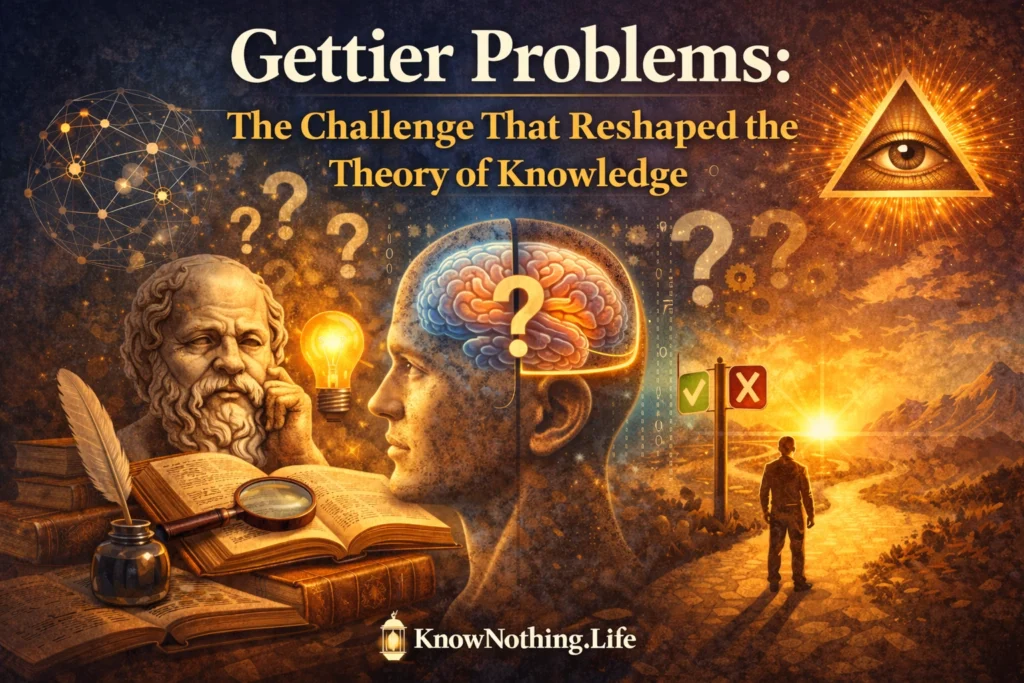
Few philosophical developments have had as immediate and lasting an impact as the introduction of Gettier problems. In 1963, Edmund Gettier published a brief paper titled Is Justified True Belief Knowledge? that fundamentally altered the course of epistemology. In just a few pages, Gettier demonstrated that the long-standing definition of knowledge as justified true belief (JTB) was insufficient. His argument was deceptively simple, yet its implications were profound.
For centuries, philosophers had largely accepted that knowledge consists of beliefs that are true and justified. This classical framework, rooted in Plato’s discussions in Theaetetus, appeared to capture the essence of knowledge. Gettier’s insight was not to reject these components, but to show that even when all three conditions are satisfied, something can still be missing. The result is a belief that is true and justified, yet intuitively not knowledge.
Gettier problems have since become a central focus of epistemology, inspiring decades of debate and a wide range of proposed solutions. They expose a subtle but critical issue: the role of luck in knowledge. By highlighting how truth and justification can coincide accidentally, Gettier forced philosophers to reconsider what it means to truly know something.
The Structure of Gettier Cases
At the heart of Gettier problems are carefully constructed scenarios that reveal a gap between justified true belief and knowledge. These cases typically involve a subject who forms a belief based on strong evidence, yet the belief’s truth is ultimately due to coincidence rather than a reliable connection to reality.
One of Gettier’s original examples involves two individuals, Smith and Jones. Smith has strong evidence that Jones will get a job and that Jones has ten coins in his pocket. Based on this, Smith concludes that the person who will get the job has ten coins in their pocket. However, unknown to Smith, he himself will get the job—and he also happens to have ten coins in his pocket. Smith’s belief is justified and true, yet it seems wrong to say that he knew it.
The structure of such cases reveals a key insight: justification can be disconnected from the truth of a belief. The reasoning process appears sound, yet the outcome depends on an element of luck. This disconnect undermines the idea that justification alone can secure knowledge. As a result, Gettier cases demonstrate that knowledge requires more than just belief, truth, and justification—it requires the absence of certain kinds of epistemic luck.
Epistemic Luck and Its Implications
The concept of epistemic luck lies at the core of Gettier problems. A belief is subject to epistemic luck when it happens to be true despite factors that could easily have made it false. In such cases, the truth of the belief is not securely tied to the justification that supports it.
Philosophers have distinguished between different types of epistemic luck. Veritic luck, for example, occurs when a belief is true by accident, while reflective luck involves situations where the subject cannot distinguish between reliable and unreliable methods of belief formation. Gettier cases primarily highlight veritic luck, showing that a belief can be both justified and true while still being correct only by chance.
This insight has far-reaching implications. It suggests that knowledge must involve a stronger connection between belief and truth than previously assumed. The mere presence of justification is not enough; the justification must be appropriately related to the truth of the belief. This requirement has driven the search for new theories of knowledge that can account for and eliminate epistemic luck.
Responses to Gettier Problems
The philosophical response to Gettier problems has been extensive and varied. One of the earliest attempts to resolve the issue was the “no false lemmas” approach, which adds a fourth condition to the JTB framework: a belief must not be derived from any false premises. While this modification addresses some Gettier cases, it fails to eliminate all instances of epistemic luck.
Another influential response is reliabilism, developed by philosophers such as Alvin Goldman. According to reliabilism, a belief counts as knowledge if it is produced by a reliable cognitive process—one that tends to generate true beliefs. This approach shifts the focus from justification as conscious reasoning to the objective reliability of belief-forming mechanisms. By emphasizing reliability, reliabilism aims to ensure a stronger connection between belief and truth.
Virtue epistemology offers a different solution by focusing on the intellectual character of the knower. Drawing on ideas from Aristotle, this approach argues that knowledge arises from the exercise of intellectual virtues such as careful reasoning and intellectual honesty. A belief qualifies as knowledge when it is the result of the knower’s cognitive abilities functioning properly. This perspective reframes knowledge as an achievement rather than merely a state of belief.
Despite these efforts, no single solution has achieved universal acceptance. Gettier problems continue to challenge philosophers, suggesting that the nature of knowledge may be more complex than any simple definition can capture.
Internalism, Externalism, and the Debate Over Justification
The impact of Gettier problems extends beyond the definition of knowledge to broader debates about justification. One major division is between internalism and externalism, two competing views about what it means for a belief to be justified.
Internalists argue that justification depends on factors accessible to the subject’s conscious awareness. From this perspective, a belief is justified only if the individual can reflect on the reasons supporting it. Gettier cases pose a challenge for internalism because they show that even well-justified beliefs, from the subject’s perspective, can fail to be knowledge due to hidden factors.
Externalists, by contrast, emphasize factors outside the subject’s awareness. They argue that justification—and thus knowledge—depends on the reliability of the processes that produce beliefs. Reliabilism is a key example of this approach. By focusing on objective reliability, externalism seeks to avoid the pitfalls revealed by Gettier cases.
This debate highlights a deeper question: should knowledge be defined in terms of what the knower can access and justify, or in terms of how beliefs are actually formed and connected to truth? Gettier problems do not settle this issue, but they have intensified the discussion, pushing epistemology toward more nuanced accounts of justification.
The Enduring Significance of Gettier Problems
The significance of Gettier problems lies not only in their critique of justified true belief but in their broader impact on epistemology. By exposing the role of luck in knowledge, Gettier shifted the focus of philosophical inquiry toward the relationship between belief, justification, and truth.
Subsequent developments in epistemology, including contextualism and pragmatic approaches, can be seen as responses to the challenges raised by Gettier. These perspectives explore how knowledge claims vary depending on context or practical considerations, offering alternative ways of understanding the conditions under which knowledge is attributed.
Gettier’s work also underscores the importance of thought experiments in philosophy. His cases demonstrate how carefully constructed scenarios can reveal hidden assumptions and test the limits of theoretical frameworks. In this sense, Gettier problems are not merely objections but tools for advancing philosophical understanding.
As Edmund Gettier himself showed, even a brief argument can have a transformative effect when it targets a fundamental concept. The enduring relevance of Gettier problems reflects their ability to challenge deeply held assumptions and inspire ongoing inquiry into the nature of knowledge.
Conclusion
Gettier problems represent a turning point in the philosophy of knowledge. By demonstrating that justified true belief is not sufficient for knowledge, Edmund Gettier forced philosophers to reconsider one of the most basic assumptions in epistemology. His work revealed that knowledge cannot be reduced to a simple combination of belief, truth, and justification.
The debates that followed have enriched epistemology, leading to new theories and a deeper understanding of the complexities involved in knowing. From reliabilism to virtue epistemology, each response reflects an attempt to capture what distinguishes knowledge from mere true belief.
As Plato suggested in Theaetetus, the nature of knowledge is not easily defined. Gettier problems remind us that even the most intuitive theories can harbor hidden flaws. By confronting these challenges, philosophy continues to refine its understanding of knowledge, ensuring that the question of what it means to know remains as vital and compelling as ever.