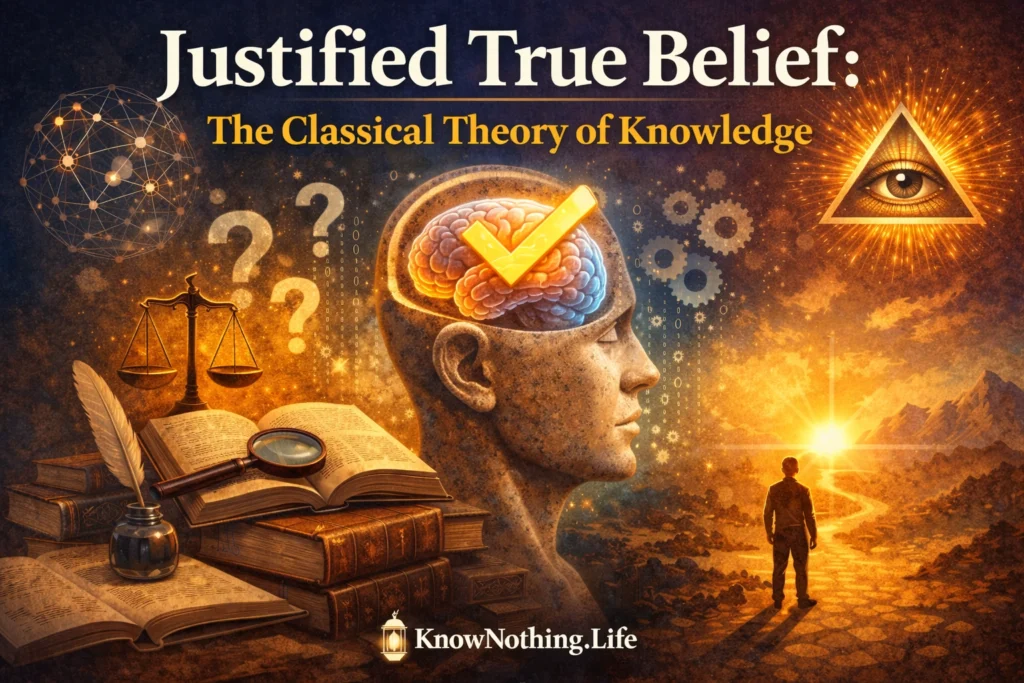
Few ideas in philosophy have exerted as much influence on the study of knowledge as the concept of justified true belief (JTB). For centuries, this framework served as the standard definition of what it means to know something. At its core, the theory proposes that knowledge arises when three conditions are satisfied: a belief is held, it is true, and it is justified. Though simple in structure, this formulation has generated some of the most intricate and enduring debates in epistemology.
The roots of justified true belief can be traced to Plato, particularly in his dialogue Theaetetus. While Plato ultimately leaves the definition unresolved, his exploration laid the groundwork for later philosophers who sought to formalize the concept of knowledge. Over time, JTB became widely accepted as a comprehensive account, appearing to capture both the objective and subjective dimensions of knowing.
However, the apparent clarity of justified true belief masks deeper philosophical tensions. Questions arise about the nature of justification, the role of truth, and the possibility of error or luck. These issues culminated in one of the most significant turning points in modern philosophy: the challenge posed by Edmund Gettier in the 20th century. His critique reshaped epistemology and forced philosophers to reconsider whether JTB can truly define knowledge.
The Components of Justified True Belief
The strength of the JTB model lies in its three-part structure, each component addressing a crucial aspect of knowledge. First, belief is necessary because knowledge requires a mental commitment. One cannot be said to know something without believing it; knowledge is not merely external truth but involves the knower’s internal acceptance. This distinguishes knowledge from information that is true but not recognized or endorsed by an individual.
Second, truth ensures that knowledge corresponds to reality. A false belief, no matter how convincing, cannot count as knowledge. This condition reflects a long-standing philosophical commitment to objectivity. As Aristotle famously articulated, “to say of what is that it is, and of what is not that it is not, is true.” Truth anchors knowledge in the world, preventing it from collapsing into mere opinion or illusion.
Third, justification provides the reasoning or evidence that supports a belief. Without justification, a belief might be true by coincidence rather than by understanding. Justification distinguishes knowledge from lucky guesses, ensuring that the belief is formed through reliable or rational means. Together, these three components form a compelling account of knowledge—one that appears to balance subjective belief with objective truth and rational support.
Plato’s Influence and the Origins of JTB
The concept of justified true belief emerges most clearly in Theaetetus, where Plato examines several definitions of knowledge. One proposal suggests that knowledge is true belief accompanied by an account or explanation—an early formulation of justification. While Plato ultimately rejects this definition, his analysis highlights the necessity of distinguishing knowledge from mere true belief.
Plato illustrates this distinction through analogies that emphasize the instability of true belief without justification. A person might arrive at a correct conclusion by chance, but without understanding the reasons behind it, their belief lacks the stability required for knowledge. This insight anticipates later concerns about epistemic luck, showing that justification is essential for transforming belief into something more secure.
Although Plato did not settle the issue, his exploration set the stage for centuries of philosophical inquiry. Later thinkers built upon his ideas, refining the concept of justification and integrating it into broader epistemological systems. The enduring influence of Theaetetus demonstrates how foundational Plato’s work remains in shaping the understanding of knowledge.
The Gettier Problem: A Turning Point
For much of philosophical history, justified true belief was regarded as an adequate definition of knowledge. This consensus was dramatically challenged in 1963 by Edmund Gettier in his paper Is Justified True Belief Knowledge?. Gettier presented brief but powerful counterexamples showing that JTB could be satisfied even when knowledge seemed absent.
In a typical Gettier case, an individual holds a belief that is justified and true, yet its truth arises from an element of luck rather than a reliable connection to reality. For instance, a person might have strong evidence for a claim that turns out to be false, but by coincidence, a related statement they infer from it happens to be true. Although the belief meets all three conditions of JTB, it does not intuitively qualify as knowledge.
These cases revealed a fundamental flaw in the classical definition: it fails to exclude epistemic luck. Gettier’s challenge sparked an explosion of philosophical responses, each محاولة to refine or replace the JTB model. Some proposed adding a fourth condition to eliminate luck, while others sought entirely new frameworks for understanding knowledge. The Gettier problem remains one of the most influential developments in modern epistemology.
Responses and Alternative Theories
In response to Gettier’s critique, philosophers have developed a range of alternative theories aimed at preserving the core insights of JTB while addressing its shortcomings. One approach involves adding a “no false lemmas” condition, which requires that the justification for a belief must not depend on any false assumptions. While this modification addresses some Gettier cases, it does not resolve all of them.
Another influential response is reliabilism, associated with thinkers like Alvin Goldman. This theory shifts the focus from justification as conscious reasoning to the reliability of the processes that produce beliefs. If a belief arises from a generally reliable method—such as perception under normal conditions—it may count as knowledge even if the individual cannot articulate the justification.
Virtue epistemology offers a different perspective by emphasizing the intellectual character of the knower. Drawing on ideas from Aristotle, this approach views knowledge as the result of intellectual virtues such as careful reasoning and intellectual honesty. Knowledge, in this sense, is not merely a property of beliefs but an achievement of a well-functioning cognitive agent. These diverse responses illustrate the ongoing effort to refine the concept of knowledge in light of Gettier’s challenge.
Justification Revisited: Internalism vs. Externalism
One of the most significant debates arising from the critique of JTB concerns the nature of justification itself. Philosophers have divided into two main camps: internalists and externalists. Internalists argue that justification depends on factors accessible to the individual’s conscious awareness. To be justified, a belief must be supported by reasons or evidence that the knower can reflect upon.
Externalists, by contrast, contend that justification can depend on factors outside the individual’s awareness. According to this view, what matters is not whether the knower can articulate their reasons, but whether the belief is produced by a reliable process. Reliabilism, for example, is a form of externalism that emphasizes the objective functioning of cognitive systems.
This debate reflects deeper questions about the nature of knowledge and the role of the knower. Should knowledge be understood in terms of subjective justification, or should it be grounded in objective reliability? The tension between these perspectives continues to shape contemporary epistemology, highlighting the complexity of defining knowledge in a way that captures both its internal and external dimensions.
Conclusion
The theory of justified true belief stands as one of the most influential and enduring ideas in the philosophy of knowledge. Its elegant simplicity offers a compelling framework for understanding how belief, truth, and justification interact to produce knowledge. Yet its limitations, exposed most notably by Edmund Gettier, reveal that the nature of knowledge is more complex than this classical model suggests.
Rather than rendering JTB obsolete, these challenges have deepened philosophical inquiry, prompting new theories and perspectives that continue to refine our understanding of knowledge. From reliabilism to virtue epistemology, each response builds upon the foundation laid by the classical definition while addressing its shortcomings.
As Plato observed, “Knowledge which is acquired under compulsion obtains no hold on the mind.” This insight underscores the importance of justification and understanding in distinguishing knowledge from mere belief. The ongoing debate over justified true belief reflects the enduring significance of epistemology itself—a discipline that continues to explore one of humanity’s most fundamental questions: what does it mean to know?