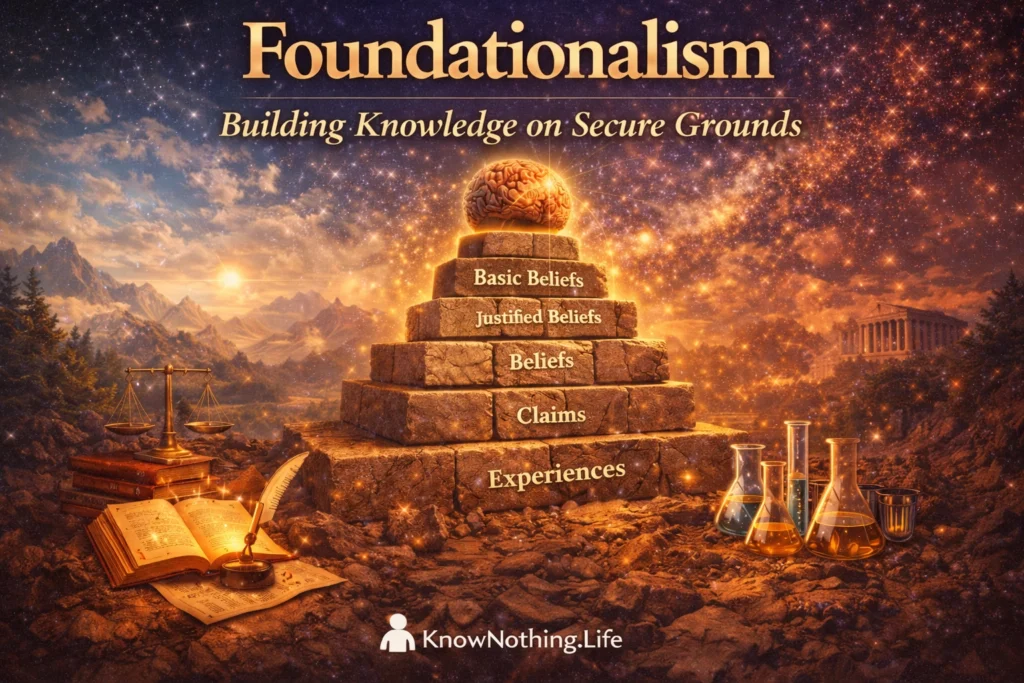
Foundationalism is one of the most influential theories of justification in epistemology, proposing that knowledge is structured upon a base of fundamental philosophical beliefs. According to this view, not all beliefs require justification from other beliefs; instead, some beliefs are self-evident, indubitable, or directly justified and serve as the foundation for all other knowledge. These foundational beliefs provide the stability needed to avoid skepticism and infinite regress.
The appeal of foundationalism lies in its intuitive clarity. Just as a building requires a stable base to support its structure, knowledge requires certain beliefs that do not depend on further justification. Without such foundations, every belief would require another belief to justify it, leading either to an endless chain or circular reasoning. Foundationalism seeks to resolve this problem by identifying beliefs that can stand on their own.
The theory has been shaped by philosophers such as René Descartes, John Locke, and more recently Roderick Chisholm. Each has contributed to defining what counts as a foundational belief and how such beliefs support the broader structure of knowledge. While foundationalism remains widely discussed, it has also faced significant criticism, leading to ongoing debates about its viability.
The Structure of Foundationalism
At its core, foundationalism divides beliefs into two categories: basic (or foundational) beliefs and non-basic beliefs. Basic beliefs are justified independently of other beliefs, while non-basic beliefs derive their justification from their relationship to these foundational beliefs. This hierarchical structure ensures that justification ultimately rests on a secure base.
The concept of basic beliefs is central to foundationalism. These beliefs are often thought to arise from direct experience, such as sensory perception or introspection. For example, the belief that one is experiencing pain or seeing a color may be considered foundational because it does not depend on inference or reasoning. Such beliefs are typically regarded as self-justifying or immediately evident.
Non-basic beliefs, by contrast, are justified through their connection to foundational beliefs. For instance, the belief that there is a tree outside may be supported by perceptual experiences that serve as foundational beliefs. This structure allows for complex systems of knowledge to be built upon a relatively small set of basic beliefs, providing both stability and coherence.
Descartes and the Search for Indubitable Foundations
The modern formulation of foundationalism is closely associated with René Descartes, whose work Meditations on First Philosophy represents a systematic attempt to establish a secure foundation for knowledge. Descartes begins by doubting all beliefs that can be called into question, seeking to identify those that remain certain even under radical skepticism.
Through this process, Descartes arrives at the famous conclusion, “Cogito, ergo sum” (“I think, therefore I am”). This belief, he argues, is indubitable because it is self-verifying: the very act of doubting confirms the existence of the thinker. The cogito thus serves as a foundational belief upon which further knowledge can be built.
Descartes’ approach reflects a strong version of foundationalism, often referred to as classical foundationalism. In this model, foundational beliefs must be absolutely certain and immune to doubt. While this standard provides a robust defense against skepticism, it also raises questions about whether such indubitable beliefs are sufficient to support the full range of human knowledge.
Empiricist Foundationalism: Locke and Experience
While Descartes’ foundationalism is rooted in reason, empiricist philosophers developed an alternative version based on experience. John Locke, in An Essay Concerning Human Understanding, argues that knowledge originates from sensory experience and reflection.
For Locke, foundational beliefs are derived from immediate experience, such as sensations and perceptions. These experiences provide the raw data from which more complex beliefs are constructed. Unlike Descartes, Locke does not require absolute certainty for foundational beliefs; instead, he emphasizes their directness and immediacy.
This empiricist version of foundationalism broadens the scope of basic beliefs, allowing for a more flexible account of knowledge. However, it also raises concerns about the reliability of sensory experience. If perception can be deceptive, then the foundational beliefs based on it may not be as secure as foundationalism requires.
The Regress Problem and Foundationalism’s Appeal
One of the primary motivations for foundationalism is the regress problem in epistemology. If every belief requires justification by another belief, then we face three possibilities: an infinite regress of justifications, circular reasoning, or a stopping point in the form of foundational beliefs.
Foundationalism resolves this problem by positing basic beliefs that do not require further justification. These beliefs serve as the endpoint of justification, preventing the regress from continuing indefinitely. This solution provides a clear and structured account of how knowledge can be justified.
The appeal of foundationalism lies in its ability to offer a stable basis for knowledge while avoiding the pitfalls of infinite regress and circularity. It provides a framework in which beliefs can be systematically justified, ensuring that knowledge is grounded in secure foundations. However, the success of this approach depends on whether such foundational beliefs can be adequately identified and defended.
Critiques of Foundationalism
Despite its strengths, foundationalism has faced significant criticism. One major challenge concerns the nature of basic beliefs. Critics argue that it is difficult to identify beliefs that are truly self-justifying or immune to error. Even seemingly immediate experiences, such as perception, can be influenced by interpretation and bias.
Another criticism comes from coherentists, who argue that justification does not require a foundation but instead arises from the coherence of a belief system. According to this view, the hierarchical structure of foundationalism is unnecessary, and knowledge can be understood as a network of mutually supporting beliefs.
Philosophers such as Wilfrid Sellars have also challenged the idea of the “given”—the notion that certain beliefs are directly and unproblematically given to the mind. Sellars argues that all knowledge involves conceptual interpretation, undermining the idea of purely foundational beliefs. These critiques have led to the development of alternative theories and revisions of foundationalism.
Contemporary Foundationalism
In response to these criticisms, contemporary philosophers have developed more moderate forms of foundationalism. These approaches relax the requirement of absolute certainty, allowing for foundational beliefs that are fallible but still justified. This shift reflects a broader trend in epistemology toward fallibilism—the view that knowledge can exist even in the presence of possible error.
Philosophers such as Roderick Chisholm have defended internalist versions of foundationalism, emphasizing the role of conscious justification. Others have explored externalist approaches, which focus on the reliability of belief-forming processes rather than their accessibility to the subject.
These contemporary developments demonstrate that foundationalism remains a vital and evolving theory. By adapting to new challenges, it continues to provide a framework for understanding the structure of knowledge and the nature of justification.
Conclusion
Foundationalism offers a compelling vision of knowledge as a structured system grounded in basic beliefs. From the rationalist foundations of René Descartes to the empiricist insights of John Locke, the theory has played a central role in shaping epistemological thought.
While foundationalism faces significant challenges, particularly regarding the nature and reliability of basic beliefs, it continues to provide an important framework for addressing the problem of justification. Its emphasis on stability and structure highlights the importance of grounding knowledge in secure foundations.
As René Descartes famously demonstrated, the search for certainty begins with doubt. Foundationalism represents one of the most enduring attempts to resolve this tension, offering a path from uncertainty to knowledge through the identification of fundamental truths.