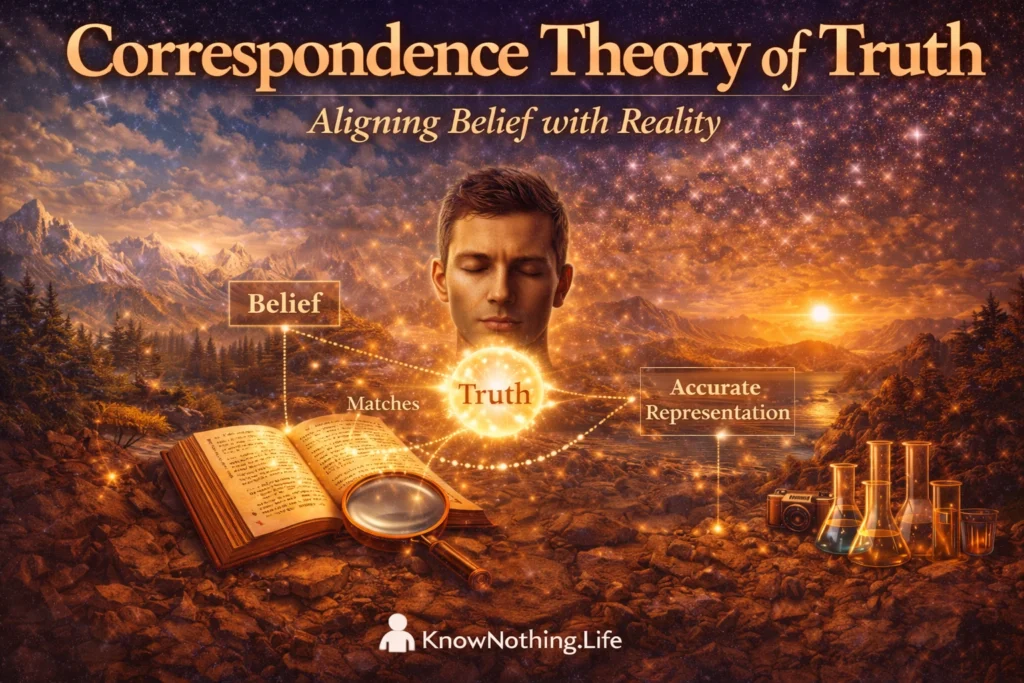
The correspondence theory of truth is one of the oldest and most intuitively compelling accounts of what it means for a statement to be true. At its core, the theory asserts that truth consists in a relationship between language (or thought) and the world: a statement is true if it corresponds to the way things actually are. This simple idea has shaped philosophical discussions for centuries and continues to serve as a foundational concept in epistemology and metaphysics.
The appeal of correspondence lies in its alignment with common sense. When we say that a belief is true, we typically mean that it accurately reflects reality. If someone claims that it is raining and it is indeed raining, the statement is true because it matches the facts. This straightforward understanding has made correspondence theory a dominant framework in philosophical and everyday thinking.
The roots of the correspondence theory can be traced to Aristotle, whose formulation of truth remains influential: “To say of what is that it is, and of what is not that it is not, is true.” Later philosophers, including Thomas Aquinas and Bertrand Russell, developed and refined this idea, seeking to clarify how language relates to reality and what it means for a statement to correspond to a fact.
The Core Idea of Correspondence
At the heart of the correspondence theory is the notion that truth involves a relation between propositions and facts. A proposition—such as “the sky is blue”—is true if it corresponds to a fact in the world, namely that the sky is indeed blue. This relation is often described as one of agreement or alignment between thought and reality.
This idea assumes that the world exists independently of our beliefs and that it has a determinate structure that can be described accurately or inaccurately. Truth, therefore, is not a matter of opinion or coherence within a system of beliefs, but of how well those beliefs match the external world. This objective dimension of truth is one of the theory’s greatest strengths.
However, the concept of correspondence raises important questions. What exactly are facts, and how do they relate to propositions? Are facts themselves entities in the world, or are they constructs of language? These questions have led philosophers to explore the nature of the correspondence relation in greater detail, resulting in various interpretations and refinements of the theory.
Aristotle and the Classical Formulation
The origins of the correspondence theory can be found in the philosophy of Aristotle, particularly in his work Metaphysics. Aristotle’s formulation of truth emphasizes the alignment between statements and reality, capturing the intuitive idea that truth involves getting things right about the world.
Aristotle’s account is notable for its simplicity and clarity. By defining truth in terms of what is and what is not, he provides a framework that has influenced philosophical thought for centuries. His approach underscores the importance of objectivity, suggesting that truth is determined by the way the world is, not by our perceptions or beliefs.
This classical formulation has been widely accepted and adapted by later philosophers. It serves as the foundation for many subsequent theories of truth, even those that challenge or modify the correspondence view. Aristotle’s insight continues to shape the way we think about truth, highlighting its connection to reality.
Medieval and Early Modern Developments
The correspondence theory was further developed in the medieval period by philosophers such as Thomas Aquinas, who described truth as the “adequation of the intellect and the thing” (adaequatio intellectus et rei). This formulation emphasizes the alignment between the mind and the world, reinforcing the idea that truth involves a correspondence between thought and reality.
In the early modern period, philosophers such as John Locke and René Descartes engaged with the correspondence theory in different ways. Locke’s empiricism emphasized the role of experience in forming ideas that correspond to reality, while Descartes’ rationalism sought to establish certainty through clear and distinct ideas.
These developments highlight the adaptability of the correspondence theory. While its core idea remains consistent, its interpretation has evolved in response to changing philosophical contexts. The medieval and early modern periods contributed to refining the theory and integrating it into broader epistemological frameworks.
Russell and the Fact-Based Approach
In the 20th century, Bertrand Russell provided a more detailed and rigorous account of the correspondence theory. In works such as The Problems of Philosophy, Russell argued that truth involves a relation between propositions and facts, which he regarded as objective components of reality.
Russell’s approach emphasizes the importance of analyzing the structure of propositions and their relation to facts. He distinguishes between different types of facts, including atomic facts and complex facts, and argues that understanding these structures is essential for explaining how correspondence works.
One of Russell’s key contributions is his attempt to clarify the nature of facts themselves. By treating facts as entities that can be analyzed and described, he provides a more precise account of the correspondence relation. This analytical approach has had a significant influence on contemporary philosophy, particularly in the fields of logic and language.
Challenges and Criticisms
Despite its intuitive appeal, the correspondence theory faces several important challenges. One major issue concerns the nature of the correspondence relation itself. How do propositions “correspond” to facts? Is this relation one of resemblance, representation, or something else entirely? Philosophers have struggled to provide a clear and satisfactory account of this relationship.
Another challenge involves the concept of facts. Critics argue that the notion of facts as independent entities is problematic. Are facts distinct from the objects and events they describe, or are they simply ways of talking about those objects and events? This ambiguity raises questions about the ontological commitments of the correspondence theory.
Additionally, some philosophers argue that the theory oversimplifies the complexity of language and meaning. Statements are not always straightforward representations of reality; they can involve interpretation, context, and ambiguity. These factors complicate the idea that truth is simply a matter of correspondence.
Correspondence in Contemporary Philosophy
In contemporary philosophy, the correspondence theory remains an important but contested view. Some philosophers continue to defend it as the most plausible account of truth, while others seek to refine or replace it with alternative theories.
Advances in logic and semantics have contributed to a more nuanced understanding of correspondence. Philosophers such as Alfred Tarski have developed formal theories of truth that capture aspects of correspondence while avoiding some of its traditional problems. Tarski’s semantic theory, for example, provides a rigorous framework for understanding how statements relate to reality.
At the same time, debates about realism and anti-realism have influenced discussions of correspondence. Realists tend to support the idea that truth involves a correspondence with an objective reality, while anti-realists question whether such a reality can be meaningfully described. These debates highlight the ongoing relevance of the correspondence theory in contemporary philosophy.
Conclusion
The correspondence theory of truth offers a powerful and intuitive account of what it means for a statement to be true. By emphasizing the relationship between language and reality, it provides a framework for understanding truth as an objective and measurable concept.
From the classical insights of Aristotle to the analytical rigor of Bertrand Russell, the theory has evolved while retaining its core idea: truth consists in aligning belief with reality. Despite the challenges it faces, correspondence remains a central concept in philosophical discussions of truth.
As Thomas Aquinas observed, truth involves the conformity of the mind to the world. This enduring insight captures the essence of the correspondence theory, reminding us that the pursuit of truth is ultimately a quest to understand reality as it truly is.