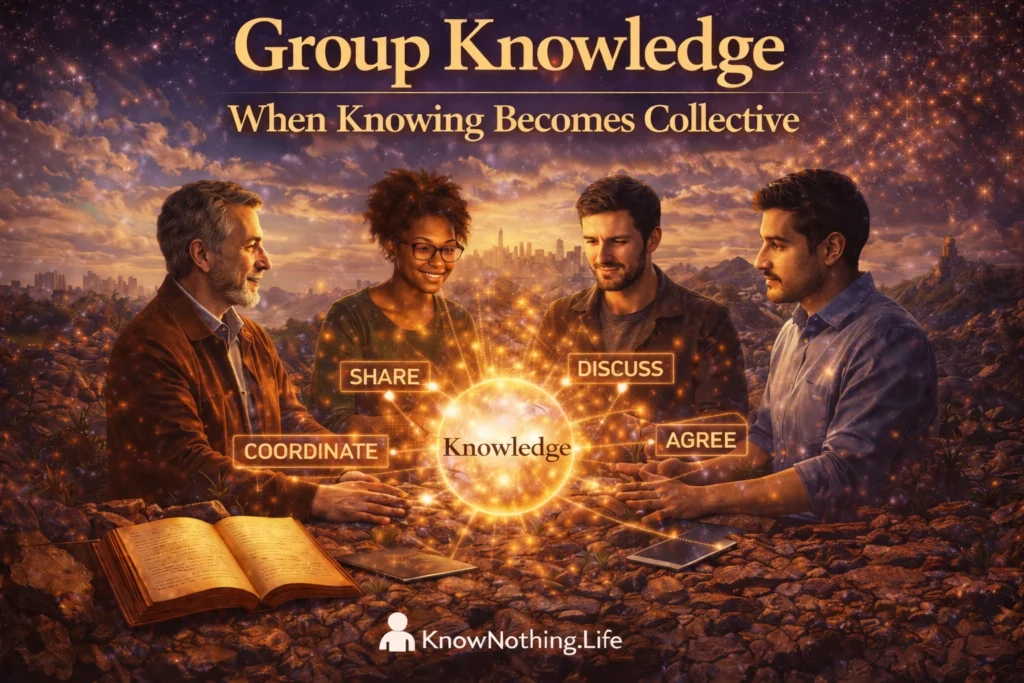
Group knowledge challenges the traditional assumption that knowledge is always an achievement of individual minds. Instead, it asks whether groups—such as scientific communities, institutions, or even societies—can themselves be knowers. If individuals can possess knowledge, can collectives also hold beliefs, evaluate evidence, and arrive at truths that are not reducible to any single member?
This question arises naturally in modern contexts where knowledge production is highly collaborative. Scientific discoveries, legal decisions, and technological innovations are rarely the work of isolated individuals. Instead, they emerge from networks of cooperation, shared expertise, and institutional processes. Understanding how knowledge operates in these contexts requires moving beyond individual epistemology to a social and collective framework.
Philosophers such as Margaret Gilbert, Philip Pettit, Alvin Goldman, and Miranda Fricker have explored the nature of group knowledge. Their work examines whether groups can be genuine epistemic agents and how collective processes shape what is accepted as knowledge.
The Concept of Group Knowledge
Group knowledge refers to the idea that a collective entity can possess knowledge in a way that is not simply reducible to the knowledge of its individual members. This raises a fundamental question: what does it mean for a group to know something? Is it merely that all or most members hold a true belief, or does group knowledge involve something more?
One approach is to treat group knowledge as an aggregation of individual knowledge. On this view, a group knows something if its members know it. However, this approach faces challenges, particularly in cases where no individual possesses the full knowledge, yet the group as a whole does. For example, in complex scientific research, different individuals may contribute partial knowledge that, when combined, results in a complete understanding.
An alternative view is that groups can function as epistemic agents with their own beliefs, intentions, and reasoning processes. This perspective suggests that group knowledge is not merely a sum of individual contributions but a distinct phenomenon arising from collective interaction. This idea has significant implications for how we understand knowledge in modern, collaborative environments.
Collective Intentionality and Joint Commitment
Margaret Gilbert has developed a theory of collective intentionality that provides a foundation for understanding group knowledge. In her work On Social Facts, Gilbert argues that groups can form “joint commitments,” where individuals collectively commit to a belief or course of action.
According to Gilbert, when individuals jointly commit to a belief, they form a plural subject—a collective entity that can be said to hold that belief. This goes beyond mere agreement, as it involves a shared commitment that binds the group together. In this sense, group knowledge arises from the coordinated actions and intentions of its members.
This framework highlights the social and normative dimensions of group knowledge. Joint commitments create obligations among group members, influencing how they maintain and revise their beliefs. Gilbert’s theory suggests that group knowledge is not only about shared information but also about shared responsibility and coordination.
Pettit and Group Agency
Philip Pettit offers another influential account of group knowledge through his theory of group agency. In collaboration with others, Pettit has argued that groups can function as agents with their own beliefs and decision-making processes.
Pettit emphasizes that groups can exhibit rationality and coherence in ways that individuals alone cannot. For example, institutions such as courts or corporations can adopt positions that are the result of structured deliberation and decision-making procedures. These positions may not align perfectly with the beliefs of any individual member, yet they represent the stance of the group as a whole.
This view supports the idea that group knowledge is a genuine phenomenon. If groups can act as agents, then they can also be said to know things. Pettit’s account highlights the importance of organizational structures and decision-making processes in shaping collective knowledge.
The Role of Epistemic Institutions
Group knowledge is often produced and maintained within institutions such as scientific communities, universities, and governmental bodies. These institutions provide frameworks for collaboration, peer review, and the evaluation of evidence, enabling groups to generate reliable knowledge.
Alvin Goldman has explored the role of institutions in social epistemology, particularly in Knowledge in a Social World. Goldman examines how institutional practices can enhance or undermine the reliability of knowledge production. He emphasizes the importance of mechanisms such as expert evaluation and information filtering in maintaining epistemic standards.
Institutions also play a crucial role in distributing knowledge. Through education, publication, and communication, they make collective knowledge accessible to individuals. However, their effectiveness depends on their ability to maintain transparency, accountability, and resistance to bias.
Epistemic Injustice in Group Contexts
The concept of epistemic injustice, developed by Miranda Fricker, is particularly relevant to group knowledge. In collective settings, certain voices may be marginalized or excluded, leading to distortions in the production and recognition of knowledge.
Testimonial injustice can occur when individuals within a group are not taken seriously due to prejudice, while hermeneutical injustice arises when groups lack the conceptual resources to understand certain experiences. These forms of injustice can affect not only individuals but also the quality of group knowledge.
Addressing epistemic injustice requires ensuring that diverse perspectives are included in collective processes. By promoting fairness and inclusivity, groups can improve the reliability and comprehensiveness of their knowledge. This highlights the ethical dimension of group epistemology, emphasizing the importance of equitable participation.
Challenges and Critiques
Despite its appeal, the concept of group knowledge faces several challenges. One major issue is the problem of attribution: how can knowledge be attributed to a group rather than to its individual members? Critics argue that group knowledge may simply be a convenient way of describing the combined knowledge of individuals.
Another challenge involves disagreement within groups. If members hold conflicting beliefs, can the group still be said to know something? Resolving such conflicts requires mechanisms for decision-making and consensus, which may not always produce reliable outcomes.
Additionally, the idea of group agency raises questions about responsibility. If a group holds a belief or makes a decision, who is accountable for its consequences? These issues highlight the complexity of treating groups as epistemic agents and underscore the need for careful analysis.
Group Knowledge in the Modern World
In contemporary society, group knowledge plays an increasingly important role. Scientific research, technological development, and policy-making all rely on collective processes that generate and evaluate knowledge. Understanding how these processes function is essential for addressing global challenges.
The rise of digital networks has further expanded the scope of group knowledge. Online communities, collaborative platforms, and crowdsourcing initiatives enable new forms of collective knowledge production. However, they also introduce challenges related to misinformation, coordination, and trust.
Philosophical insights into group knowledge can help inform the design of systems and institutions that promote reliable and inclusive knowledge production. By understanding the dynamics of collective epistemology, we can better navigate the complexities of the modern information landscape.
Conclusion
Group knowledge represents a significant expansion of traditional epistemology, highlighting the collective dimensions of knowing. From the theories of Margaret Gilbert and Philip Pettit to the social epistemology of Alvin Goldman and the ethical insights of Miranda Fricker, philosophers have developed a rich framework for understanding how groups can be knowers.
By examining collective intentionality, institutional practices, and issues of justice, the study of group knowledge reveals the complexity of knowledge in a shared world. It shows that knowing is not merely an individual achievement but a collaborative process shaped by interaction and coordination.
As our world becomes increasingly interconnected, the importance of group knowledge continues to grow. Understanding how groups produce, maintain, and distribute knowledge is essential for addressing the challenges of modern society and advancing the pursuit of truth.