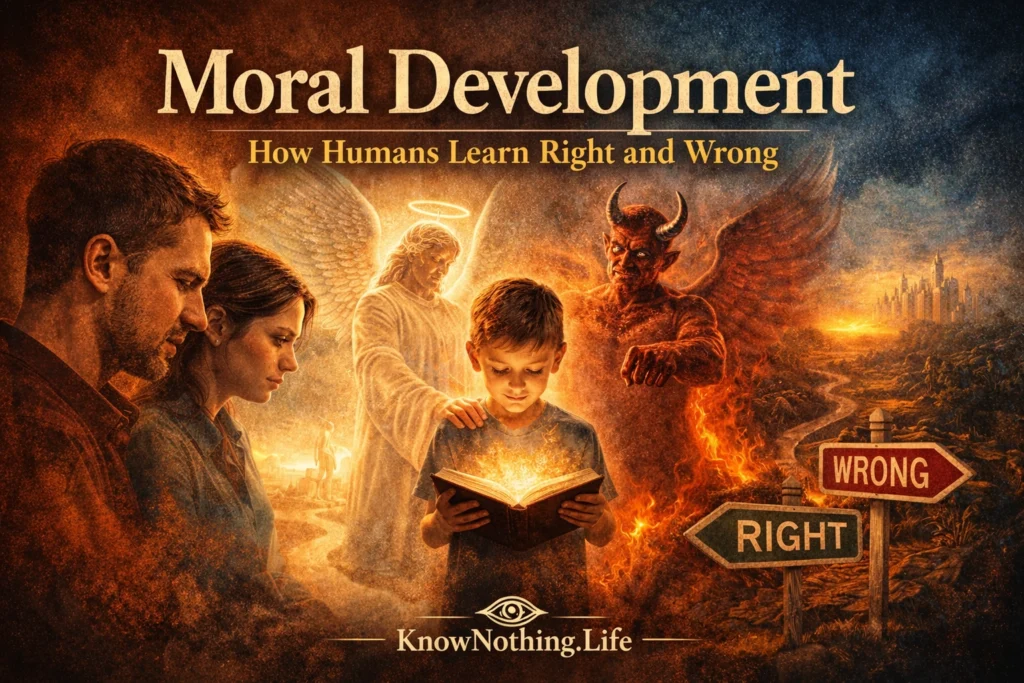
Moral development is the process through which individuals come to understand, internalize, and act upon concepts of right and wrong. It is a central topic in both philosophy and psychology, exploring how moral reasoning evolves over time and how individuals acquire ethical values. From early childhood to adulthood, moral development reflects a complex interplay of cognitive growth, emotional maturation, and social influence.
Unlike abstract ethical theory, which focuses on what people ought to do, the study of moral development investigates how people actually come to make moral judgments. It asks how children learn fairness, why individuals differ in their moral reasoning, and how cultural and environmental factors shape ethical behavior. This field provides a bridge between normative ethics and real-world human experience.
The importance of moral development extends beyond individual behavior to the functioning of society as a whole. Shared moral values underpin social cooperation, legal systems, and cultural norms. Understanding how these values are formed and transmitted is essential for addressing issues such as education, justice, and social cohesion.
Early Philosophical Foundations
The roots of moral development theory can be traced to philosophical debates about human nature and the origins of morality. Jean-Jacques Rousseau argued that humans are naturally good but are shaped by society, suggesting that moral development involves both innate tendencies and external influences. In Émile, Rousseau emphasized the importance of education in cultivating moral character, advocating for an approach that nurtures empathy and autonomy.
In contrast, Thomas Hobbes viewed human nature as fundamentally self-interested, requiring social structures and rules to maintain order. In Leviathan, Hobbes argued that morality arises from the need for cooperation and the avoidance of conflict. This perspective highlights the role of social institutions in shaping moral behavior.
These early philosophical views set the stage for later psychological theories by raising key questions about the origins of morality. Are moral values innate or learned? What role do society and culture play in shaping ethical understanding? These questions continue to inform contemporary research on moral development.
Cognitive Development and Moral Reasoning
One of the most influential approaches to moral development is the cognitive-developmental theory, pioneered by Jean Piaget. In The Moral Judgment of the Child, Piaget studied how children’s understanding of rules and fairness evolves over time. He identified two main stages: heteronomous morality, where rules are seen as fixed and imposed by authority, and autonomous morality, where individuals recognize that rules are created by people and can be changed through mutual agreement.
Building on Piaget’s work, Lawrence Kohlberg developed a more detailed stage theory of moral development. In Essays on Moral Development, Kohlberg proposed six stages grouped into three levels: pre-conventional, conventional, and post-conventional. At the highest level, individuals base their moral judgments on universal principles such as justice and human rights. Kohlberg’s model emphasizes the role of reasoning and cognitive growth in ethical development.
Kohlberg famously argued that moral development is a process of increasing sophistication in reasoning, stating that individuals progress through stages in a fixed sequence. While his theory has been highly influential, it has also been subject to criticism, particularly regarding its emphasis on abstract reasoning and its potential cultural bias. Nonetheless, it remains a foundational framework in the study of moral development.
Emotion, Empathy, and Moral Growth
While cognitive theories emphasize reasoning, other approaches highlight the role of emotion in moral development. Emotions such as empathy, guilt, and compassion are crucial for understanding and responding to the needs of others. Martin Hoffman, in Empathy and Moral Development, argued that empathy is a key driver of moral behavior, enabling individuals to feel concern for others and motivating prosocial actions.
Empathy develops early in life, beginning with basic emotional responses and becoming more complex as cognitive abilities grow. As children learn to recognize and interpret the emotions of others, they become better equipped to navigate social interactions and make moral decisions. This process highlights the interconnectedness of emotional and cognitive development.
Carol Gilligan challenged Kohlberg’s emphasis on justice-based reasoning by introducing the ethics of care. In In a Different Voice, she argued that moral development also involves an orientation toward relationships, responsibility, and care for others. Gilligan’s work broadened the understanding of moral development, emphasizing that ethical growth is not solely about abstract principles but also about emotional engagement and social context.
Socialization and Cultural Influences
Moral development does not occur in isolation; it is shaped by socialization processes that transmit values, norms, and expectations. Family, education, peers, and cultural institutions all play significant roles in shaping moral beliefs. Through interaction with others, individuals learn what behaviors are acceptable and how to navigate ethical dilemmas.
Cultural differences in moral development highlight the diversity of ethical perspectives. What is considered right or wrong can vary across societies, reflecting differences in values, traditions, and social structures. This raises important questions about the universality of moral development theories and the extent to which they apply across cultures.
At the same time, certain aspects of moral development appear to be universal. Concepts such as fairness, reciprocity, and empathy are observed across cultures, suggesting that there are common elements in human moral experience. Understanding the balance between universal and culturally specific aspects of morality is a key challenge in this field.
Moral Identity and Behavior
A critical aspect of moral development is the formation of moral identity—the extent to which individuals see themselves as moral beings and integrate ethical values into their sense of self. Moral identity influences behavior, guiding individuals to act in ways that are consistent with their values.
Research suggests that moral identity is shaped by both internal and external factors, including personal experiences, role models, and social expectations. Individuals who strongly identify with moral values are more likely to engage in ethical behavior, even in challenging situations. This highlights the importance of fostering moral identity through education and socialization.
However, moral behavior is not always consistent with moral beliefs. Situational factors, social pressures, and cognitive biases can lead individuals to act in ways that contradict their values. Understanding these discrepancies is essential for addressing ethical failures and promoting moral integrity.
Contemporary Perspectives and Applications
Modern research on moral development integrates insights from psychology, neuroscience, and philosophy. Advances in neuroscience have shed light on the brain mechanisms underlying moral judgment, while psychological studies have explored the role of intuition and emotion in ethical decision-making.
Moral development has important implications for education, where programs aimed at character development seek to cultivate ethical reasoning, empathy, and social responsibility. These initiatives recognize that moral development is an ongoing process that extends throughout life.
In a rapidly changing world, moral development also plays a role in addressing global challenges such as inequality, conflict, and environmental sustainability. By understanding how moral values are formed and how they can be influenced, individuals and societies can work toward more ethical and cooperative outcomes.
Conclusion
Moral development is a complex and dynamic process that reflects the interplay of cognitive, emotional, and social factors. Through the contributions of thinkers such as Jean Piaget, Lawrence Kohlberg, Martin Hoffman, and Carol Gilligan, the field has developed a rich understanding of how individuals come to navigate ethical life.
By examining how moral reasoning evolves, how emotions shape judgment, and how social contexts influence behavior, moral development provides valuable insights into the foundations of human ethics. It highlights the importance of education, empathy, and reflection in fostering moral growth.
Ultimately, the study of moral development reminds us that ethics is not static but evolves over time. It challenges individuals to continue developing their moral understanding and to strive toward a more just and compassionate society.