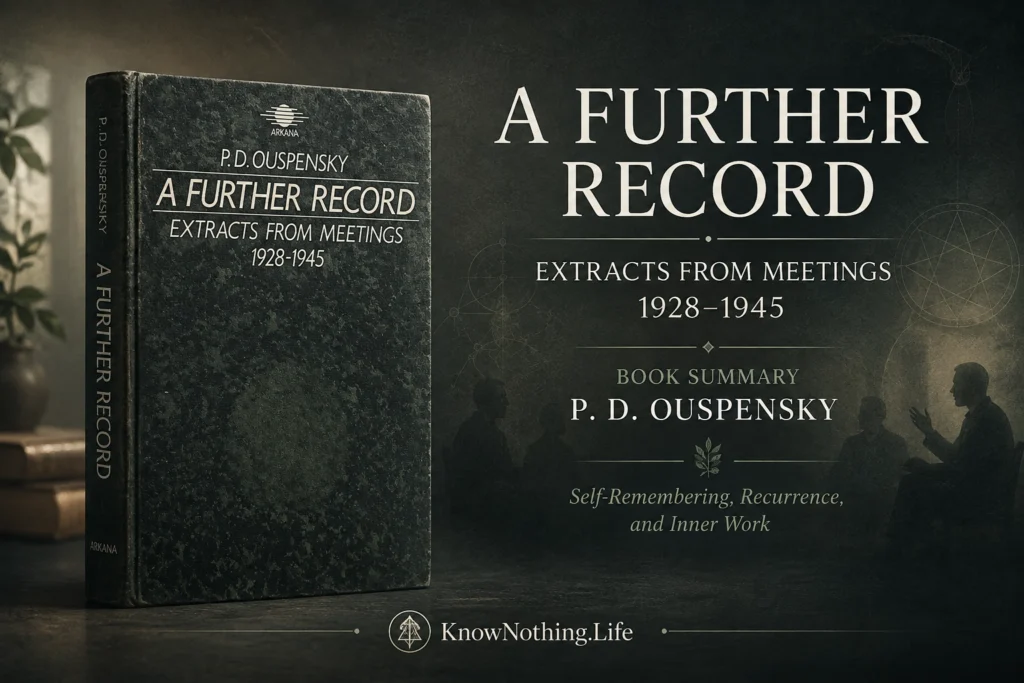
P. D. Ouspensky’s A Further Record: Extracts from Meetings 1928–1945 is a collection of conversations rather than a continuous philosophical treatise. Published in 1952 from records of Ouspensky’s meetings, it preserves questions posed by students and the answers he offered across nearly two decades. Its subjects include recurrence, self-remembering, negative emotions, knowledge and being, will, school discipline, the three lines of work, the enneagram, and Fourth Way cosmology.
Compared with the more systematically arranged The Fourth Way, this volume feels less like a handbook and more like entry into an active classroom. Ouspensky rarely allows a question to remain abstract. Speculation about immortality becomes a question about what one is doing today; permanent identity becomes an exercise in observing competing “I’s”; and interest in spiritual development becomes a demand to identify the habits consuming attention. The book’s force comes less from proving its metaphysics than from returning ideas to personal experience.
Recurrence as a Demand on the Present
The book opens with Ouspensky’s theory of recurrence, according to which a life may repeat with variations while acquired tendencies reappear or strengthen. He is unusually cautious about the doctrine, repeatedly calling it theoretical and acknowledging that he possesses no decisive evidence. Its practical meaning is more important than its cosmological truth. If habits and evasions continue unchanged, another opportunity would reproduce essentially the same life. Change must therefore begin where one presently possesses some degree of awareness and choice.
The argument resembles the central problem of Ouspensky’s novel Strange Life of Ivan Osokin, but it also has a modern psychological parallel. Habit research describes repeated behavior as learned associations between contexts and responses that can become efficient defaults, sometimes operating despite a person’s current goals. Ouspensky turns that process into a metaphysical image: the past returns because the same individual meets familiar circumstances with the same organization of attention, emotion, and desire. Recurrence becomes not a reassuring promise of endless chances but an argument against postponement.
Self-Remembering and the Discovery of Sleep
Self-remembering is the volume’s central practical idea. Ouspensky distinguishes it from self-observation: observation notices thoughts, emotions, gestures, and reactions, while self-remembering attempts to include an immediate awareness of the observer’s own presence. Students are advised to begin by noticing the opposite condition—how frequently they speak, act, and think without remembering themselves. The exercise is not ordinary self-consciousness or inward analysis, but an effort to remain aware of oneself while attention also remains directed toward the surrounding world.
Modern psychology does not confirm Ouspensky’s higher centers or hierarchy of consciousness, but metacognition and mindfulness offer useful comparisons. Metacognition concerns the monitoring and evaluation of one’s cognitive processes, while influential mindfulness models emphasize attention regulation, body awareness, emotion regulation, and changes in one’s perspective on the self. A meta-analysis of 111 randomized trials found small-to-moderate benefits of mindfulness-based interventions across several measures of attention, inhibition, working memory, and cognitive flexibility. These findings support the trainability of awareness, though not the esoteric structure Ouspensky builds around it.
Negative Emotions, Identification, and Imagination
Ouspensky devotes extensive attention to anger, resentment, jealousy, fear, and self-pity. He argues that such states are intensified by “identification”—a loss of psychological distance in which the person temporarily becomes the grievance—and by imagination, which repeats, decorates, and justifies the original reaction. He distinguishes unavoidable suffering from the narratives added to it. A painful event may be real, but rumination can convert pain into a prolonged identity organized around blame and accusation.
This analysis remains powerful when interpreted as a critique of rumination and automatic emotional expression, but it becomes too absolute when Ouspensky declares negative emotions useless or entirely self-produced. Emotions may communicate threat, injustice, loss, frustration, or violated boundaries. Research also distinguishes cognitive reappraisal and acceptance from expressive suppression: reconsidering an event’s meaning is generally associated with healthier outcomes than merely concealing emotion. Rumination, meanwhile, can prolong negative mood, interfere with problem-solving, and reduce sensitivity to changing circumstances. The strongest contemporary reading is therefore not “never feel anger or grief,” but “observe how imagination and repetition transform emotion into a self-reinforcing pattern.”
The Many “I’s,” Knowledge, and Being
Ordinary personality is presented as a plurality of temporary “I’s.” One part makes a promise, another avoids the effort, and a third later explains why failure was reasonable. Unity is not assumed to exist behind these shifts; it must gradually be created. Ouspensky asks students to attempt being “one” for only a few minutes by refusing to let contradictory impulses continually interrupt and replace one another. The modest scale of the exercise reveals how ambitious the ideal of a permanent self actually is.
Contemporary personality psychology also recognizes that the self-concept contains multiple, context-dependent aspects, although it does not consider plurality itself a spiritual defect. Ouspensky’s distinctive move is to connect integration with the difference between knowledge and being. Knowledge concerns what a person can explain; being concerns the stability, awareness, and organization of the person who knows it. Understanding appears only when both develop together. The idea resembles Aristotle’s account of practical wisdom in Nicomachean Ethics: general principles are insufficient unless perception, desire, and action have been educated into a coherent capacity for living.
From Intention to Will
Ouspensky denies that ordinary people possess a stable will. What is usually called will is the temporary victory of one desire over competing desires, while self-will appears as resistance merely because guidance or limitation comes from outside. His practical advice is severe but concrete: count the things that could have been done but were excused, identify the specific cause of each failure, and replace vague explanations such as laziness with observation of the thought, feeling, or resistance present at the decisive moment.
Research on the intention-action gap gives this discussion a less metaphysical vocabulary. Strong intentions alone are limited predictors of behavior, while implementation intentions—specific if-then plans connecting a foreseeable situation with a goal-directed response—can improve the likelihood of action. Experimental evidence also indicates that monitoring progress helps translate goals into achievement. Ouspensky does not formulate his exercises in these terms, but his demand to connect insight with a definite act reaches a similar conclusion: aspiration becomes effective only when attached to recognizable moments, cues, and observable conduct.
Schools and the Three Lines of Work
The book’s most institutional teaching concerns schools and the three lines of work. The first line is work on oneself: studying the teaching, observing mechanical functions, and struggling with identification. The second is work with other people, where cooperation and friction expose reactions that may remain hidden during solitary reflection. The third is work for the continuation and aims of the school. Ouspensky argues that knowledge and being must develop together under deliberately created conditions that ordinary life does not normally provide.
Groups can plausibly support change through feedback, accountability, varied perspectives, shared norms, and social support. Reviews of group-based behavioral interventions identify interacting group, social, and personal processes through which change may occur. Yet Ouspensky’s school model also requires ethical scrutiny. Rules intended to create discomfort and demands to surrender self-will may expose habits, but they can also empower authoritarian leadership. Voluntary discipline, transparent purposes, independent judgment, and freedom to leave are essential distinctions between constructive practice and coercive obedience.
Cosmology and the Limits of Verification
A Further Record also explores the Ray of Creation, the Law of Three, the Law of Seven, the enneagram, higher centers, and different categories or “types” of humanity. Ouspensky treats these as interconnected symbolic structures describing processes within individuals and throughout the cosmos. The enneagram discussed in the book is not the later nine-personality typology popular in contemporary self-help; it is presented as a diagram uniting the Law of Three with the Law of Seven and representing the development of processes.
These claims have not been established by modern physics, neuroscience, or experimental psychology. Readers may find the diagrams philosophically suggestive while withholding literal belief. Ouspensky is most credible when he admits that ordinary thought and language are limited instruments and that theories should not be mistaken for verified facts. His own caution about recurrence and incomplete evidence supplies the best rule for approaching the volume’s largest cosmological and supernatural claims.
Meaning and Lasting Value
A Further Record presents development as a movement from explanation to verification. Recurrence asks whether tendencies are being strengthened or interrupted. Self-remembering exposes the discontinuity of awareness. Work on emotion reveals the narratives that maintain resentment. The many “I’s” challenge assumed unity, while the distinction between knowledge and being asks whether ideas have altered the person who holds them. The three lines of work place this experiment within relationships and shared responsibilities.
The book is not scientific psychology, and its metaphysical hierarchy, theory of higher centers, and model of school authority deserve skepticism. Its enduring value lies in the precision of its practical questions. What happens to attention during irritation? Which self made a promise, and which now avoids it? Is a spiritual idea being verified, or merely repeated? Ouspensky’s answer throughout is that no theory can substitute for sustained observation. A more conscious life begins not with accepting the system, but with becoming present enough to test it.