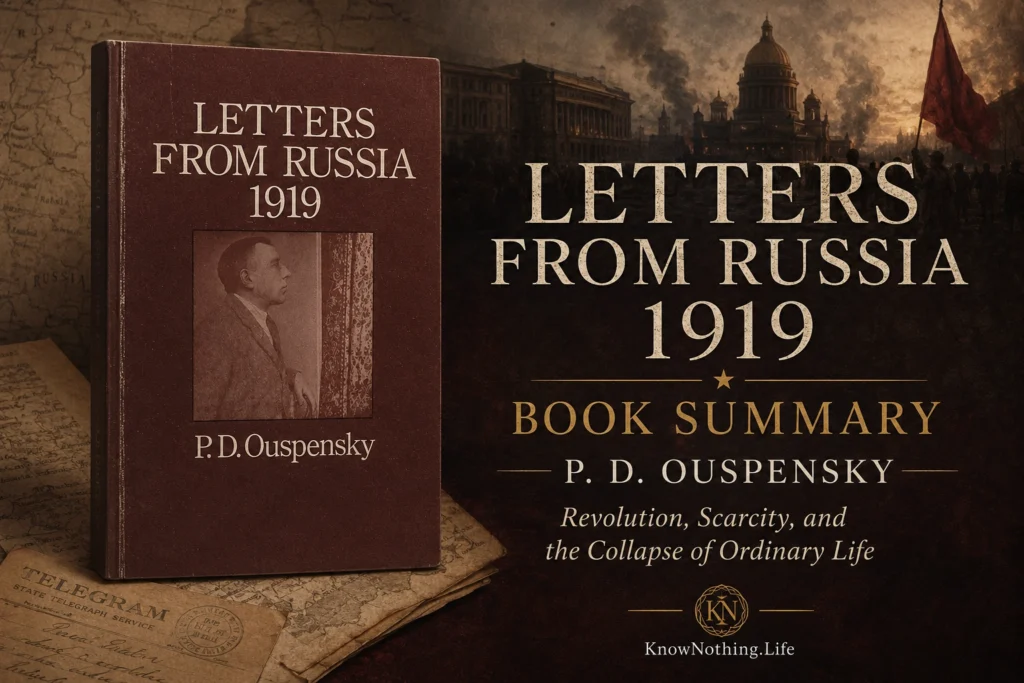
P. D. Ouspensky’s Letters from Russia is unlike his better-known works on higher dimensions, consciousness, and the Fourth Way. It is a brief collection of political journalism written from Ekaterinodar in southern Russia during the Russian Civil War. Ouspensky sent five articles to A. R. Orage, editor of the London weekly The New Age, where they appeared in six installments. The pieces were later collected in a 1978 edition translated by Paul Leon, with an introduction by Fairfax Hall and an epilogue drawn from C. E. Bechhofer’s In Denikin’s Russia.
The book is not a neutral history of the Revolution. It is an alarmed, fiercely anti-Bolshevik testimony written amid shortages, epidemics, military movements, currency collapse, political repression, and widespread fear. Ouspensky tries to explain this transformed reality to British readers who still inhabit functioning institutions and therefore lack the concepts required to understand social disintegration. Its central subject is larger than Bolshevism: the psychological distance separating people who live inside catastrophe from those who know it only through newspapers.
The Meaning of a Box of Matches
The first letter begins with apparently trivial objects—shoe leather, shaving soap, bread, and a box of matches. Ouspensky explains that Russians who long to live “in the old way” are not necessarily asking for the monarchy’s return. They are remembering a world in which necessities could be purchased, salaries retained value, trains operated predictably, and ordinary plans extended beyond the next meal. Bribery, speculation, inflation, and scarcity have turned minor transactions into struggles organizing the entire day.
This is one of the book’s deepest philosophical insights. Stable societies make their supporting systems nearly invisible; breakdown renders every dependence suddenly conspicuous. Ouspensky’s matches resemble malfunctioning equipment in Martin Heidegger’s later Being and Time: what normally recedes into practical use becomes an object of anxious attention when unavailable. Modern scarcity research gives the observation a psychological counterpart. An influential study by Anandi Mani and colleagues found that pressing financial concerns can consume cognitive resources needed for reasoning and self-control. Scarcity does not merely reduce possessions; it narrows what people can afford to think about.
The Loss of a Shared Language
Ouspensky repeatedly tells his English audience that words no longer carry the same meanings for them. “Winter,” “bread,” “culture,” “revolution,” and “economic life” have become embodied experiences rather than abstract topics. He recounts a woman fearing reunion with her absent husband because he may ask why their son has not studied English, while she has spent years concentrating on survival. The question would expose an emotional gulf: one person remembers normal expectations, while the other remembers the conditions that made them impossible.
The letters therefore describe a crisis of communication as much as a political crisis. Extreme experience reorganizes relevance. A distant observer may debate constitutions while a resident worries about fuel, disease, transport, and food. Research on stress and attention supports the general principle that threat alters information processing and can preserve attention to danger while reducing accuracy elsewhere. Ouspensky’s claim that Russians and Britons seemed to inhabit “different planets” is rhetorical, but it captures how radically different environments produce incompatible assumptions about what deserves immediate attention.
A Warning Addressed to England
In the second letter, Ouspensky describes receiving British newspapers after more than two years of isolation. His initial pleasure turns to fear because the papers seem to assume that ordinary life survived the Great War intact. He reads British discussions of prices, strikes, and Bolshevism as signs that England cannot recognize processes Russia has already experienced. Russia becomes his cautionary laboratory: ideas that appear idealistic from abroad have, in his account, produced coercion, hunger, censorship, and political violence when translated into institutions.
The warning is also where the book becomes most polemical. Ouspensky portrays Bolshevism as a resurgence of older destructive forces and repeatedly claims that Germany created or strategically directed it. These arguments reflect wartime suspicion and his position within anti-Bolshevik southern Russia; they should not be treated as settled historical conclusions. Psychologist Ziva Kunda’s work on motivated reasoning is relevant: people often select and evaluate evidence through strategies compatible with conclusions they strongly desire. Ouspensky sees certain realities clearly, but fear and political commitment also shape the pattern he constructs from them.
Inflation, Profiteering, and Social Reversal
The third letter returns to material conditions. Ouspensky lists extraordinary prices for paper, pens, tea, coffee, bread, and books, while teachers and other “brain-workers” go unpaid or receive salaries that cannot keep pace with inflation. Speculation becomes both condemned and necessary: families survive by carrying goods, trading across regions, or converting cash into commodities before it loses more value. Attempts to suppress profiteering can remove goods from the market and return them at even higher prices.
Ouspensky calls this the “Law of Opposite Aims and Results,” a political version of the mechanicality he later emphasized in his psychological teaching. Measures intended to protect consumers worsen shortages; movements promising freedom generate new systems of command; campaigns against privilege create new privileged classes. Sociologist Robert K. Merton later analyzed a related problem in “The Unanticipated Consequences of Purposive Social Action,” arguing that ignorance, error, immediate interests, and rigid values can cause deliberate policies to produce results their authors never intended.
Ideology and the Attack on Culture
Letters three and four attempt a history of revolutionary collapse. Ouspensky argues that Russia’s parties were dominated by theories, slogans, and moral postures insufficiently connected to practical conditions. The Bolsheviks prevailed, he says, because they possessed a definite aim while their opponents remained divided and abstract. He is especially concerned with the repression of journalists, teachers, doctors, engineers, artists, and other members of the intelligentsia, whom the new state classified as bourgeois and placed under political control.
His analysis anticipates later psychological accounts of ideological violence. Albert Bandura’s theory of moral disengagement explains how harmful conduct may be redescribed as necessary, virtuous, or historically inevitable, while responsibility is displaced and victims are blamed or dehumanized. Henri Tajfel’s social-identity work likewise showed how group categorization can encourage favoritism toward insiders and discrimination against outsiders. Ouspensky sees revolutionary labels functioning this way: they cease to describe complex individuals and instead determine whose knowledge, property, safety, or life counts.
No Simple Refuge in the White South
The final letter is valuable because Ouspensky does not portray territory controlled by General Anton Denikin’s Volunteer Army as restored normality. He describes political fragmentation, regional rivalries, requisitioned rooms, unstable currencies, government incompetence, profiteering, and economic blockades. Denikin’s forces were then advancing toward Moscow in an ambitious southern offensive, but the social world behind the front remained disordered. Ouspensky also acknowledges repeated anti-Jewish pogroms and connects them with organized political forces and surviving habits of the old regime.
That acknowledgment matters, but the book still carries serious limitations. Ouspensky sometimes uses ethnic stereotypes, reduces diverse opponents to criminal or diseased types, and describes complicated national movements through his Russian anti-Bolshevik framework. Historical evidence confirms that civil-war pogroms involved multiple armed forces and that anti-Communist forces in southern Russia participated extensively in violence against Jewish communities. The letters must therefore be read as a situated witness statement, not an impartial map of guilt.
The Human Epilogue
C. E. Bechhofer’s epilogue shifts the tone from political warning to tragicomic survival. Visiting Ouspensky in Rostov-on-the-Don, he finds housing requisitioned, rooms overcrowded, and everyday arrangements dependent on temporary favors. Ouspensky nevertheless remains hospitable and composed, improvising shelter and conversation amid instability. The epilogue prevents the author from becoming only a prophetic voice; it shows the vulnerable man behind the letters, living above a barn and adapting to circumstances he cannot control.
Letters from Russia 1919 is ultimately a study of how civilization is experienced when its background structures fail. Its political judgments are passionate, uneven, and sometimes prejudiced, but its descriptions of scarcity, dislocated language, institutional decay, and psychological narrowing remain powerful. Ouspensky’s lasting insight is that collapse does not first appear as an abstract change of regime. It appears as the missing match, the worthless banknote, the closed newspaper, the requisitioned room, and the recognition that people outside the disaster may no longer understand what ordinary words mean.