Motivation & Behavior

Motivation & Behavior

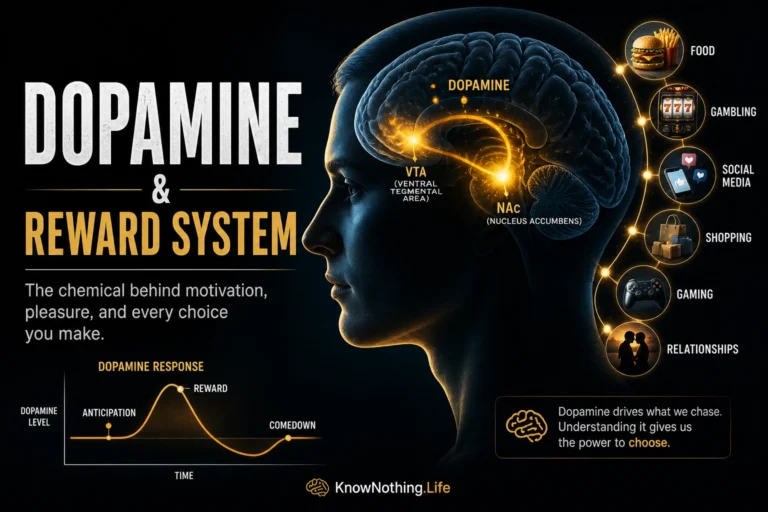
Motivation is the driving force behind human behavior—the set of processes that initiate, direct, and sustain actions toward goals. Whether pursuing basic needs such as food and safety or complex ambitions like achievement and self-fulfillment, individuals are constantly guided by…

Psychedelic Psychology

Psychedelic Psychology

Psychedelic psychology explores how certain substances—most notably LSD, psilocybin, mescaline, and DMT—alter perception, cognition, emotion, and the sense of self. The term “psychedelic,” coined by Humphry Osmond, literally means “mind-manifesting,” reflecting the idea that these substances reveal aspects of consciousness…

Meditation

Meditation

Meditation is a disciplined practice of training attention and awareness, cultivated across cultures for thousands of years. Though often associated with spiritual traditions, meditation today is studied extensively within psychology and neuroscience as a method for enhancing mental clarity, emotional…

Altered States

Altered States

Altered states of consciousness refer to conditions in which an individual’s perception, cognition, emotion, or sense of self differs significantly from ordinary waking awareness. These states can arise naturally, as in sleep and dreaming, or be induced through meditation, sensory…

Dreams

Dreams

Dreams have fascinated human beings across cultures and centuries, occupying a unique space between biology, psychology, and philosophy. They are vivid experiences that occur primarily during sleep, often characterized by imagery, emotion, and narrative structure. Despite their familiarity, dreams remain…

Conscious vs Unconscious Mind

Conscious vs Unconscious Mind

The distinction between the conscious and unconscious mind stands as one of the most enduring and influential ideas in psychology and philosophy. At its simplest, the conscious mind encompasses the thoughts, perceptions, and intentions of which we are aware in…

Consciousness & States of Mind

Consciousness & States of Mind

Consciousness remains one of the most profound and elusive subjects in both philosophy and science. It refers, at its most basic level, to subjective experience—the sense of “what it is like” to be aware, to perceive, to feel, and to…

Dunning-Kruger Effect

Dunning-Kruger Effect

The Dunning–Kruger Effect describes a paradox at the heart of human cognition: those who lack skill or knowledge in a domain are often the least aware of their deficiencies, while those with greater competence tend to recognize the limits of…

Hindsight Bias

Hindsight Bias

Hindsight bias is the tendency to perceive past events as having been more predictable than they actually were. Often summarized as the “I knew it all along” effect, this bias leads individuals to reconstruct their prior beliefs after an outcome…

Self-Serving Bias

Self-Serving Bias

Self-serving bias is a pervasive cognitive tendency in which individuals attribute successes to internal factors—such as ability, effort, or intelligence—while attributing failures to external factors, such as luck, circumstance, or other people. This pattern of attribution allows individuals to maintain…

Availability Heuristic

Availability Heuristic

The availability heuristic is a fundamental cognitive shortcut through which individuals estimate the likelihood or frequency of events based on how easily examples come to mind. Rather than relying on statistical reasoning or comprehensive evidence, people often judge probability by…

Anchoring Bias

Anchoring Bias

Anchoring bias is one of the most influential and robust cognitive biases affecting human judgment. It refers to the tendency to rely heavily on the first piece of information encountered—the “anchor”—when making decisions, even when that information is irrelevant or…