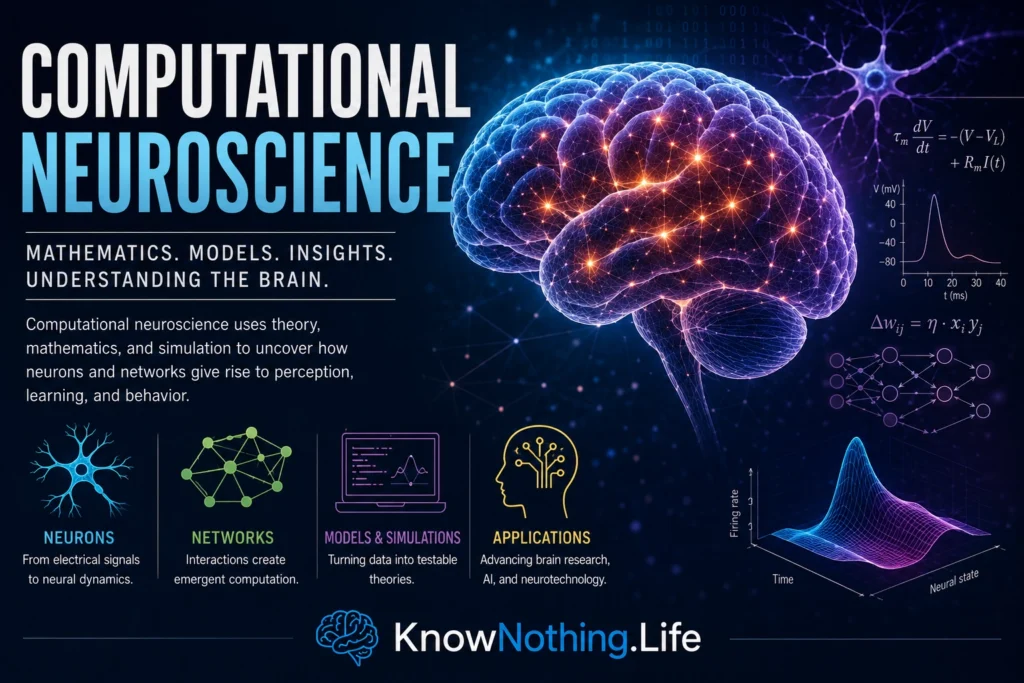
Computational neuroscience uses mathematics, physics, computer science, engineering, and statistics to investigate how nervous systems process information. Its central question is not merely which brain regions become active during a task, but how the activity of neurons and neural networks produces perception, movement, memory, learning, decision-making, and behavior. Researchers build models that convert biological observations into explicit mechanisms, allowing them to test whether a proposed explanation can reproduce the patterns measured in experiments.
The field operates across several levels. A model may describe ion channels within a membrane, electrical signaling along a dendrite, interactions among thousands of neurons, or the computations performed by a large-scale brain network. Some models closely reproduce cellular anatomy and physiology, while others deliberately simplify biological detail to isolate an essential principle. The value of a model does not depend on realism alone. A successful model should explain observations, generate testable predictions, reveal which assumptions matter, and clarify why a neural system behaves as it does.
Modeling the Electrical Activity of Neurons
One of the foundational achievements of computational neuroscience was Alan Hodgkin and Andrew Huxley’s 1952 quantitative model of the action potential. Working with the squid giant axon, they described how voltage-dependent sodium and potassium conductances generate the rapid electrical signal transmitted along a nerve membrane. Their equations connected experimental measurements with a mechanistic account of excitation, showing that the timing and interaction of ionic currents could explain the shape and propagation of an action potential. The Hodgkin–Huxley framework remains a central example of how mathematical modeling can turn physiological data into a predictive theory.
Real neurons are more complicated than uniform electrical cables. They possess branching dendrites that receive and combine thousands of synaptic inputs. Wilfrid Rall’s cable-theory models demonstrated how dendritic geometry and membrane properties influence the spread of electrical signals through neurons. Detailed conductance-based models can capture these processes but may require substantial computational resources. Simpler alternatives sacrifice biological detail for speed and interpretability. Eugene Izhikevich’s 2003 model, for example, reproduced numerous forms of neuronal spiking and bursting with only a small set of equations, illustrating the productive balance between biological richness and computational efficiency.
Networks and Emergent Computation
The behavior of a neural system cannot always be predicted by examining its cells individually. Neurons interact through excitation, inhibition, feedback, and recurrent connectivity, allowing networks to produce oscillations, persistent activity, competition, synchronization, and transitions between stable states. Hugh Wilson and Jack Cowan’s 1972 model described the average activity of interacting excitatory and inhibitory populations using coupled nonlinear equations. Their analysis showed how relatively simple network interactions could generate oscillations, multiple stable states, and complex responses to stimulation.
John Hopfield’s 1982 work demonstrated how recurrent networks could function as associative memories. In a Hopfield network, stored patterns behave like stable states toward which incomplete or corrupted inputs can evolve. The model connected neural computation with ideas from statistical physics and showed that memory could emerge from collective network behavior rather than being stored in a single cell. Although biological brains are far more complex than classical Hopfield networks, the work helped establish attractor dynamics as a framework for studying memory, decision-making, spatial representation, and persistent neural activity.
Neural Coding and Sensory Representation
A major goal of computational neuroscience is to determine how neural activity represents information. A single neuron may respond selectively to orientation, sound frequency, movement direction, location, or another feature, but information is usually distributed across populations. Researchers therefore study firing rates, precise spike timing, correlations between neurons, and the geometry of population activity. The correct description may vary across systems: some computations can be understood through the activity of individual cells, while others become apparent only when many neurons are analyzed together.
Models can also explain why sensory neurons develop particular response properties. Bruno Olshausen and David Field showed that an algorithm trained to represent natural images with a sparse code developed localized, oriented filters resembling receptive fields found in the primary visual cortex. The study suggested that aspects of sensory organization may reflect adaptation to the statistical structure of the natural environment. In the retina, Jonathan Pillow and colleagues used a population model that included stimulus responses, spike history, and interactions among neighboring cells. Accounting for correlated firing improved the extraction of information from retinal activity compared with treating neurons as independent encoders.
Internal Maps and Representations
Computational models help researchers connect neural firing with internal representations of the world. In 1971, John O’Keefe and Jonathan Dostrovsky reported that particular hippocampal neurons became active when a freely moving rat occupied particular locations. These place cells supported the idea that the hippocampus contributes to an internal spatial map. Later computational theories described how networks of place cells, grid cells, head-direction cells, and other neurons could support navigation, memory, and the representation of relationships among events.
The idea of a neural representation must nevertheless be handled carefully. A neuron’s correlation with a variable does not prove that the cell alone calculates, stores, or controls that variable. Its response may depend on behavior, attention, task demands, movement, or the activity of a wider circuit. Computational neuroscience addresses this problem by constructing encoding models that predict neural responses from stimuli or behavior and decoding models that estimate external variables from recorded activity. Comparing these models allows researchers to test what information is present, how it is distributed, and whether a proposed readout could plausibly be used by other brain regions.
Learning, Reward, and Prediction
Learning requires neural systems to modify behavior using experience. Computational approaches often describe learning as an adjustment of synaptic strengths, internal beliefs, or action values in response to error. Reinforcement-learning theory formalizes how an agent can learn which actions produce future rewards. A central quantity is the reward-prediction error: the difference between the reward that occurs and the reward that was expected. Positive errors strengthen expectations or actions, while negative errors indicate that an anticipated outcome did not arrive.
Wolfram Schultz, Peter Dayan, and Read Montague connected this computational concept with dopamine activity in their influential 1997 paper “A Neural Substrate of Prediction and Reward.” Dopamine neurons responded strongly to unexpected rewards, shifted their responses toward cues that predicted those rewards, and reduced activity when an expected reward failed to occur. This pattern resembled the prediction-error signal used in temporal-difference learning algorithms. The correspondence did not imply that dopamine has only one function, but it showed how a formal learning model could explain a previously puzzling physiological response.
Neural Dynamics and Cognitive Computation
Traditional neuroscience often asks what variable a neuron represents. A complementary approach asks how the state of an entire neural population changes over time. In this dynamical-systems view, computation is a trajectory through a high-dimensional activity space. Individual neurons may display complex and mixed responses, while the population follows an organized pattern that transforms inputs, maintains information, or prepares an action.
Mark Churchland and colleagues applied this approach to motor cortex activity during reaching. They found rotational population dynamics that emerged from preparatory activity and unfolded during movement, suggesting that motor cortex may operate partly as a dynamical system that generates patterns of muscle activity. Valerio Mante and colleagues later showed that context-dependent decisions in prefrontal cortex could be understood through recurrent population dynamics. A trained recurrent neural network reproduced important features of the recorded activity and revealed how the same circuit could select and integrate different sensory inputs according to the current task.
Data, Artificial Intelligence, and Neural Interfaces
Modern experiments can record from hundreds or thousands of neurons, producing datasets too large and complex for simple visual inspection. Computational neuroscientists use dimensionality reduction, probabilistic modeling, machine learning, and dynamical-systems analysis to identify latent patterns within this activity. These methods can reveal shared population states, distinguish task-related signals from noise, and predict how neural activity relates to behavior. Artificial neural networks are also used as experimental models, particularly when their internal representations can be compared with activity measured in biological systems.
The relationship between neuroscience and artificial intelligence is reciprocal. Brain research has inspired artificial networks, reinforcement learning, attention mechanisms, and adaptive control, while machine-learning methods now help scientists interpret neural recordings. These approaches have direct clinical applications. In 2017, Chethan Pandarinath and colleagues demonstrated that intracortical signals could support comparatively high-performance computer communication in people with paralysis. In 2021, Francis Willett and colleagues decoded attempted handwriting movements from motor-cortex activity and translated them into text, showing how computational models can transform neural intentions into assistive communication.
Limitations and the Future of the Field
A model can fit data without capturing the true biological mechanism. Flexible models may memorize patterns, while simplified models may omit features necessary for understanding real brains. Researchers must therefore test models on new data, compare competing explanations, examine sensitivity to assumptions, and design experiments capable of proving a model wrong. Interpretability is particularly important when machine-learning systems contain millions of parameters but provide little explanation of how a result was produced.
Future computational neuroscience will increasingly combine cellular physiology, large-scale recording, connectomics, behavior, and artificial intelligence. Better models may explain how molecular changes alter circuit dynamics, why neurological and psychiatric symptoms differ among individuals, and how stimulation or medication can move a dysfunctional network toward a healthier state. Yet the brain is not merely a computer waiting to be reverse-engineered. It is a living, adaptive system shaped by development, the body, social experience, and the environment. Computational neuroscience is most powerful when mathematical precision remains closely connected to biological evidence and meaningful behavior.