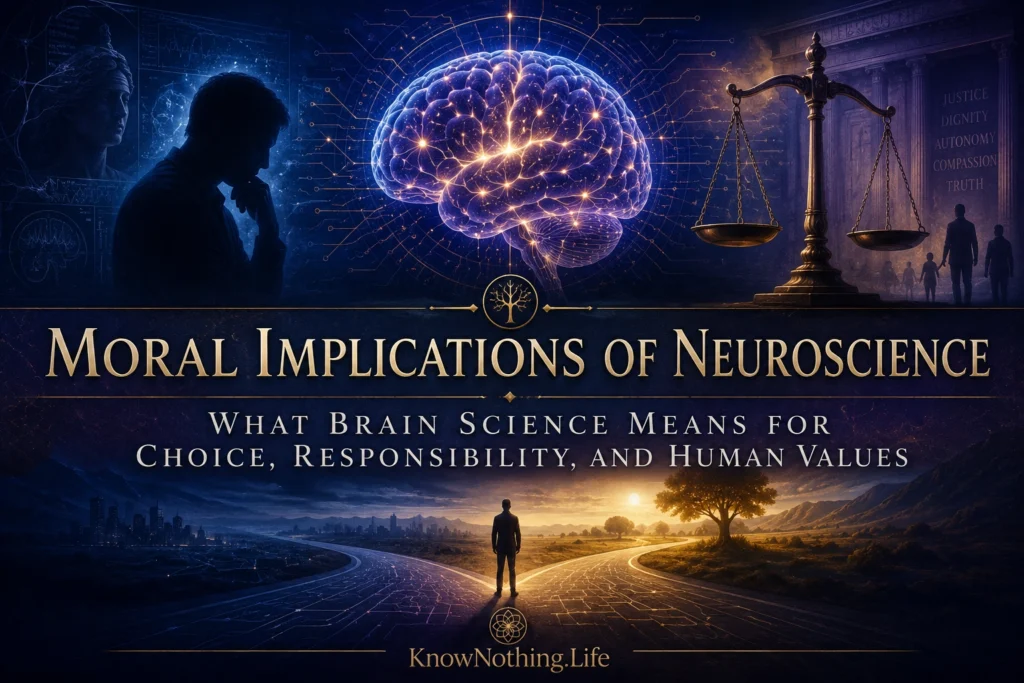
Neuroscience can investigate the biological processes involved when people make moral judgments, experience guilt, resist temptation, recognize another person’s suffering, or decide whether an action deserves punishment. It can identify networks associated with emotion, reasoning, empathy, intention, and behavioral control. These discoveries matter because morality is expressed through a functioning brain rather than through a mental faculty detached from biology. Injury, disease, development, drugs, and stimulation can alter judgment and behavior, demonstrating that moral capacities depend partly on neural systems. Yet describing how the brain produces a judgment is not the same as establishing whether that judgment is ethically correct.
This distinction separates descriptive science from normative ethics. A brain scan might show that a decision recruits regions associated with emotion or cognitive control, but it cannot determine whether the decision is fair, compassionate, or justifiable. Moral standards also depend on philosophical principles, cultural practices, social relationships, laws, and reflection on the consequences of human action. Thomas Fuchs has argued that neuroscientific findings create important ethical questions about responsibility, autonomy, and intervention, while warning against reducing persons to neural mechanisms. The moral significance of neuroscience lies not in replacing ethics but in changing the evidence that ethical reasoning must consider.
The Neuroscience of Moral Judgment
One influential line of research examines how emotion and reasoning contribute to moral decisions. In a landmark 2001 functional imaging study, Joshua Greene and colleagues presented participants with personal and impersonal moral dilemmas. Personal dilemmas involving direct harm produced greater activity in regions associated with emotional and social processing, while some impersonal dilemmas more strongly engaged systems associated with working memory. The findings challenged the belief that moral reasoning is purely logical by showing that emotionally charged circumstances recruit partly different neural processes.
Lesion and stimulation studies have provided more direct evidence. Michael Koenigs and colleagues found that people with damage to the ventromedial prefrontal cortex were more likely to endorse utilitarian responses to a restricted set of highly emotional dilemmas, such as sacrificing one person to save several others. Liane Young and colleagues later used transcranial magnetic stimulation to disrupt the right temporoparietal junction, a region involved in representing other people’s beliefs. Participants temporarily placed less weight on harmful intentions when evaluating attempted harms. These studies show that moral judgment depends on several interacting processes, but they do not identify a single moral center or prove that one style of judgment is inherently superior.
Does Neuroscience Disprove Free Will?
Few neuroscience experiments have generated as much philosophical discussion as Benjamin Libet’s study of voluntary movement. Participants watched a rapidly moving clock, moved a finger or wrist whenever they felt the urge, and reported when they first became aware of intending to act. Libet and colleagues found that an electrical signal called the readiness potential began before participants reported conscious intention. The result was widely interpreted as evidence that the brain initiates actions before the conscious mind decides, apparently threatening traditional ideas of free will.
That conclusion goes far beyond what the experiment established. The task involved arbitrary movements without meaningful reasons, competing values, long-term planning, or serious consequences. The reported timing of intention was subjective, and later research questioned whether the readiness potential represents a completed unconscious decision. Aaron Schurger, Jacobo Sitt, and Stanislas Dehaene proposed that it may partly reflect random fluctuations accumulating until movement crosses a threshold. Their model reproduced the characteristic signal without requiring the brain to have secretly decided long before conscious awareness. Libet-style experiments illuminate the timing of simple actions, but they do not resolve whether people can deliberate, respond to reasons, form commitments, or exercise meaningful control over complex behavior.
Responsibility, Brain Injury, and the Law
Neuroscience can be morally relevant when neurological damage substantially impairs judgment or self-control. Injury to frontal systems may alter impulse regulation, emotional learning, planning, or sensitivity to social consequences. Courts already recognize that responsibility can be reduced when a person lacks the capacity to understand an action or control behavior because of severe mental disturbance. Brain evidence may strengthen a clinical explanation, establish the presence of disease, or help clarify how an impairment affects functioning. It can also support rehabilitation by identifying treatable conditions rather than treating every harmful act as evidence of an unchangeable character.
A neural explanation does not automatically remove responsibility. Every intentional act has a biological basis, so merely demonstrating brain activity or an abnormal scan does not establish that a person lacked legally relevant control. Legal scholar Stephen Morse coined the expression “brain overclaim syndrome” to describe the tendency to infer too much from neuroscientific evidence. Criminal responsibility ordinarily concerns whether someone understood the situation, formed an intention, recognized reasons, and possessed a meaningful capacity to act differently—not whether the behavior had a neural cause. Reviews of neuroscience and criminal responsibility continue to conclude that present evidence can make modest contributions in selected cases but cannot replace behavioral, psychiatric, and contextual evaluation.
Addiction, Compulsion, and Moral Blame
Addiction illustrates the difficulty of translating brain science into moral judgment. Repeated substance use can alter reward, stress, motivation, learning, and control systems. Nora Volkow, George Koob, and A. Thomas McLellan argued that the brain-disease model helps explain why intense craving and relapse can persist even when a person recognizes serious consequences. Framing addiction as a medical condition may reduce the belief that patients are simply weak, selfish, or morally corrupt, while encouraging treatment through medication, behavioral support, and changes to the person’s environment.
The disease model does not settle every question about agency. Neuroscientific evidence suggests that control can be impaired without being uniformly or completely absent. People with addictions differ in severity, resources, stress exposure, opportunities, and ability to respond to incentives. Wayne Hall and colleagues have warned that describing addiction only as a brain disease can obscure learning, social disadvantage, relationships, and the choices that remain possible. A balanced moral approach rejects both condemnation and fatalism: addiction is neither merely a moral failure nor proof that a person has no agency. Responsibility can coexist with compassion, treatment, harm reduction, and recognition of diminished control.
Adolescence and Diminished Culpability
Developmental neuroscience has influenced moral and legal thinking about young people. Systems involved in reward sensitivity, social evaluation, planning, and cognitive control continue to change through adolescence. Laurence Steinberg’s developmental model emphasizes that adolescents may reason competently in calm situations while becoming more vulnerable to impulsive decisions in emotionally intense or peer-influenced settings. This helps explain why young people can understand rules yet still show greater risk-taking, short-term thinking, and susceptibility to social pressure than mature adults.
These findings support treating adolescent culpability differently from adult culpability, but they should not be converted into the claim that every teenager is neurologically incapable of responsibility. Brain development varies among individuals, and group averages cannot determine the mental state of a specific young person at the moment of an offense. Developmental evidence is most persuasive as support for broad policies that recognize reduced maturity and greater capacity for change. Researchers studying juvenile justice have argued that neuroscience should inform decisions about sentencing and rehabilitation without becoming a mechanical age calculator or an excuse to ignore individual circumstances.
Prediction, Stigma, and the Risk of Biological Labels
Researchers increasingly use brain imaging and machine learning to predict behavior, treatment response, relapse, or vulnerability. Some studies have associated patterns of neural activity with later substance-use relapse or other outcomes. Such research may eventually improve prevention and clinical care, but individual prediction remains technically difficult. Brain–behavior relationships are influenced by measurement noise, small samples, population differences, changing environments, and the fact that people learn and adapt. A recent review of brain-based behavioral prediction emphasized that useful models require strong validation, reliable measurements, appropriate comparison data, and careful interpretation of uncertainty.
Prediction becomes morally dangerous when probabilities are treated as destinies. Labeling someone as neurologically dangerous, impulsive, or unlikely to recover could influence employment, insurance, education, parole, or medical care even when the prediction is inaccurate. Biological language can reduce blame in some contexts, but it can also increase fear by making a condition appear permanent and essential to the person. Moral evaluation should therefore distinguish between evidence of risk and proof of future conduct. Individuals must not be reduced to statistical similarities with a research group, especially when the consequences involve liberty, opportunity, or social status.
Manipulating Moral Thought
If neural systems contribute to moral judgment, technologies that alter those systems might also influence moral decisions. Young and colleagues’ stimulation experiment showed that temporarily disrupting the right temporoparietal junction could reduce the weight given to intentions in a laboratory judgment task. Deep brain stimulation, medication, and other interventions can sometimes alter mood, motivation, or impulse control. These findings raise questions about whether institutions could attempt to increase compliance, suppress aggression, strengthen empathy, or reshape socially undesirable behavior through neural intervention.
Treatment voluntarily chosen to restore control differs morally from intervention imposed to create conformity. A person may welcome therapy that reduces compulsions or violent impulses because it increases the ability to live according to personally endorsed values. Coercive intervention is more troubling when governments, employers, schools, or courts define the desired personality and pressure individuals to accept biological modification. Ethical evaluation must consider consent, reversibility, safety, proportionality, and whose values determine the intended change. Neuroscience can expand human agency when it treats disabling conditions, but it can threaten autonomy when it becomes a tool for enforced behavioral normalization.
Moral Humility in the Age of Neuroscience
Neuroscience makes morality more biologically understandable without making it morally simple. It shows that judgment depends on emotion, social understanding, learning, development, and cognitive control. It also demonstrates that disease or injury can alter the capacities on which ordinary responsibility depends. These findings support more informed treatment, fairer evaluation of impairment, and greater compassion toward people whose behavior is affected by neurological conditions.
At the same time, no scan can determine what society ought to value. Brain activity cannot by itself tell us how punishment should be distributed, which forms of enhancement are fair, or what degree of self-control responsibility requires. Moral decisions remain decisions about persons embedded in relationships, institutions, and histories—not merely about organs inside skulls. The most responsible use of neuroscience is therefore neither to ignore biology nor to treat it as destiny. It is to integrate neural evidence with behavior, context, philosophy, law, and respect for the human capacity to learn and change.