Social neuroscience investigates how biological systems support relationships, communication, group life, and the ability to understand other people. The field connects social psychology with neuroscience, physiology, endocrinology, genetics, and behavioral science. John Cacioppo and Gary Berntson helped establish its modern framework by arguing that social behavior should be examined across multiple levels, from neural activity and hormones to individual experience, relationships, communities, and culture. Their multilevel approach rejected the assumption that biological and social explanations compete with one another. Instead, each level can reveal mechanisms that the others cannot capture alone.
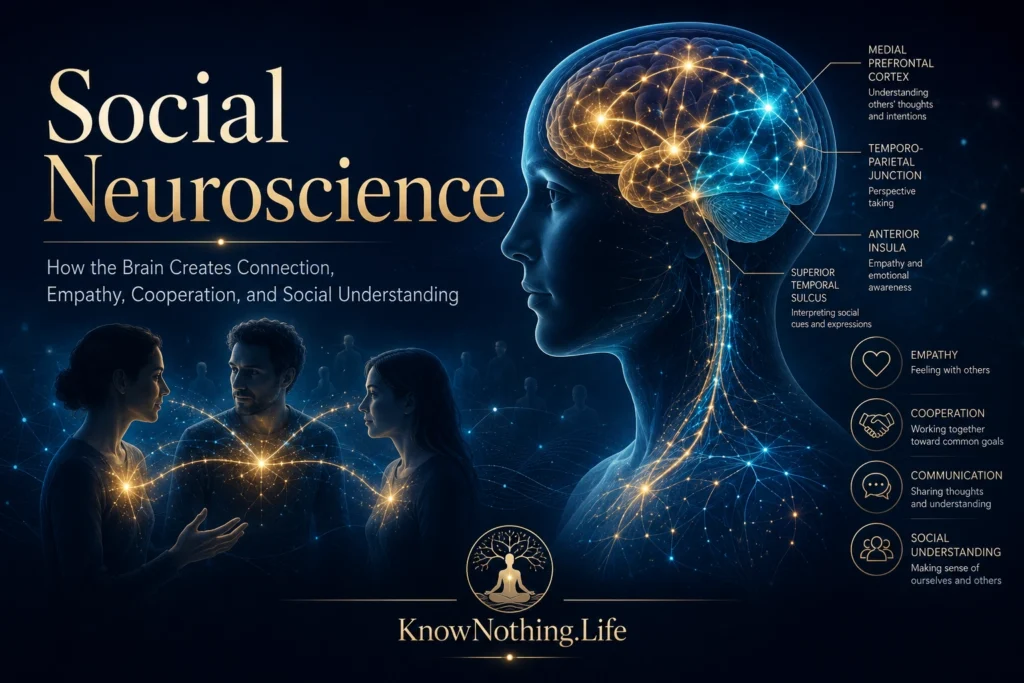
Human brains develop and operate within social environments. Facial expressions, tone of voice, reputation, group membership, cooperation, rejection, and attachment can alter attention, memory, motivation, bodily arousal, and decision-making. Social neuroscience therefore does not search for a single “social center.” It studies distributed networks involving the amygdala, superior temporal sulcus, temporoparietal junction, medial prefrontal cortex, anterior insula, anterior cingulate cortex, striatum, orbitofrontal cortex, and hippocampus. Modern network models emphasize that each region’s contribution depends on the person, relationship, context, and social task.
Social Perception and the Amygdala
Social interaction begins with perception. The brain must identify faces, gaze direction, body movement, vocal emotion, and signals of intention while deciding which information deserves attention. Temporal visual regions help analyze faces and biological motion, while the superior temporal sulcus responds strongly to changing social information such as gaze, expression, and movement. The amygdala connects these perceptual signals with emotional significance, uncertainty, learning, and motivation. Ralph Adolphs’s research helped establish that the amygdala contributes not merely to fear but to determining what social information matters.
Evidence from people with amygdala damage illustrates this broader function. Some patients experience difficulty recognizing fearful expressions or complex social emotions, partly because they do not spontaneously examine the eye region of faces in the usual way. Yet the amygdala is not simply a detector for fear or untrustworthy people. It communicates with sensory cortex, the hippocampus, striatum, and prefrontal regions to evaluate ambiguity, novelty, reward, and threat. Kevin Bickart and colleagues also reported a correlation between amygdala volume and the size and complexity of adult social networks, although the study could not determine whether brain structure shapes social life, social experience changes the brain, or both processes occur together.
Mentalizing and Understanding Other Minds
Mentalizing, often called theory of mind, is the capacity to infer another person’s beliefs, intentions, desires, knowledge, and perspective. This ability allows people to recognize that someone else may understand a situation differently from themselves. Chris and Uta Frith described a mentalizing network that prominently includes the medial prefrontal cortex, temporoparietal junction, posterior cingulate cortex, precuneus, and temporal regions. Meta-analyses associate the temporoparietal junction particularly with reasoning about temporary mental states, while the medial prefrontal cortex contributes to judgments about people, personality traits, social norms, and more enduring characteristics.
These regions are not exclusive to social thought. The temporoparietal junction also contributes to attention and switching between perspectives, while the medial prefrontal cortex participates in valuation, memory, prediction, and self-referential thought. Their social role emerges from coordinated activity across larger networks. Mentalizing also differs from merely observing or internally simulating an action. Meta-analytic research by Jody Van Overwalle and Kris Baetens found that action-observation systems respond strongly to visible movements, whereas mentalizing networks become especially important when people infer hidden goals, beliefs, intentions, or moral meaning.
Empathy, Emotion Sharing, and Compassion
Empathy includes several related but separable abilities. A person may share another individual’s emotional state, understand that person’s perspective, recognize suffering without reproducing it, or experience concern that motivates assistance. Jean Decety and Philip Jackson proposed a distributed architecture in which emotion sharing, self–other distinction, perspective taking, and executive regulation interact. Emotional resonance alone is not sufficient for effective empathy. Without regulation and a clear distinction between self and other, another person’s distress may produce personal discomfort or withdrawal rather than helpful concern.
Tania Singer and colleagues demonstrated that watching a loved one receive a painful stimulus recruited parts of the observer’s anterior insula and anterior cingulate cortex associated with the emotional significance of pain, but not the full sensory pattern produced by personally receiving the stimulus. A later meta-analysis by Claus Lamm, Decety, and Singer supported both shared and distinct components of experienced and observed pain. Empathy also changes with context. Familiarity, attention, responsibility, perceived fairness, and group membership can alter neural and behavioral responses, showing that empathy is shaped by evaluation rather than distributed automatically and equally toward everyone.
Belonging, Rejection, and Social Pain
Social connection provides safety, caregiving, information, resources, and opportunities for cooperation. Because exclusion can be costly for a social species, the brain closely monitors signs of acceptance and rejection. In the influential Cyberball experiment, Naomi Eisenberger, Matthew Lieberman, and Kipling Williams found that exclusion during a virtual ball-tossing game increased anterior cingulate activity, which correlated with participants’ reported distress. The results helped establish the study of “social pain” by suggesting that threats to social connection engage some systems also involved in processing physically painful experiences.
The relationship between physical and social pain is more complicated than complete neural overlap. Choong-Wan Woo and colleagues found that physical pain and social rejection could produce distinct multivariate patterns even within some of the same broad brain regions. Social rejection can therefore recruit shared affective and salience systems without being neurologically identical to bodily injury. Perceived social isolation may also increase vigilance for interpersonal threat and encourage cycles of negative interpretation, withdrawal, and disrupted stress regulation. Social support can work in the opposite direction by reducing perceived demands and distributing the burden of coping.
Cooperation, Fairness, and Social Reward
Social life requires decisions about trust, reciprocity, fairness, competition, and shared benefit. James Rilling and colleagues used an iterated Prisoner’s Dilemma and found that mutual cooperation recruited reward-related regions including the nucleus accumbens, caudate, ventromedial frontal cortex, and rostral anterior cingulate cortex. Cooperation can therefore be intrinsically reinforcing, especially when it creates reciprocal benefit and supports an ongoing relationship. Jean Decety and colleagues similarly found that cooperation and competition engage shared executive and arousal systems while also producing different patterns related to their opposing social goals.
Fairness can sometimes outweigh immediate material gain. In Alan Sanfey and colleagues’ Ultimatum Game study, unfair offers activated the anterior insula and dorsolateral prefrontal cortex, and stronger insula responses were associated with rejecting unfair divisions. Oxytocin has also been studied in trust and affiliation, but it is not a universal “bonding hormone.” Michael Kosfeld and colleagues initially reported greater trust after intranasal oxytocin, while a later registered replication did not reproduce the original effect in the same straightforward form. Oxytocin’s social consequences appear sensitive to the person, group, situation, and experimental method.
The Social Brain as a Flexible Network
Robin Dunbar’s social brain hypothesis proposed that the cognitive demands of maintaining complex relationships contributed to primate brain evolution. Comparative work linked aspects of neocortical size with typical social-group size, while studies of human relationships suggested layered networks ranging from intimate support ties to broad circles of acquaintances. The well-known estimate of approximately 150 meaningful contacts remains influential, but it should not be treated as a fixed neurological limit. Researchers have questioned its statistical precision and emphasized differences among societies, communication systems, life stages, and definitions of a relationship.
Social experience may both reflect and shape the brain. Research has associated social-network characteristics with variation in the amygdala and temporal regions, but these findings remain correlational. Contemporary social neuroscience increasingly uses naturalistic video, interactive games, mobile measurements, network analysis, and hyperscanning, which records two or more people during interaction. These methods aim to move beyond isolated participants viewing simplified images and toward the changing reciprocity of conversation, cooperation, and shared activity.
Social Neuroscience and Human Well-Being
Social-cognitive difficulties are relevant to conditions including autism, schizophrenia, frontotemporal dementia, social anxiety, depression, and brain injury. Yet no condition can be explained by one defective social circuit. Similar outward behaviors may arise from different mechanisms, such as difficulty recognizing facial emotion, inferring beliefs, regulating arousal, experiencing social reward, or learning from interpersonal feedback. Meta-analyses comparing autism and schizophrenia demonstrate both shared social-cognitive challenges and differences in their patterns and developmental trajectories.
The field’s central insight is that the social world is biologically consequential without being biologically predetermined. Brains help create relationships, but relationships also train attention, shape expectations, regulate stress, and influence behavior. Empathy, trust, prejudice, cooperation, attachment, and loneliness emerge from interactions among neural systems, bodily states, personal histories, and cultural environments. Social neuroscience therefore explains neither society through the brain alone nor the brain without society. It studies the continuous exchange through which human nervous systems become capable of understanding, influencing, and supporting one another.