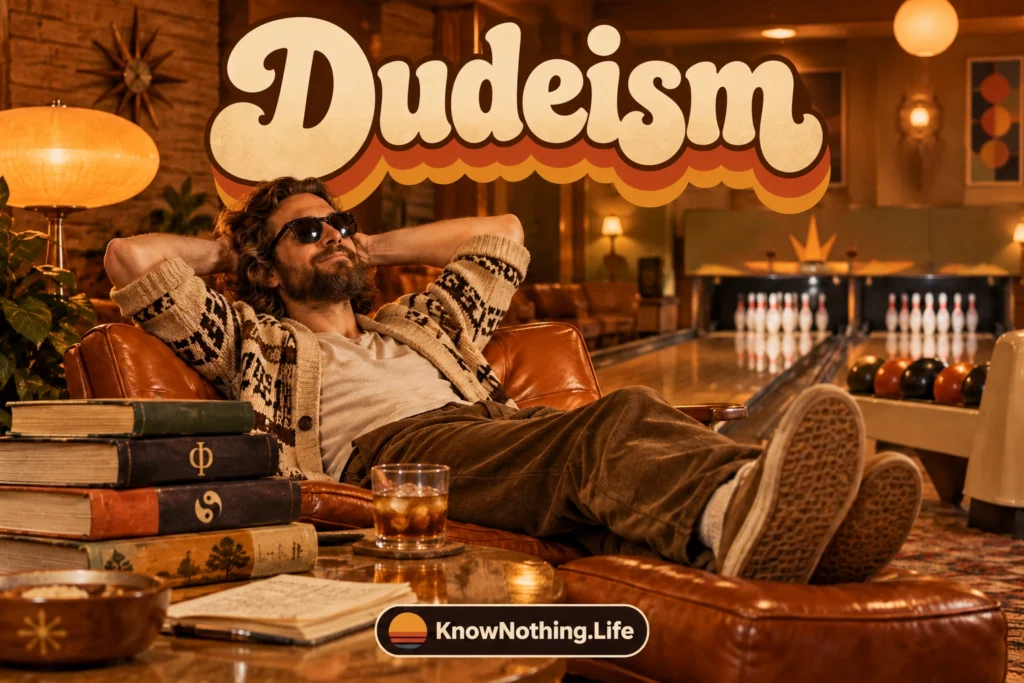
Dudeism began as a joke, but jokes have a long history of saying serious things that solemn philosophies sometimes struggle to express. Inspired by the Coen brothers’ 1998 film The Big Lebowski and especially by Jeff Bridges’ character Jeffrey “The Dude” Lebowski, Dudeism presents relaxation, humility, tolerance, simplicity, and adaptability as responses to an anxious and excessively complicated world. Its central vocabulary is deliberately ridiculous. Followers are “Dudeists.” Clergy are Dudeist priests. Its institutional home calls itself the Church of the Latter-Day Dude. Its most recognizable spiritual formula is simply “The Dude abides.” Yet beneath the bathrobe, bowling, White Russians, and movie quotations is a recognizable philosophical question: How should a person live when much of life cannot be controlled and many of the things society tells us to pursue do not actually make us happier?
Dudeism’s answer is intentionally less systematic than those of Aristotle, Kant, or the Stoics. It does not offer a metaphysical system, detailed moral commandments, or a final explanation of reality. Founder Oliver Benjamin instead describes it as an “open source religion,” one willing to remain uncertain and revise itself. Dudeism’s own materials identify Daoism, Zen, Humanism, Epicureanism, and other traditions as major inspirations rather than claiming that its philosophy began with The Big Lebowski. Its comedic surface therefore functions as a contemporary container for much older ideas: act without forcing, distrust excessive ambition, distinguish necessities from manufactured desires, tolerate uncertainty, avoid taking yourself too seriously, and recognize that sometimes the wisest response to disorder is simply to remain psychologically flexible enough to abide.
From The Big Lebowski to the Church of the Latter-Day Dude
Oliver Benjamin founded the Church of the Latter-Day Dude in 2005 after an encounter with The Big Lebowski that he later described as transformative. Benjamin had spent years traveling and studying religions and philosophies but felt that no existing framework quite expressed the outlook he was seeking. In interviews, he explained that the Dude gave recognizable form to ideas he associated with Daoism, Zen Buddhism, Epicureanism, and other traditions. The organization that emerged around this insight deliberately blurred the boundary between philosophy, religion, fandom, satire, and self-help. Benjamin and Dwayne Eutsey later developed the ideas further in The Abide Guide, while The Tao of the Dude and The Dude De Ching explicitly connect Dudeist themes with older philosophical traditions.
The Dude himself is an unusual philosophical exemplar. He is not conventionally successful. He possesses little status, displays almost no career ambition, dresses without concern for prestige, and repeatedly becomes entangled in conflicts he did not initiate. He is certainly imperfect: he becomes irritated, makes mistakes, avoids responsibility at times, and is hardly a model of disciplined moral excellence. That imperfection is part of his appeal. Dudeism does not present the sage as an unreachable figure who has conquered every weakness. Instead, the Dude represents a person continually knocked off balance who somehow returns to equilibrium. His achievement is not mastery of the universe. It is the ability, however unevenly, to stop demanding that the universe behave according to his plans.
Dudeism and Daoism: Acting Without Forcing
The strongest philosophical ancestor claimed by Dudeism is Daoism. Classical Daoist philosophy associated with the Daodejing and Zhuangzi questions the human tendency to impose rigid schemes upon a world that is constantly changing. One central concept is wu wei, often translated as “nonaction,” although scholars caution that the phrase does not mean total passivity. It can instead suggest non-coercive, effortless, or unforced action—responding appropriately without adding unnecessary struggle. The related concept ziran refers to naturalness or spontaneity, the way things emerge or become so through their own processes. Scholarly interpretations emphasize that Dao is not simply a list of commandments but a field of possible ways through which beings move and develop.
This is almost exactly the territory Dudeism turns into comedy. The Dude does not conquer situations through elaborate planning; much of the humor of The Big Lebowski comes from the failure of everyone else’s plans. Characters scheme, threaten, manipulate, posture, and pursue grand narratives about themselves. The Dude mostly gets carried through the resulting confusion. Dudeism interprets his relaxed style as a pop-cultural version of wu wei: not refusal to act, but refusal to force everything into obedience. Its official description reduces the attitude to “Just take it easy, man.” That sounds trivial until placed beside the Daoist suspicion that excessive striving can produce precisely the disorder it was intended to eliminate.
What Does It Mean to “Abide”?
The word abide provides Dudeism with something close to a central virtue. In ordinary English, to abide can mean to endure, remain, tolerate, or continue. Dudeism turns that ambiguity into philosophy. To abide is not necessarily to approve of everything that happens. It is to remain psychologically intact when reality refuses to match expectation. Life contains losses, embarrassment, uncertainty, conflict, aging, failure, other people’s irrationality, and countless events beyond personal control. Much human suffering arises not merely from these events but from the demand that they should never have occurred.
That makes abiding different from simple surrender. Resignation says, nothing can be done. Abiding says, not everything needs to be fought in the same way. Some situations require action; others require patience, humor, adaptation, or acceptance. This resembles modern psychological ideas concerning psychological flexibility—the capacity to remain in contact with difficult experience while adapting behavior to circumstances rather than rigidly attempting to eliminate discomfort. A 2026 meta-analysis of 45 studies involving more than 16,000 participants found a substantial positive association between mindfulness and psychological flexibility, although such research obviously does not test Dudeism itself. The parallel is conceptual rather than evidentiary: both resist the assumption that mental health requires controlling every unwanted thought, emotion, or circumstance.
The Epicurean Dude: Wanting Less Instead of Getting More
Dudeism also resembles Epicureanism, though both philosophies are easily misunderstood. Epicurus is often imagined as an advocate of indulgence, just as the Dude can be mistaken for a mascot of mindless consumption. Historical Epicureanism was nearly the reverse. Epicurus distinguished necessary desires from unnecessary and “empty” desires and argued that increasing one’s cravings often increases anxiety rather than happiness. The Epicurean goal of ataraxia was tranquility or freedom from mental disturbance, joined with freedom from unnecessary physical suffering. Simple pleasures, friendship, security, and the reduction of irrational fear mattered more than endless acquisition.
From that perspective, the Dude’s modest lifestyle becomes philosophically interesting. He does not require wealth, professional prestige, luxury, or social recognition to regard an afternoon of bowling with friends as worthwhile. Dudeism explicitly identifies Epicureanism as one of its major historical inspirations and has even published a playful Dudeist adaptation of Epicurus’ Letter to Menoeceus. The deeper connection is not alcohol, laziness, or hedonistic excess. It is the suspicion that civilization continually manufactures desires and then convinces people they have failed if those desires remain unsatisfied. Epicurus’ philosophy asks what humans actually need for contentment. Dudeism answers in less dignified language: probably less than we have been told.
Dudeism and Stoicism Are Similar—but Not the Same
Dudeism is also frequently compared with Stoicism because both emphasize remaining steady when external events become difficult. The Stoic tradition distinguishes between genuine goods—ultimately centered on virtue—and external conditions such as wealth, health, reputation, and status. Later Stoics such as Epictetus emphasize the importance of directing concern toward what depends upon our own judgment and action rather than becoming enslaved to circumstances we cannot command. Stoic ethics is therefore fundamentally about developing rational self-mastery and consistency of character.
Yet the mood of the two philosophies differs dramatically. Stoicism can sound disciplined, demanding, and morally strenuous. Dudeism distrusts strenuousness itself when it becomes compulsive. The Stoic sage cultivates reason so thoroughly that external fortune cannot overthrow virtue; the Dude is more likely to shrug, put on a bathrobe, and admit that the entire situation is confusing. Where Stoicism often emphasizes mastery of judgment, Dudeism emphasizes loosening one’s grip. Both seek equanimity, but one reaches it through disciplined philosophical training while the other idealizes relaxed adaptation. Dudeism could consequently be described as Stoicism with lower blood pressure and considerably less interest in appearing stoic.
Leisure as a Philosophical Protest
Dudeism’s celebration of laziness is deliberately provocative because modern societies frequently treat constant productivity as evidence of moral worth. Work is necessary, effort can be meaningful, and ambition can produce valuable accomplishments. But problems arise when productivity expands from an activity into an identity. A person can begin measuring every hour by output, every hobby by whether it can be monetized, every relationship by usefulness, and even rest by whether it improves later performance. Leisure then stops being part of life and becomes maintenance performed so that more work can happen.
Modern psychological research gives this concern more substance than the Dude’s lifestyle alone could provide. Organizational psychologist Sabine Sonnentag and colleagues have repeatedly found that psychological detachment from work during nonwork hours is associated with better recovery and well-being. A major review found that inability to mentally disengage from work is linked with greater strain, burnout, and lower life satisfaction, while successful detachment can support recovery without implying reduced engagement at work. Later reviews likewise emphasize the importance of breaks, evenings, weekends, vacations, and other recovery periods for maintaining well-being and performance. None of this proves that everyone should imitate the Dude, but it challenges the assumption that constant occupational preoccupation is inherently virtuous.
Humor Is Part of the Philosophy
A feature distinguishing Dudeism from most traditional philosophies is that it refuses to become entirely serious about itself. This is more than decoration. Religious and philosophical systems can become dangerous when their followers become incapable of recognizing their own fallibility. Dudeism counters that risk with humor. One of its stated principles is that claims remain open to debate; its language continually undermines attempts to transform the movement into rigid doctrine. Even its sacred literature parodies the very idea of sacred literature. The Dude De Ching, for example, explicitly remakes the Tao Te Ching using the idiom of The Big Lebowski, placing Dudeist versions beside older Daoist material.
Humor also functions philosophically as a change in perspective. An experience that seems catastrophic from inside one’s ego can become absurd when viewed from a wider angle. This does not mean that tragedy is funny or that genuine suffering should be dismissed. Rather, self-directed humor can reduce the importance we assign to minor humiliations, status contests, arguments, and failures. Dudeism’s signature line—“That’s just, like, your opinion, man”—is funny because it sounds intellectually unimpressive. Yet hidden inside it is a modest epistemological principle: human beings frequently mistake their perspective for reality itself. Dudeism turns intellectual humility into a punch line.
The Strongest Criticism: Is Dudeism Just Privileged Laziness?
The most obvious criticism of Dudeism is also serious: taking it easy is easier when someone has the luxury to take it easy. Poverty, caregiving responsibilities, illness, dangerous employment, discrimination, war, and other forms of hardship cannot simply be shrugged away. A philosophy centered on leisure can become shallow if it implies that overwhelmed people merely need to relax. The Dude himself can afford his detached lifestyle partly because the fictional story does not seriously investigate how his rent, health care, aging, or long-term material security work. Real people often strive not because they are neurotically ambitious but because survival requires it.
Dudeism also risks confusing acceptance with avoidance. There are situations in which anger is appropriate, effort is necessary, injustice must be confronted, and failing to act harms others. Daoist wu wei does not mean doing nothing, and Epicurus did not recommend intellectual laziness. Even Stoic acceptance of uncontrollable events was embedded within a demanding ethics of virtue. Dudeism is strongest when “taking it easy” means avoiding needless internal struggle; it is weakest when the phrase becomes an excuse for irresponsibility. A person who always abides while friends, families, or communities carry the consequences of that passivity is no sage. He is simply making other people do the difficult parts of life.
Dudeism as a Philosophy for an Age of Overreaction
Dudeism should therefore not be mistaken for a rigorous philosophical system comparable with Daoism, Epicureanism, or Stoicism. It is a modern synthesis, parody, and cultural philosophy that selectively borrows from those traditions. Its founder openly describes it as something inspired by many different sources, and its scriptures are intentionally humorous reinterpretations rather than ancient authorities. That lack of systematic structure is both its philosophical weakness and part of its point. Dudeism distrusts the human urge to turn every insight into another rigid institution.
What it offers instead is a temperament: desire less, worry less about status, recognize uncertainty, make room for leisure, avoid unnecessary conflict, value friendship, distrust people who claim absolute certainty, and remain adaptable when life inevitably throws a gutter ball. Daoism provides the idea of unforced action. Epicurus contributes simplicity and tranquility. Stoicism supplies resilience toward external events. Modern psychology gives some empirical support to the need for recovery and psychological flexibility. The Big Lebowski gives the whole thing a bathrobe.
Dudeism’s philosophical contribution may ultimately be less profound than its most enthusiastic followers suggest, but it addresses a genuine modern problem. Humans have become extraordinarily good at turning inconvenience into crisis, desire into necessity, disagreement into identity, and productivity into a measure of personal worth. Against that tendency, Dudeism proposes an intentionally modest ideal.
Life will not always make sense.
Things will go wrong.
People will disagree.
Plans will collapse.
And sometimes, when there is nothing useful left to force, control, optimize, or prove, there remains a surprisingly difficult philosophical practice:
The Dude abides.