Truth is one of the most fundamental yet elusive concepts in philosophy. Every claim to knowledge presupposes some understanding of truth, yet defining what truth is has proven remarkably difficult. Is truth a correspondence between statements and reality? Is it a matter of coherence within a system of beliefs? Or is it something more practical, tied to usefulness and success? These questions have given rise to a range of competing theories, each offering a different account of what it means for a proposition to be true.
The study of truth is central not only to epistemology but also to logic, language, and metaphysics. Philosophers have long recognized that without a clear concept of truth, it is impossible to evaluate beliefs or distinguish knowledge from error. As Aristotle famously stated, “To say of what is that it is, and of what is not that it is not, is true.” This classical formulation continues to influence discussions of truth to this day.
From ancient philosophy to contemporary analytic thought, truth theories have evolved in response to new challenges and insights. Thinkers such as Alfred Tarski, William James, Bertrand Russell, and Donald Davidson have each contributed to shaping the modern understanding of truth. By examining these theories, we can better understand how truth functions as a cornerstone of knowledge.
The Correspondence Theory of Truth
The correspondence theory is perhaps the most intuitive and historically influential account of truth. According to this theory, a statement is true if it corresponds to the way the world actually is. Truth, in this sense, is a relationship between language and reality.
This idea can be traced back to Aristotle and later developed by philosophers such as Bertrand Russell. Russell argued that propositions are true when they correspond to facts, which are objective features of the world. For example, the statement “the sky is blue” is true if and only if the sky is indeed blue.
The strength of the correspondence theory lies in its alignment with common sense. It captures the intuitive idea that truth involves getting things right about the world. However, it also raises difficult questions about the nature of facts and how language relates to reality. What exactly are facts, and how do they correspond to statements? These questions have led to refinements and critiques of the theory.
The Coherence Theory of Truth
In contrast to correspondence, the coherence theory defines truth in terms of consistency within a system of beliefs. According to this view, a statement is true if it coheres with a set of beliefs that are themselves consistent and mutually supportive.
This theory is often associated with philosophers such as G. W. F. Hegel and later defended by thinkers like Brand Blanshard. Coherence theorists argue that truth cannot be understood in isolation but must be considered within the context of a broader system of beliefs.
The coherence theory emphasizes the interconnected nature of knowledge. A belief is not evaluated solely on its own but in relation to other beliefs. This approach aligns with the idea that knowledge forms a network rather than a collection of isolated facts. However, critics point out that a coherent system of beliefs could still be false if it does not correspond to reality, raising concerns about the relationship between coherence and truth.
The Pragmatic Theory of Truth
The pragmatic theory offers a different perspective by linking truth to practical consequences. According to this view, a statement is true if it works—if it proves useful, successful, or effective in guiding action. Truth, in this sense, is not a static property but something that emerges through experience and application.
This theory is most closely associated with William James and Charles Sanders Peirce. James famously described truth as “what works,” suggesting that beliefs are validated by their ability to produce satisfactory results. Peirce, on the other hand, emphasized the long-term convergence of inquiry, arguing that truth is what would be agreed upon by an ideal community of investigators.
The pragmatic theory highlights the dynamic and practical aspects of truth, making it particularly relevant to scientific and everyday reasoning. However, it also raises questions about whether usefulness is sufficient for truth. A belief may be useful without being true, leading critics to question whether pragmatism conflates truth with practicality.
Deflationary and Minimalist Theories
In the 20th century, some philosophers began to question whether truth requires a substantive theory at all. Deflationary and minimalist theories argue that truth is not a deep or complex property but a logical or linguistic convenience.
Alfred Tarski played a key role in this development with his semantic theory of truth. In his work on formal languages, Tarski introduced the idea that the statement “’Snow is white’ is true if and only if snow is white” captures the essence of truth. This approach focuses on the logical structure of truth rather than its metaphysical nature.
Similarly, philosophers such as Donald Davidson argued that truth is a basic concept that does not require further analysis. According to these views, saying that a statement is true does little more than affirm the statement itself. While deflationary theories simplify the concept of truth, critics argue that they fail to address its deeper philosophical significance.
Truth, Language, and Meaning
The relationship between truth and language is a central concern in modern philosophy. Truth is often expressed through statements or propositions, making it closely tied to issues of meaning and interpretation. Philosophers have explored how language represents reality and how truth emerges from this relationship.
Donald Davidson, for example, argued that understanding truth is essential to understanding meaning. His work suggests that truth conditions—the circumstances under which a statement is true—play a key role in interpreting language. This approach connects theories of truth with broader questions about communication and understanding.
The study of truth in relation to language also raises questions about relativism and objectivity. If meaning varies across contexts or cultures, does truth vary as well? These debates highlight the complexity of truth as both a philosophical and linguistic concept.
Challenges and Paradoxes of Truth
The concept of truth is not without its difficulties. One of the most famous challenges is the liar paradox, exemplified by the statement “This sentence is false.” If the sentence is true, then it must be false; if it is false, then it must be true. Such paradoxes reveal tensions within our understanding of truth and have led to significant developments in logic and philosophy.
Philosophers have proposed various solutions to these paradoxes, including hierarchical theories of language and revisions to classical logic. Alfred Tarski, for instance, addressed the liar paradox by distinguishing between object language and meta-language, preventing self-referential contradictions. These challenges demonstrate that truth is not a simple or straightforward concept. It involves deep questions about language, logic, and reality, making it one of the most complex topics in philosophy.
Conclusion
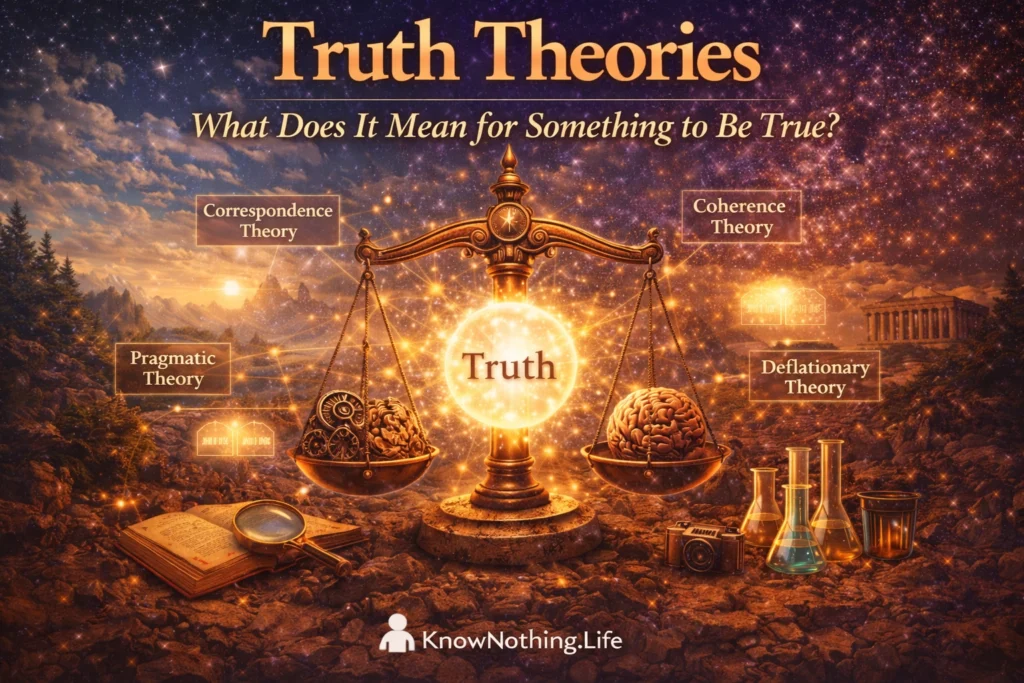
The study of truth reveals the richness and complexity of one of philosophy’s most fundamental concepts. From the correspondence theory’s emphasis on reality to the coherence theory’s focus on systems of belief, and from pragmatism’s practical orientation to deflationary approaches, each theory offers a unique perspective on what it means for something to be true.
What unites these theories is the recognition that truth is essential to knowledge and understanding. Without a concept of truth, it would be impossible to evaluate beliefs or distinguish between knowledge and error. As William James observed, “Truth happens to an idea. It becomes true, is made true by events.”
The ongoing debate over truth reflects its central importance in philosophy. While no single theory has achieved universal acceptance, each contributes to a deeper understanding of how truth functions in relation to belief, language, and reality. In exploring these theories, we come closer to understanding not only what truth is, but why it matters.