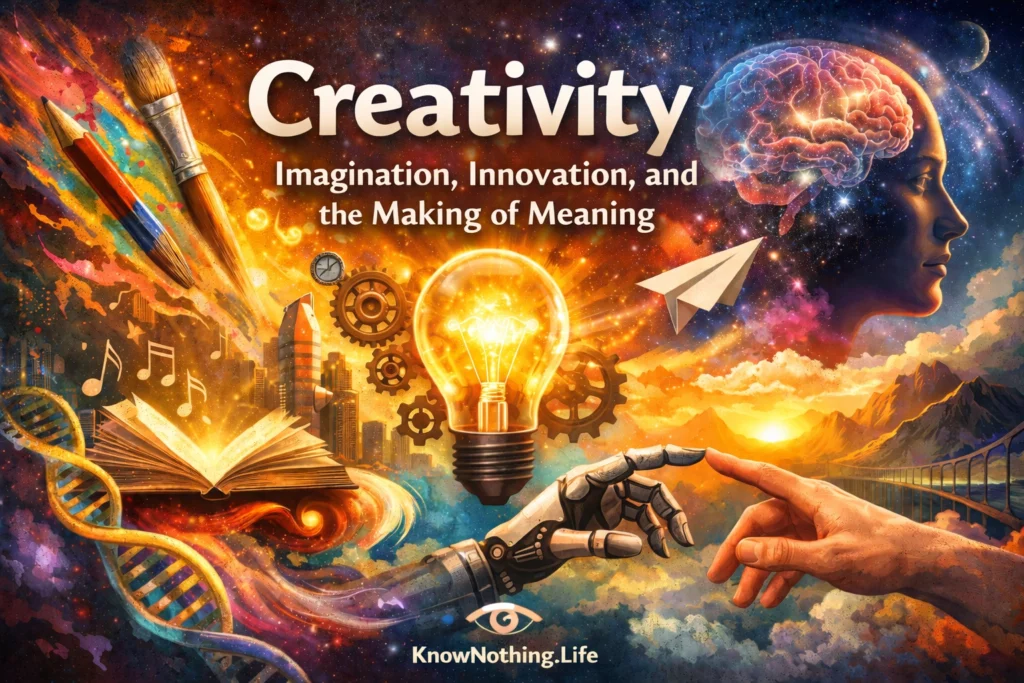
Creativity is one of the defining capacities of human beings, shaping art, science, language, and culture. It is often described as the ability to produce something new, original, and valuable, yet this definition only begins to capture its philosophical depth. What does it mean to create? Is creativity a rare gift possessed by a few, or a universal capacity present in all minds? And how does creativity relate to imagination, knowledge, and experience?
Philosophers have long grappled with these questions, exploring creativity as both a psychological process and a metaphysical phenomenon. It involves not only the generation of new ideas but the transformation of existing ones, drawing connections between seemingly unrelated concepts. Creativity thus reveals a dynamic aspect of human thought, one that resists rigid structures and embraces possibility.
From the aesthetic theories of Immanuel Kant to modern reflections on innovation and cognition, creativity has been understood as a central feature of human freedom and expression. It is through creative activity that individuals shape the world and give form to meaning, making creativity a cornerstone of both personal and cultural development.
Classical and Enlightenment Foundations
In classical philosophy, creativity was not always treated as a distinct concept but was closely tied to ideas of imitation and craftsmanship. Plato, for example, viewed artistic creation with skepticism, seeing it as a form of imitation (mimesis) rather than genuine creation. In The Republic, he argues that artists do not create new realities but merely reproduce appearances, distancing themselves from truth. This perspective limits creativity to replication rather than innovation.
Aristotle offers a more constructive view, recognizing the role of imagination in artistic production. While he also emphasizes mimesis, Aristotle suggests that artists do not simply copy reality but reorganize it, presenting what could be rather than what is. This introduces an element of creativity as transformation, allowing for new possibilities within representation.
The Enlightenment marks a turning point in the philosophical understanding of creativity. Immanuel Kant introduces the concept of genius in his Critique of Judgment, describing it as the natural ability to produce works that are both original and exemplary. Kant writes, “Genius is the talent (natural gift) which gives the rule to art,” emphasizing that true creativity cannot be reduced to learned techniques or rules. Instead, it involves a spontaneous and innovative capacity that sets new standards for others to follow.
Imagination and the Creative Mind
At the heart of creativity lies imagination—the ability to form images, ideas, and possibilities beyond immediate perception. Philosophers have long considered imagination as the driving force behind creative activity, enabling individuals to transcend the given and explore new forms of thought.
Samuel Taylor Coleridge provides one of the most influential accounts of imagination, distinguishing between “primary” and “secondary” imagination in his work Biographia Literaria. The primary imagination is a fundamental human faculty that shapes perception, while the secondary imagination is a creative power that transforms and reconfigures experience. Coleridge describes this process as dissolving and re-creating, suggesting that creativity involves both deconstruction and synthesis.
This view highlights the active nature of the mind in creative processes. Creativity is not simply about generating ideas but about reshaping existing materials into new configurations. It involves a balance between freedom and constraint, where imagination operates within and against established structures.
Modern philosophy and cognitive theory have expanded on these ideas, examining how creativity emerges from the interaction of memory, perception, and reasoning. Creative thought often involves making unexpected connections, challenging assumptions, and exploring alternative possibilities. This dynamic process reflects the complexity of human cognition, showing that creativity is not a single faculty but a multifaceted activity.
Creativity and Expression
Creativity is closely linked to expression, particularly in the arts, where it serves as a means of communicating inner experience. Artistic creation often involves translating emotions, thoughts, and perceptions into external forms, making them accessible to others.
Leo Tolstoy emphasizes this connection in What Is Art?, where he argues that art is the communication of feeling. Creativity, in this context, is the process through which personal experience is transformed into shared meaning. Tolstoy writes that art “infects” others with the artist’s emotions, highlighting the relational nature of creative expression.
Similarly, R. G. Collingwood argues that creativity involves the clarification of emotion. In The Principles of Art, he suggests that artists do not begin with fully formed ideas but discover their meanings through the act of creation. Creativity, therefore, is not merely expressive but exploratory, revealing aspects of experience that were previously undefined.
This perspective underscores the transformative power of creativity. It is not only a means of communication but a way of understanding oneself and the world. Through creative activity, individuals articulate their inner lives, contributing to a shared cultural landscape.
Creativity, Innovation, and Knowledge
Beyond the arts, creativity plays a crucial role in science, technology, and intellectual inquiry. Scientific discoveries, for example, often require imaginative leaps that go beyond existing knowledge. Creativity, in this sense, is essential for innovation, enabling new ways of thinking and problem-solving.
Philosophers of science have emphasized the role of creativity in theory formation and discovery. Karl Popper argues that scientific progress depends on bold conjectures and imaginative hypotheses. While empirical testing is essential, the generation of new ideas requires creative insight. Popper’s view highlights the interplay between imagination and rationality, suggesting that creativity is integral to the advancement of knowledge.
Similarly, Thomas Kuhn explores how scientific revolutions involve shifts in perspective that cannot be explained by incremental reasoning alone. In The Structure of Scientific Revolutions, Kuhn argues that paradigm shifts require new ways of seeing the world, often driven by creative thinking. These transformations demonstrate that creativity is not limited to artistic domains but is fundamental to intellectual progress.
Creativity, Freedom, and Human Potential
Creativity is often associated with freedom—the ability to think and act beyond constraints. Philosophers have explored this connection, suggesting that creativity reflects the open-ended nature of human existence.
Friedrich Nietzsche emphasizes the creative power of individuals in shaping values and meaning. In his writings, creativity is linked to the concept of self-creation, where individuals actively construct their identities and perspectives. Nietzsche’s idea of the “artist-philosopher” highlights the role of creativity in redefining norms and exploring new possibilities.
Existentialist thinkers such as Jean-Paul Sartre further develop this idea, arguing that human beings are fundamentally free and responsible for creating their own meanings. Creativity, in this context, is not limited to artistic production but extends to all aspects of life. It is through creative choices that individuals shape their existence, making creativity a central aspect of human freedom.
This broader perspective reveals creativity as a fundamental dimension of human potential. It is not confined to specific domains but permeates everyday life, influencing how individuals think, act, and relate to the world.
Conclusion
Creativity is a complex and multifaceted phenomenon that spans philosophy, art, science, and culture. From the concept of genius in Immanuel Kant to the imaginative processes described by Samuel Taylor Coleridge and the transformative insights of Friedrich Nietzsche, philosophical accounts of creativity reveal its depth and significance.
What emerges from these perspectives is a recognition that creativity is not merely the production of novelty but a dynamic process of transformation and meaning-making. It involves imagination, expression, and innovation, reflecting the interplay between individual thought and cultural context.
To understand creativity is to understand how humans engage with possibility. It is a capacity that allows us to go beyond what is given, to imagine what could be, and to bring new forms into existence. In this sense, creativity is not only a feature of human activity but a defining aspect of what it means to be human.