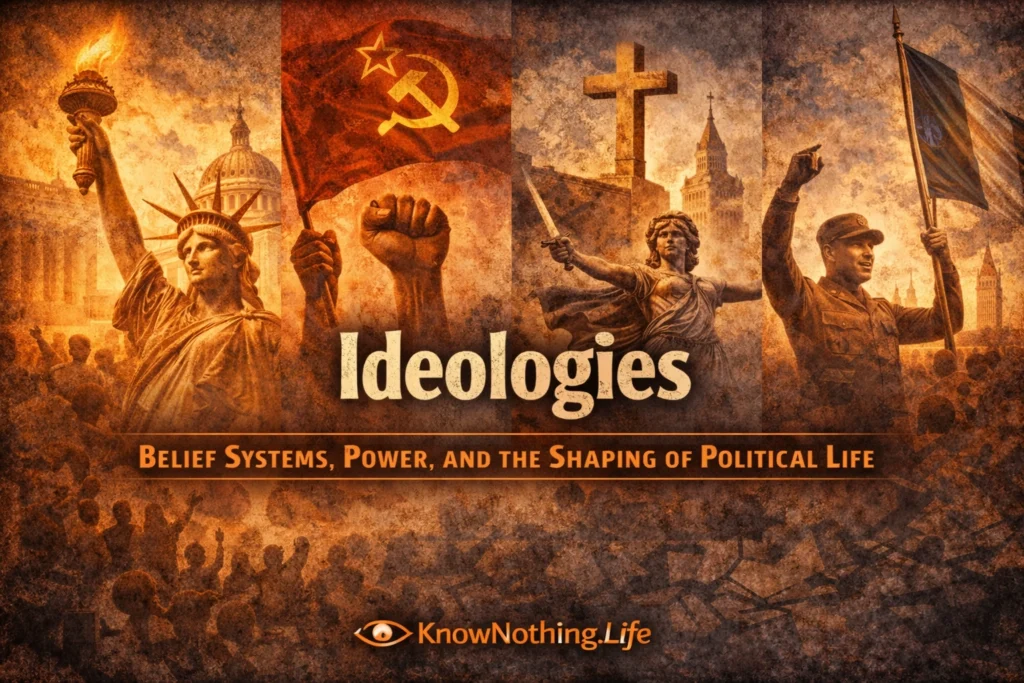
Ideologies are structured philosophical systems of ideas that shape how individuals and societies understand the world, organize political life, and justify authority. They provide frameworks for interpreting social realities, defining values, and guiding action. Whether expressed as liberalism, conservatism, socialism, or nationalism, ideologies influence institutions, policies, and collective identities. They do not merely describe the world but prescribe how it ought to be, linking descriptive claims with normative commitments.
The power of ideology lies in its ability to shape perception. It frames what counts as natural, just, or inevitable, often operating beneath conscious awareness. This makes ideology both a tool for organizing society and a mechanism for maintaining power. By examining ideologies, we gain insight into the assumptions that underlie political systems and the ways in which beliefs can both liberate and constrain human thought.
The Origins and Development of Ideological Thought
The concept of ideology emerges in the late eighteenth and early nineteenth centuries, initially associated with the study of ideas themselves. However, it gains a more critical meaning in the work of Karl Marx and Friedrich Engels. In The German Ideology, they argue that dominant ideas in society reflect the interests of the ruling class. Ideology, in this sense, is not neutral but serves to legitimize existing power structures.
Marx and Engels famously assert, “The ideas of the ruling class are in every epoch the ruling ideas.” This statement captures the critical function of ideology as a means of maintaining dominance by shaping beliefs. According to this view, ideology obscures the true nature of social relations, presenting them as natural or inevitable rather than historically contingent. This critique introduces the idea of “false consciousness,” where individuals internalize beliefs that work against their own interests.
At the same time, ideology is not merely a tool of domination. It can also serve as a source of resistance and transformation. Revolutionary movements often develop their own ideologies to challenge existing systems, offering alternative visions of society. This dual role highlights the complexity of ideology as both a stabilizing and destabilizing force in political life.
Liberalism, Conservatism, and Competing Visions
Among the most influential ideologies in modern political thought are liberalism and conservatism, each offering distinct perspectives on freedom, authority, and change. Liberalism, rooted in the work of John Locke and later thinkers like John Stuart Mill, emphasizes individual rights, limited government, and the protection of personal liberty. In On Liberty, Mill argues for the importance of individual autonomy and freedom of expression, asserting that “over himself, over his own body and mind, the individual is sovereign.”
Conservatism, by contrast, stresses tradition, social stability, and the gradual evolution of institutions. Edmund Burke, in Reflections on the Revolution in France, criticizes radical change and defends the value of inherited practices. He warns against abstract reasoning detached from historical experience, arguing that society is a complex organism that cannot be easily redesigned. As Burke writes, “A state without the means of some change is without the means of its conservation.”
These ideologies reflect different attitudes toward change and continuity. Liberalism tends to prioritize reform and individual autonomy, while conservatism emphasizes order and the preservation of established institutions. Their ongoing tension shapes political debates, influencing policies and public discourse in diverse contexts.
Ideology and Power: Critical Perspectives
The relationship between ideology and power has been a central concern of critical theory. Antonio Gramsci expands on Marxist ideas by introducing the concept of cultural hegemony. In his Prison Notebooks, Gramsci argues that ruling classes maintain power not only through coercion but also by securing the consent of the governed. This is achieved by shaping cultural norms and values, making certain ideas appear natural and unquestionable.
Gramsci’s analysis highlights the subtle ways in which ideology operates, embedding itself in everyday practices and institutions. It suggests that power is not only exercised through laws and force but also through the control of meaning and representation. Challenging dominant ideologies, therefore, requires not only political action but also cultural transformation.
Louis Althusser further develops this perspective by examining how institutions such as schools, media, and religion function as “ideological state apparatuses.” In his essay “Ideology and Ideological State Apparatuses,” Althusser argues that these institutions reproduce the conditions of production by shaping individuals’ beliefs and identities. Ideology, in this view, is not simply a set of ideas but a lived experience that structures how individuals understand themselves and their place in society.
Ideology, Identity, and Modern Politics
In contemporary society, ideologies are closely linked to identity and cultural belonging. Political beliefs often intersect with issues of race, gender, nationality, and religion, shaping how individuals understand their place in the world. This intersection can strengthen solidarity within groups but also deepen divisions between them. Ideology becomes not only a matter of policy preferences but a reflection of personal and collective identity.
The rise of mass media and digital communication has transformed the way ideologies are disseminated and contested. Information flows rapidly across networks, allowing for the spread of ideas but also the fragmentation of public discourse. Competing ideologies can coexist within the same society, each supported by its own narratives and sources of information. This environment challenges traditional forms of consensus and raises questions about the possibility of shared understanding.
At the same time, new ideological movements continue to emerge, addressing issues such as environmental sustainability, global justice, and technological change. These developments demonstrate that ideology is not static but constantly evolving, responding to new challenges and opportunities. Understanding these shifts requires attention to both historical context and contemporary dynamics.
The Functions and Limits of Ideology
Ideologies serve important functions in organizing political life. They provide frameworks for interpreting complex realities, guiding decision-making, and mobilizing collective action. By offering coherent narratives and values, ideologies help individuals make sense of the world and their role within it. They also facilitate coordination, enabling groups to pursue shared goals.
However, ideologies also have limitations. Their tendency to simplify and generalize can obscure complexity and nuance. When held rigidly, ideologies can lead to dogmatism, preventing critical reflection and adaptation. This rigidity can exacerbate conflicts, as competing ideologies become entrenched and resistant to compromise.
Philosophers such as Hannah Arendt warn of the dangers of ideological thinking. In works like The Origins of Totalitarianism, Arendt argues that totalitarian regimes rely on ideologies that claim to explain all aspects of reality, eliminating uncertainty and dissent. This comprehensive and rigid form of ideology can lead to the suppression of individuality and the erosion of freedom.
The Enduring Role of Ideologies
Ideologies remain central to political and social life because they shape how individuals and societies understand and organize their world. They influence not only policies and institutions but also the values and identities that underpin collective action. By providing frameworks for interpreting reality, ideologies play a crucial role in guiding both thought and behavior.
At the same time, the study of ideology reveals the importance of critical reflection. Recognizing the assumptions and biases embedded in ideological systems allows for a more nuanced understanding of political life. It encourages openness to alternative perspectives and a willingness to question established beliefs.
Ultimately, ideologies are neither inherently good nor bad; their value depends on how they are used and interpreted. They can inspire progress and solidarity, but they can also justify oppression and division. Understanding their power and limitations is essential for navigating the complexities of modern society and for engaging in thoughtful and informed political discourse.