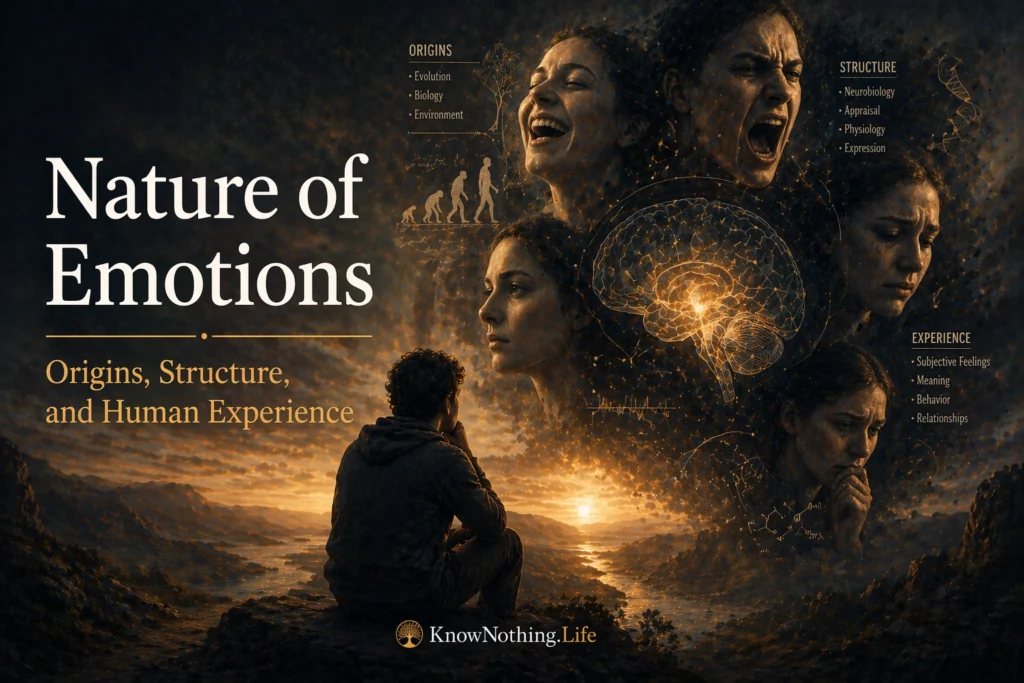
Emotions are among the most immediate and influential features of human life. They shape how individuals perceive the world, interpret events, and respond to challenges and opportunities. From the intensity of fear to the warmth of affection, emotions provide a rich texture to experience, guiding attention and motivating action. Yet despite their familiarity, emotions remain difficult to define. Are they biological reactions, cognitive judgments, or something more complex that integrates both mind and body?
The question of the nature of emotions lies at the intersection of philosophy, psychology, and neuroscience. Philosophers have long debated whether emotions are rational or irrational, whether they reveal truths or distort them, and whether they are universal or culturally shaped. Understanding emotions requires examining not only what they feel like but how they arise, how they function, and how they relate to other aspects of the mind. By exploring these questions, we gain a deeper understanding of the role emotions play in shaping human existence.
Historical Perspectives on Emotion
Philosophical reflection on emotion dates back to ancient times, where early thinkers sought to understand the place of feeling within human life. In classical Greek philosophy, Plato viewed emotions as part of the non-rational soul, often associated with disorder and instability. For Plato, the ideal life required reason to govern these passions, ensuring harmony within the individual. This perspective established a long-standing tradition of viewing emotions as potentially disruptive forces.
Aristotle offered a more nuanced account, recognizing that emotions can be appropriate and even virtuous when expressed in the right way. In his ethical framework, emotions are not inherently opposed to reason but can be aligned with it through proper cultivation. This idea introduced the possibility that emotions play a constructive role in moral life, rather than merely needing to be controlled or suppressed.
Later traditions, such as Stoicism, took a more critical stance. Thinkers like Epictetus argued that emotions arise from false judgments about what is good or bad. By correcting these judgments, individuals can achieve emotional tranquility and freedom from disturbance. These early debates laid the foundation for ongoing philosophical inquiry, highlighting the tension between viewing emotions as obstacles and recognizing their potential value.
Biological and Physiological Foundations
One of the central questions about emotions concerns their biological basis. Emotions are often accompanied by distinct physiological changes, such as increased heart rate, changes in breathing, and hormonal responses. These bodily reactions suggest that emotions are deeply rooted in the physical structure of the human organism, connecting mental experience with biological processes.
Philosophers and scientists have explored this connection in various ways. William James proposed that emotions are essentially perceptions of bodily changes. According to this view, we do not first feel an emotion and then experience physical effects; rather, the physical response itself constitutes the emotion. Fear, for example, is not a separate feeling that causes trembling—it is the awareness of trembling and other bodily changes.
Modern neuroscience has expanded on these ideas, revealing the complex neural systems involved in emotional processing. Brain regions such as the amygdala and prefrontal cortex play key roles in generating and regulating emotional responses. These findings support the idea that emotions are not isolated phenomena but integrated processes involving both the brain and the body. The biological perspective highlights the fundamental role of emotion in survival, as emotional responses often prepare individuals to react quickly to environmental challenges.
Cognitive and Appraisal Theories
While biological accounts emphasize the bodily aspects of emotion, cognitive theories focus on the role of thought and interpretation. According to these views, emotions arise from how individuals evaluate situations rather than from the situations themselves. This approach suggests that emotions are closely linked to beliefs, expectations, and judgments.
Philosophers have long recognized the cognitive dimension of emotion. David Hume emphasized the role of emotion in motivating action, while later thinkers explored how emotions reflect underlying evaluations of the world. Fear, for instance, involves the judgment that something is dangerous, while anger reflects a perception of injustice or wrongdoing. These appraisals shape the intensity and nature of emotional responses.
Cognitive theories also explain why individuals can experience different emotions in response to the same situation. Because emotions depend on interpretation, variations in belief and perspective lead to different emotional outcomes. This insight underscores the flexibility of emotional experience and highlights the importance of context in shaping how emotions are felt and expressed. By integrating cognitive and biological perspectives, philosophers and scientists have developed a more comprehensive understanding of emotional processes.
Emotion and Conscious Experience
Emotions are not merely physical or cognitive events—they are also deeply tied to conscious experience. The subjective feeling of an emotion, often referred to as its qualitative aspect, is what makes it meaningful to the individual. This experiential dimension raises important philosophical questions about the nature of consciousness and its relationship to emotion.
Some philosophers argue that emotions are inseparable from conscious awareness. Without the experience of feeling, there would be no emotion in the full sense. Others suggest that emotional processes can occur without conscious recognition, influencing behavior in subtle ways. This distinction highlights the complexity of emotional experience, which can operate on both conscious and unconscious levels.
The relationship between emotion and consciousness also raises questions about self-awareness. Emotions often provide insight into personal values and concerns, revealing what matters most to an individual. At the same time, they can obscure clarity by overwhelming rational thought. Understanding how emotions interact with consciousness is essential for grasping their role in shaping perception and decision-making.
Social and Cultural Dimensions of Emotion
Emotions are not purely individual experiences; they are also shaped by social and cultural contexts. Different societies have distinct norms and expectations regarding how emotions should be expressed and interpreted. These cultural frameworks influence not only outward behavior but also the internal experience of emotion.
Philosophers and social theorists have explored how emotions are embedded in social life. Martha Nussbaum has argued that emotions are deeply connected to values and social relationships, reflecting concerns about well-being, justice, and human flourishing. This perspective emphasizes that emotions are not isolated reactions but responses to meaningful aspects of the world.
Cultural differences can lead to variations in emotional experience, suggesting that emotions are not entirely universal. While certain basic emotions may be shared across cultures, the ways in which they are understood and expressed can differ significantly. This diversity highlights the importance of considering social context when analyzing the nature of emotions, as it shapes both their form and their meaning.
The Function and Value of Emotions
Understanding the nature of emotions also involves examining their function and value. Emotions play a crucial role in guiding behavior, helping individuals respond to challenges and opportunities. Fear can prompt caution, anger can motivate action against injustice, and love can foster connection and cooperation. These functions suggest that emotions are not merely byproducts of human life but essential components of adaptive behavior.
Philosophically, emotions have been evaluated in terms of their contribution to knowledge and moral life. Some thinkers have argued that emotions provide insight into values, revealing what is important or significant. Others caution that emotions can lead to bias and error, distorting judgment and decision-making. The challenge lies in understanding how to balance these aspects, recognizing the value of emotion while remaining aware of its limitations.
The study of emotional function also intersects with ethics and personal development. Cultivating appropriate emotional responses can enhance well-being and improve relationships, while unmanaged emotions can lead to conflict and misunderstanding. This perspective highlights the practical importance of understanding emotions, not only as objects of study but as integral parts of everyday life.
Conclusion
The nature of emotions is a complex and multifaceted subject that spans biology, cognition, consciousness, and culture. Emotions are not easily reduced to a single explanation; they are dynamic processes that integrate physical responses, mental evaluations, and subjective experiences. This complexity reflects their central role in human life, influencing how individuals perceive, think, and act.
Philosophical exploration reveals that emotions are neither purely irrational nor entirely reliable. They can provide valuable insights into the world and our place within it, but they can also lead to misunderstanding and error. Understanding emotions requires a balanced perspective that acknowledges both their strengths and their limitations.
Ultimately, the study of emotions offers a deeper understanding of what it means to be human. It highlights the richness of experience and the intricate interplay between mind and body, individual and society. By examining the nature of emotions, we gain insight into the forces that shape our lives, guiding us toward a more nuanced and reflective engagement with the world.