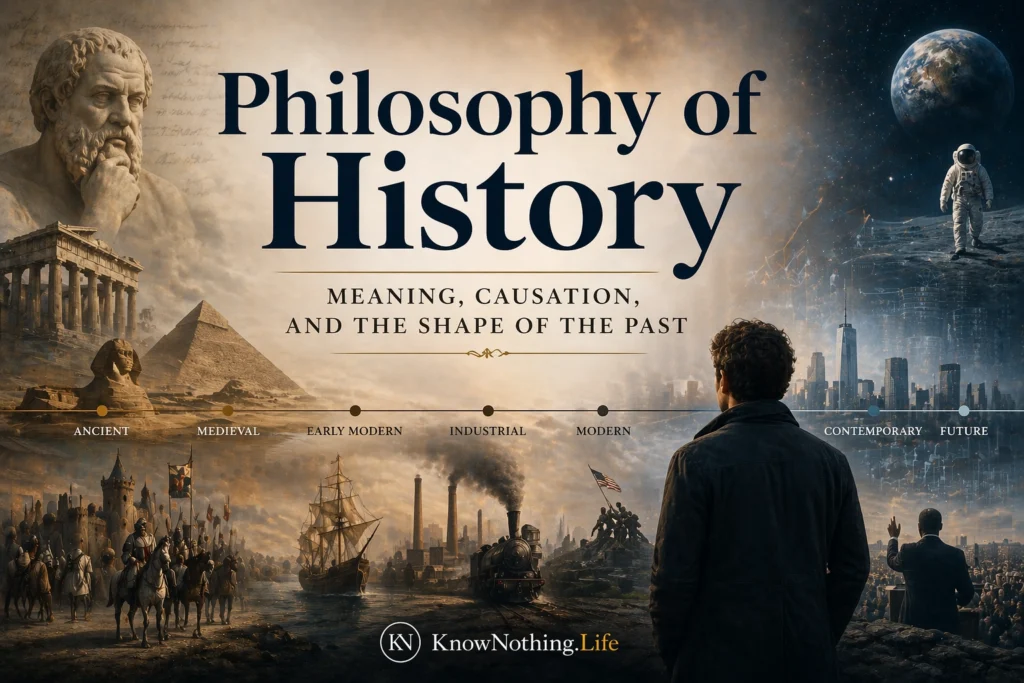
The philosophy of history is concerned with one of the most ambitious questions in human thought: what does history mean? Beyond the recording of events, it asks whether the unfolding of human affairs follows patterns, purposes, or laws that can be understood. It examines not only what happened, but how we interpret what happened, and whether those interpretations reveal deeper truths about human existence, society, and time itself.
At its core, the philosophy of history sits at the intersection of metaphysics, epistemology, and social theory. It explores whether history has direction or is simply a sequence of contingent events, shaped by chance and human action. From ancient reflections on cyclical time to modern theories of progress and decline, philosophers have sought to uncover the structure underlying historical change. These inquiries continue to shape how societies understand their past and envision their future.
What Is History?
History is often defined as the study of past events, particularly those involving human societies. However, the philosophy of history pushes this definition further, questioning what counts as a historical fact and how such facts are constructed. Historians do not merely record events; they interpret evidence, select relevant details, and organize narratives that make sense of complex realities. This interpretive dimension raises questions about objectivity and the role of perspective in historical knowledge.
Philosophers such as Leopold von Ranke emphasized the importance of presenting history “as it actually happened,” advocating for rigorous methods and reliance on primary sources. Yet even this aspiration is contested, as the act of selection and interpretation inevitably introduces subjective elements. The philosophy of history thus examines the tension between factual accuracy and narrative construction, highlighting the challenges of representing the past.
Historical Causation
One of the central concerns of the philosophy of history is causation: why do events happen as they do? Historical explanations often involve complex interactions between individuals, institutions, economic forces, and cultural contexts. Unlike the natural sciences, where causation can sometimes be isolated and tested, historical causation is multifaceted and often resistant to simple explanation.
Philosophers like Karl Marx proposed systematic accounts of historical change, emphasizing material conditions and class conflict as driving forces. Others, such as Max Weber, highlighted the role of ideas, beliefs, and cultural values in shaping historical outcomes. These differing approaches illustrate that causation in history is not merely about identifying events, but about understanding the frameworks through which those events are interpreted.
Progress and Teleology
A longstanding question in the philosophy of history is whether history has a direction or purpose. Teleological theories suggest that historical development follows a meaningful trajectory, often toward greater freedom, rationality, or complexity. Enlightenment thinkers frequently embraced the idea of progress, viewing history as a movement toward improved social and political conditions.
The work of G. W. F. Hegel represents one of the most influential teleological frameworks, proposing that history unfolds through a dialectical process leading toward the realization of freedom. In contrast, critics argue that such narratives impose artificial order on a fundamentally contingent process. Skeptics of teleology maintain that history may not have an inherent direction, and that apparent progress can coexist with regression, conflict, and unpredictability.
The Role of Individuals and Structures
Another key debate concerns the relative importance of individuals versus larger structural forces in shaping history. “Great man” theories emphasize the impact of influential leaders, innovators, and thinkers, suggesting that history is driven by the actions of exceptional individuals. This perspective highlights the role of agency and personal decision-making in historical change.
In contrast, structural approaches focus on broader forces such as economic systems, social institutions, and cultural norms. These perspectives argue that individuals operate within constraints that limit their ability to shape outcomes independently. The tension between agency and structure remains a central issue, as historians and philosophers seek to balance the contributions of individual actions with the influence of systemic conditions.
Objectivity and Interpretation
The question of objectivity is central to the philosophy of history. Can historians provide an unbiased account of the past, or are all historical narratives shaped by perspective and context? While empirical methods and critical analysis aim to minimize bias, complete objectivity may be unattainable, given that historians are themselves situated within particular cultural and intellectual frameworks.
Philosophers such as R. G. Collingwood argued that understanding history involves reconstructing the thoughts and intentions of historical actors. This interpretive approach suggests that historical knowledge is not simply about external events, but about the meanings those events held for the people involved. As a result, history becomes a dialogue between the past and the present, shaped by evolving perspectives and questions.
Narrative and Meaning
History is often conveyed through narratives that organize events into coherent stories. These narratives provide meaning by connecting disparate events into patterns that can be understood and communicated. However, the construction of narrative raises questions about selection, emphasis, and interpretation, as different narratives can present the same events in radically different ways.
The philosopher Hayden White emphasized the literary dimension of historical writing, arguing that historians use narrative structures similar to those found in literature. This perspective highlights the role of storytelling in shaping historical understanding, while also raising concerns about the potential for distortion or oversimplification. The interplay between narrative and truth remains a central issue in the philosophy of history.
History and Memory
The relationship between history and memory adds another layer of complexity. Collective memory refers to how societies remember and interpret the past, often through monuments, traditions, and shared narratives. These memories can differ from academic histories, reflecting cultural values, identities, and political agendas.
Memory plays a crucial role in shaping identity and social cohesion, but it can also lead to selective or distorted representations of the past. The philosophy of history examines how memory and history interact, exploring the ways in which the past is preserved, contested, and reinterpreted over time. This dynamic process underscores the importance of critical reflection in understanding historical narratives.
Contemporary Perspectives
In recent decades, the philosophy of history has expanded to include diverse perspectives that challenge traditional narratives. Postmodern approaches question the possibility of objective historical truth, emphasizing the role of language, power, and discourse in shaping historical knowledge. These perspectives highlight how dominant narratives can marginalize alternative voices and experiences.
At the same time, interdisciplinary approaches have enriched the study of history, incorporating insights from anthropology, sociology, and cultural studies. These developments reflect a broader recognition that history is not a single, unified account, but a complex and evolving field shaped by multiple perspectives. The philosophy of history continues to adapt, engaging with new questions and challenges in an increasingly interconnected world.
Conclusion
The philosophy of history explores the deeper questions underlying our understanding of the past, examining issues of meaning, causation, and interpretation. It challenges us to consider whether history follows patterns or purposes, and how narratives shape our perception of events. By addressing the roles of individuals, structures, and cultural contexts, it provides a framework for analyzing the complexities of historical change.
Ultimately, the philosophy of history is not only about the past but about how we make sense of human experience over time. It invites reflection on the ways in which history is constructed, remembered, and understood, highlighting the interplay between fact and interpretation. In doing so, it underscores the importance of critical inquiry in shaping our understanding of both the past and the present.