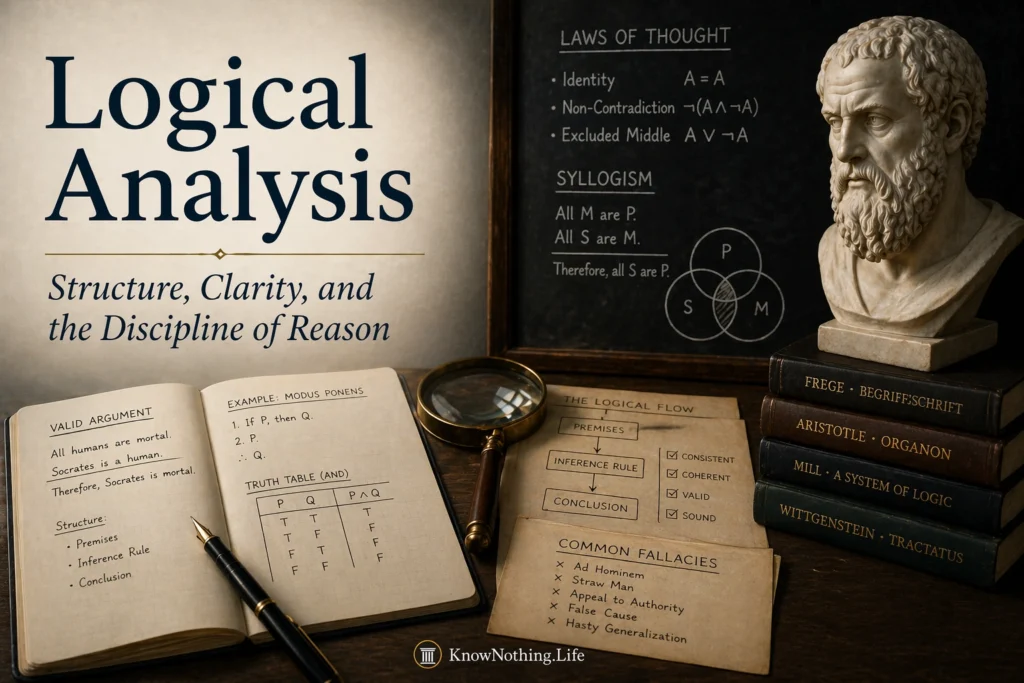
Logical analysis is one of the foundational methods of philosophy, concerned with evaluating arguments, clarifying concepts, and ensuring that reasoning is coherent and valid. At its core, it asks a simple but powerful question: do the conclusions we draw actually follow from the premises we accept? This method seeks to strip away ambiguity and confusion, revealing the underlying structure of thought and enabling more precise understanding.
While logical analysis is most closely associated with philosophy, its influence extends far beyond it. From mathematics and science to law and everyday reasoning, the principles of logic provide a framework for evaluating claims and making decisions. By examining how arguments are constructed and how conclusions are justified, logical analysis helps to distinguish sound reasoning from error, making it an essential tool for both theoretical inquiry and practical judgment.
The Nature of Arguments
Logical analysis begins with the study of arguments, which consist of premises and a conclusion. The premises provide the reasons or evidence, while the conclusion is the claim that those reasons are intended to support. Understanding this structure is essential for evaluating whether an argument is effective or flawed.
An important distinction in logic is between validity and soundness. An argument is valid if its conclusion follows logically from its premises, regardless of whether those premises are true. It is sound if it is both valid and based on true premises. This distinction highlights that good reasoning requires not only correct structure but also accurate information. Logical analysis focuses first on structure, ensuring that the reasoning itself is internally consistent before considering the truth of its components.
Formal and Informal Logic
Logical analysis can be divided into formal and informal approaches. Formal logic uses symbolic systems to represent arguments, allowing for precise and unambiguous evaluation. This method abstracts away from the content of arguments, focusing solely on their structure. By translating statements into symbolic form, formal logic enables rigorous analysis and the identification of valid patterns of reasoning.
Informal logic, by contrast, deals with arguments as they appear in everyday language. It addresses issues such as ambiguity, context, and rhetorical persuasion, which are often absent in formal representations. Informal logic is particularly useful for analyzing real-world arguments, where language is complex and nuanced. Together, formal and informal logic provide complementary tools for understanding and evaluating reasoning in different contexts.
Deductive Reasoning
Deductive reasoning is a central focus of logical analysis, involving arguments in which the conclusion necessarily follows from the premises. If the premises are true and the argument is valid, the conclusion cannot be false. This form of reasoning provides a high degree of certainty, making it a cornerstone of mathematics and formal systems.
Philosophers such as Aristotle developed early frameworks for deductive reasoning, including the study of syllogisms. These structured arguments illustrate how general principles can lead to specific conclusions. Deductive reasoning emphasizes precision and consistency, ensuring that conclusions are firmly grounded in the premises from which they are derived.
Inductive Reasoning
In contrast to deduction, inductive reasoning involves drawing general conclusions from specific observations. While inductive arguments can be strong or weak, they do not guarantee the truth of their conclusions. Instead, they provide probabilistic support, suggesting that a conclusion is likely based on available evidence.
Inductive reasoning is central to scientific inquiry, where hypotheses are formed and tested based on observed patterns. Logical analysis of induction involves assessing the strength of evidence, the representativeness of samples, and the possibility of alternative explanations. While less certain than deduction, induction is essential for expanding knowledge and making predictions about the world.
Logical Fallacies
A key aspect of logical analysis is the identification of fallacies—errors in reasoning that undermine the validity or soundness of an argument. Fallacies can take many forms, from simple mistakes in structure to more subtle issues involving language or assumptions. Recognizing these errors is crucial for evaluating arguments critically.
Common fallacies include the ad hominem, where an argument attacks a person rather than addressing the issue, and the slippery slope, which assumes that one event will inevitably lead to a chain of negative consequences. Logical analysis helps to uncover these flaws, enabling clearer and more accurate reasoning. By understanding fallacies, individuals can improve their own arguments and better assess the claims of others.
Language and Meaning
Logical analysis is deeply connected to language, as arguments are expressed through words and symbols. Ambiguity, vagueness, and imprecision in language can lead to misunderstandings and flawed reasoning. Philosophers such as Bertrand Russell emphasized the importance of precise language in avoiding confusion and clarifying thought.
Analyzing language involves examining how terms are used, identifying multiple meanings, and ensuring that concepts are consistently applied. This process is essential for resolving philosophical problems, many of which arise from misunderstandings or ambiguities in language. By refining language, logical analysis enhances the clarity and effectiveness of reasoning.
Logical Analysis in Philosophy
Logical analysis has played a central role in the development of modern philosophy, particularly in the analytic tradition. Philosophers use logic to examine fundamental questions about knowledge, reality, and ethics, seeking to clarify concepts and evaluate arguments with precision. This approach emphasizes rigor and clarity, distinguishing philosophy from more speculative forms of inquiry.
The influence of logical analysis can be seen in various philosophical movements, including logical positivism and ordinary language philosophy. While these approaches differ in their methods and conclusions, they share a commitment to using logic as a tool for understanding. Logical analysis thus serves as a unifying method, providing a common framework for addressing diverse philosophical problems.
Limits of Logical Analysis
Despite its strengths, logical analysis has limitations. Not all aspects of human experience can be fully captured through logical structure. Emotions, values, and subjective experiences often resist formalization, requiring other methods of inquiry. Additionally, logic depends on the premises it is given; if those premises are flawed, even perfectly valid reasoning can lead to incorrect conclusions.
Philosophers have also debated whether logic itself is entirely objective or whether it is influenced by linguistic and cultural factors. These discussions highlight that while logical analysis is a powerful tool, it is not sufficient on its own to address all philosophical questions. It must be complemented by other approaches that account for the richness and complexity of human life.
Conclusion
Logical analysis is a fundamental method for evaluating arguments, clarifying concepts, and ensuring the coherence of reasoning. By examining the structure of arguments and identifying errors, it provides a framework for distinguishing sound reasoning from fallacy. Its applications extend across disciplines, making it an essential tool for both philosophical inquiry and practical decision-making.
At the same time, the limits of logical analysis remind us that reasoning is only one aspect of understanding. While logic offers clarity and precision, it must be integrated with other methods to fully engage with the complexity of human experience. In this balance, logical analysis remains a cornerstone of thoughtful inquiry, guiding the pursuit of knowledge with rigor and discipline.