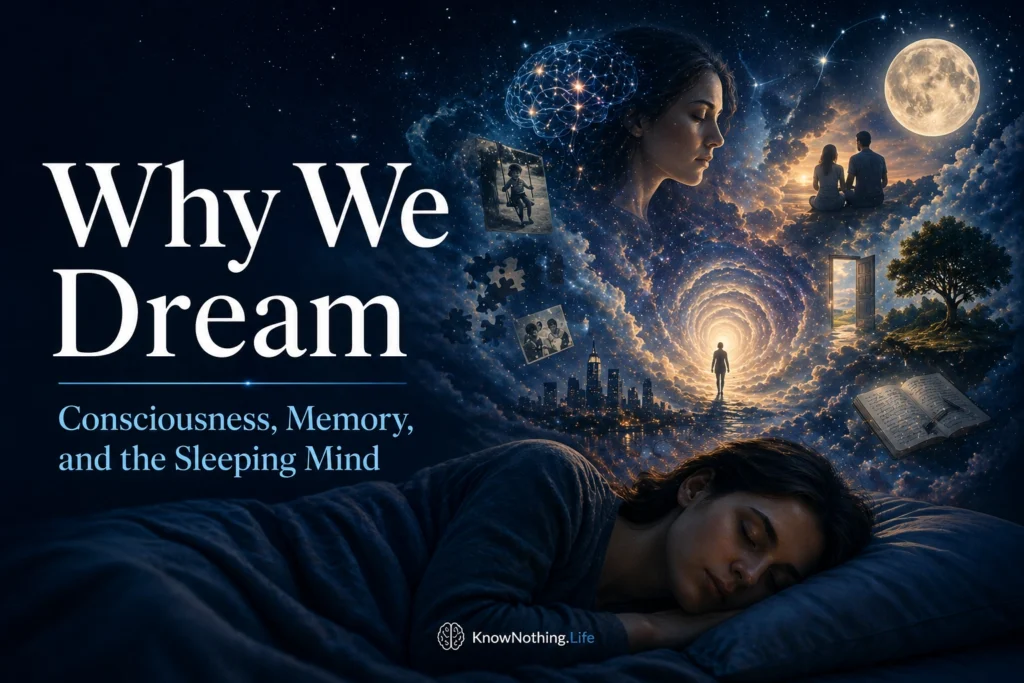
Dreaming is one of the most universal yet enigmatic features of human experience. Across cultures and historical periods, dreams have been interpreted as divine messages, psychological signals, neurological byproducts, and even glimpses into alternate realities. Despite centuries of speculation and modern scientific investigation, the question remains open: why do we dream at all? Contemporary research suggests that dreaming is not a single-purpose phenomenon but a convergence of cognitive, emotional, and biological processes. To understand why we dream, we must move through philosophy, psychology, and neuroscience—each offering partial but compelling answers.
Dreams in Early Thought and Philosophy
Long before modern science, thinkers sought meaning in dreams as reflections of the soul or the unconscious. In ancient Greece, Aristotle argued that dreams were not divine messages but natural occurrences arising from sensory impressions lingering during sleep. In contrast, Plato saw dreams as revealing suppressed desires, particularly those that reason restrains during waking life. These early interpretations already hint at a tension that persists today: are dreams meaningful expressions or meaningless byproducts?
This philosophical divide continues into modern thought. René Descartes famously used dreams to question reality itself, asking how we can distinguish waking life from dreaming. His skepticism placed dreams at the center of epistemology, suggesting that the instability of perception undermines certainty. Later philosophers would treat dreams less as metaphysical puzzles and more as windows into human psychology, setting the stage for scientific approaches.
Freud and the Unconscious Mind
The modern psychological study of dreams begins most prominently with Sigmund Freud, whose work The Interpretation of Dreams (1900) transformed dreaming into a central object of inquiry. Freud proposed that dreams are the “royal road to the unconscious,” a phrase that has become one of the most quoted lines in psychology. For Freud, dreams are disguised fulfillments of repressed wishes—often rooted in childhood desires or conflicts that the conscious mind cannot accept.
According to Freud, dreams operate through mechanisms like condensation and displacement, transforming latent (hidden) content into manifest (visible) imagery. A seemingly random dream, in this view, encodes deeper psychological truths. Freud’s theory has been widely criticized for its lack of empirical testability, yet it remains influential because it frames dreaming as meaningful rather than accidental. As Freud wrote, “Dreams are often most profound when they seem the most crazy.”
Even critics acknowledge that Freud shifted the conversation. He turned dreams from curiosities into structured phenomena worthy of systematic interpretation, opening the door for later theorists to refine or reject his conclusions.
Jung and Symbolic Meaning
Freud’s student-turned-critic Carl Jung expanded the scope of dream interpretation beyond personal repression. Jung argued that dreams are expressions of the collective unconscious, a shared psychological structure containing archetypes—universal symbols such as the shadow, the hero, or the mother. In this framework, dreams are not merely about individual desires but about deeper patterns of human experience.
Jung saw dreams as compensatory, balancing the conscious mind. If a person is overly rational in waking life, their dreams might become emotional or symbolic to restore equilibrium. “The dream is a little hidden door in the innermost and most secret recesses of the soul,” Jung wrote, emphasizing the idea that dreams reveal aspects of the self that waking consciousness suppresses or ignores.
While Jung’s theories are difficult to verify scientifically, they continue to influence psychotherapy and cultural interpretations of dreams. His work reinforces the idea that dreaming serves a psychological function tied to identity and self-integration.
The Neuroscience of Dreaming
In the mid-20th century, advances in neuroscience shifted the study of dreams from interpretation to physiology. Researchers discovered that dreaming is closely associated with REM (rapid eye movement) sleep, a stage characterized by heightened brain activity, vivid imagery, and temporary muscle paralysis. This finding suggested that dreaming is not random but tied to specific biological processes.
A major turning point came with the activation-synthesis theory proposed by J. Allan Hobson and Robert McCarley. They argued that dreams result from the brain attempting to make sense of random neural activity during REM sleep. According to this view, the brainstem generates signals, and the cortex synthesizes them into coherent narratives. Dreams, therefore, are not inherently meaningful but are constructed interpretations of physiological noise.
Hobson famously described dreaming as “the brain’s effort to make sense of its own internal signals.” This perspective challenges Freudian and Jungian interpretations by suggesting that meaning is imposed rather than intrinsic. However, it does not fully explain why dreams often contain emotionally significant or memory-related content, leading to further refinements in dream research.
Dreams and Memory Consolidation
One of the most widely supported contemporary theories is that dreaming plays a role in memory consolidation. Studies using brain imaging and sleep monitoring have shown that during sleep—especially REM and deep sleep—the brain reactivates patterns associated with recent experiences. This process helps stabilize and integrate memories into long-term storage.
Research published in journals like Nature Neuroscience has demonstrated that participants who sleep after learning tasks perform better than those who remain awake. Dreams often incorporate fragments of recent experiences, suggesting that the mind is reorganizing information. As neuroscientist Matthew Walker notes, “Sleep is the single most effective thing we can do to reset our brain and body health each day.”
Dreaming, in this context, is not just a side effect but part of the mechanism by which the brain processes and prioritizes information. It may help filter what is important, discard what is irrelevant, and integrate new knowledge with existing frameworks.
Emotional Processing and Psychological Regulation
Another major function of dreaming appears to be emotional regulation. Dreams frequently involve intense emotions—fear, anxiety, joy, or longing—and often replay or reframe emotionally charged experiences. This has led researchers to propose that dreaming helps the brain process unresolved feelings.
Studies by Rosalind Cartwright found that individuals going through emotional stress, such as divorce, often dream about their experiences in ways that gradually reduce distress over time. Dreams may provide a safe environment for confronting difficult emotions without real-world consequences.
The “threat simulation theory,” proposed by Antti Revonsuo, suggests that dreams evolved as a way to rehearse responses to danger. By simulating threatening scenarios, the brain prepares individuals for real-life challenges. This would explain why so many dreams involve conflict, pursuit, or fear. From this perspective, dreaming is not random but adaptive—a tool for emotional resilience and survival.
Creativity and Problem Solving
Dreams have also been linked to creativity and insight. Many historical figures have reported breakthroughs emerging from dreams. Dmitri Mendeleev reportedly conceived the periodic table after dreaming of elements falling into place, while Mary Shelley described the inspiration for Frankenstein as arising from a vivid dream.
Scientific studies support this connection. Experiments have shown that individuals are more likely to solve complex problems after sleep, particularly when dreams involve elements of the task. Dreaming appears to loosen rigid patterns of thought, allowing novel associations to form.
As psychologist Deirdre Barrett explains, “Dreams think in a different biochemical state,” enabling creative connections that waking logic might suppress. This suggests that dreaming contributes to innovation by expanding the range of possible ideas.
Emerging Research on Dreaming
At Harvard University, researchers in the Division of Sleep Medicine have explored how dreaming contributes to learning and performance. A well-known study led by Robert Stickgold examined participants playing a virtual maze navigation game. After sleeping, many subjects reported dreaming about the task, and those who did showed significantly improved performance compared to those who stayed awake. Stickgold concluded that dreaming reflects the brain’s attempt to “process, integrate, and understand new information,” reinforcing the link between dreams and memory consolidation.
Similarly, at Stanford University, sleep research has focused on the role of REM sleep in emotional regulation. Studies connected to William Dement, one of the pioneers of modern sleep science, demonstrated that REM deprivation leads to increased irritability, difficulty concentrating, and heightened emotional reactivity. These findings suggest that dreaming—most vivid during REM sleep—plays a critical role in stabilizing mood and maintaining psychological balance.
At University of California, Berkeley, groundbreaking work by Matthew Walker has further explored how sleep and dreaming affect emotional processing. One study found that after REM sleep, participants showed reduced emotional responses to previously distressing images, alongside decreased activity in the amygdala. Walker described this process as “overnight therapy,” where dreaming helps strip away the emotional intensity of experiences while preserving the memory itself.
Research at Massachusetts Institute of Technology has pushed the boundaries of how dreams interact with problem-solving and creativity. Experiments conducted in sleep labs have shown that participants who enter dream-like states during early sleep stages are more likely to discover hidden patterns or solutions to complex problems. These findings align with earlier anecdotal evidence but provide controlled, empirical support for the idea that dreaming enhances cognitive flexibility.
At University of Oxford, researchers have examined the relationship between dreaming and mental health. Studies on insomnia and depression indicate that disrupted dreaming patterns correlate with increased psychological distress. In particular, individuals with depression often experience altered REM sleep cycles, suggesting that the structure of dreaming itself may influence emotional well-being.
Final Thoughts
Dreaming remains one of the most fascinating frontiers of human understanding because it sits at the intersection of mind and brain, meaning and mechanism. From Sigmund Freud’s vision of hidden desires to modern neuroscience’s mapping of REM sleep, each perspective captures part of the truth without exhausting it. Dreams are neither purely symbolic messages nor meaningless noise—they are dynamic constructions emerging from the brain’s attempt to process experience.
In the end, the question “why do we dream?” may not have a single answer because dreaming itself is not a single process. It is a convergence of functions, a nightly reconstruction of memory, emotion, and imagination. As research continues, the mystery of dreams may become clearer, but it is unlikely to lose its philosophical depth. Dreams remind us that even in rest, the mind remains active—searching, organizing, and, perhaps, quietly understanding itself.