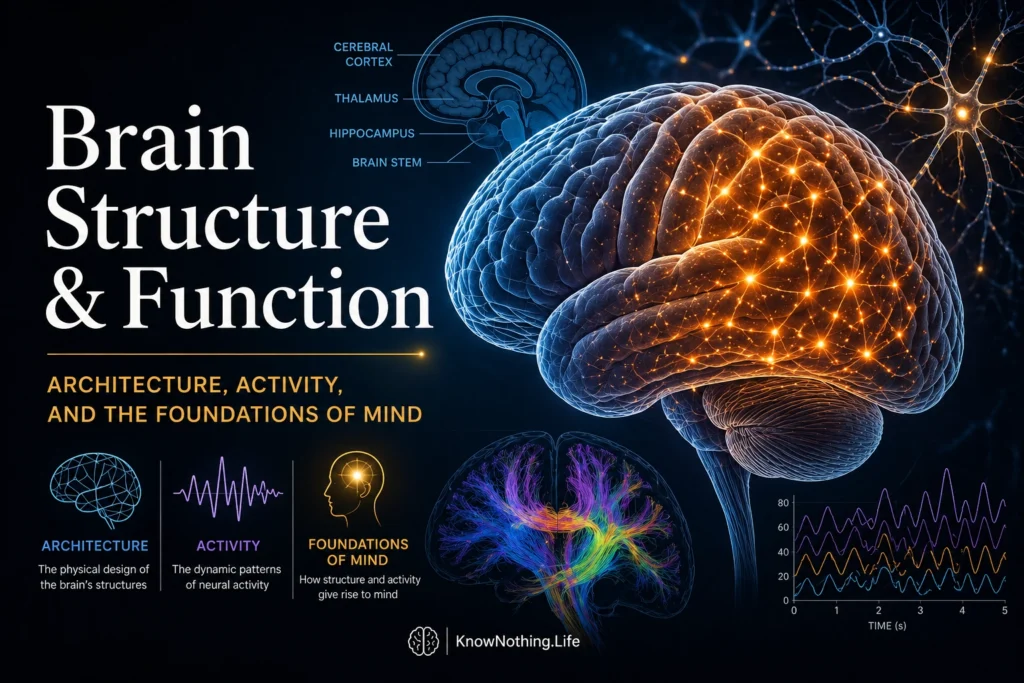
The human brain is the most complex organ known to science, composed of billions of neurons interconnected in vast networks that generate thought, emotion, perception, and behavior. Understanding brain structure and function is central to neuroscience and psychology, as it provides the biological foundation for everything from basic sensory processes to higher-order cognition. The brain is not merely a static structure but a dynamic system, constantly changing in response to experience and environment.
The effort to understand the brain has a long intellectual history. Early philosophical speculation gave way to empirical investigation, revealing that mental processes arise from physical structures. Neuroscientist Eric R. Kandel captured this relationship succinctly in In Search of Memory, writing, “All mental processes are biological processes.” This insight underscores the central premise of modern neuroscience: that to understand the mind, one must understand the brain.
Major Divisions of the Brain
The brain is organized into several major regions, each contributing to different aspects of function. The most prominent division is the cerebrum, which comprises the left and right hemispheres and is responsible for higher cognitive processes such as reasoning, language, and voluntary movement. The outer layer of the cerebrum, known as the cerebral cortex, is highly folded, increasing its surface area and enabling complex processing.
The brainstem, located at the base of the brain, regulates vital functions such as breathing, heart rate, and arousal. It connects the brain to the spinal cord and serves as a pathway for sensory and motor signals. The cerebellum, situated at the back of the brain, plays a crucial role in coordination, balance, and motor learning, ensuring that movements are smooth and precise.
These divisions are not isolated; they work together as part of an integrated system. As neurologist Alexander R. Luria emphasized, the brain operates through “functional systems” that involve multiple regions interacting dynamically. This interconnectedness allows for the flexibility and adaptability that characterize human behavior.
The Cerebral Cortex and Lobes
The cerebral cortex is divided into four primary lobes, each associated with distinct functions. The frontal lobe, located at the front of the brain, is involved in executive functions such as planning, decision-making, and impulse control. It also plays a key role in personality and social behavior, making it central to the regulation of complex actions.
The parietal lobe is responsible for processing sensory information, particularly touch, temperature, and spatial awareness. It integrates input from different sensory modalities, allowing individuals to perceive and interact with their environment. The temporal lobe is associated with auditory processing and memory, housing structures such as the hippocampus that are essential for learning and recall.
The occipital lobe, located at the back of the brain, is primarily responsible for visual processing. Damage to this region can result in visual impairments, even when the eyes themselves are functioning normally. Early work by Paul Broca and Carl Wernicke demonstrated that specific cognitive functions, such as language, are localized within these lobes, providing key evidence for the functional specialization of the cortex.
Neurons and Neural Communication
At the cellular level, the brain is composed of neurons and glial cells. Neurons are specialized for communication, transmitting electrical signals along their axons and releasing chemical messengers at synapses. Each neuron can form thousands of connections, creating an intricate network that underlies all brain activity.
Neural communication involves both electrical and chemical processes. An action potential, or electrical impulse, travels along the neuron’s axon, triggering the release of neurotransmitters at the synapse. These neurotransmitters bind to receptors on the receiving neuron, influencing whether it will generate its own action potential. Different neurotransmitters have different effects; for example, dopamine is associated with reward and motivation, while serotonin is linked to mood regulation.
The organization of neural networks is shaped by experience. Psychologist Donald Hebb proposed that “cells that fire together wire together,” suggesting that repeated activation strengthens connections between neurons. This principle, known as Hebbian learning, provides a foundation for understanding how the brain adapts and learns.
Functional Systems and Integration
While specific brain regions are associated with particular functions, most cognitive and behavioral processes involve the integration of multiple systems. For example, even a simple act such as reaching for an object requires coordination between sensory processing, motor planning, and feedback mechanisms. This integration is made possible by networks of interconnected regions that communicate continuously.
The concept of distributed processing has replaced earlier models that emphasized strict localization. Modern neuroscience shows that functions such as memory, attention, and emotion arise from the coordinated activity of multiple regions. For instance, emotional processing involves interactions between the amygdala, prefrontal cortex, and other structures, highlighting the complexity of these systems.
Neuroscientist Antonio Damasio has emphasized the role of integration in understanding the mind, arguing in Descartes’ Error that emotion and reason are deeply intertwined. He wrote, “We are not thinking machines that feel; rather, we are feeling machines that think,” underscoring the interconnected nature of cognitive and emotional processes.
Brain Plasticity and Adaptation
One of the most remarkable features of the brain is its capacity for plasticity—the ability to change and adapt in response to experience. This adaptability is evident throughout life, from early development to adulthood, allowing the brain to learn new skills, recover from injury, and adjust to changing environments.
Plasticity operates at multiple levels, from changes in synaptic strength to the growth of new neurons in certain regions. Learning and memory are closely tied to these processes, as repeated experiences reinforce neural connections. This dynamic nature of the brain challenges earlier views that it is fixed after a certain age, demonstrating instead that it remains capable of change throughout the lifespan.
Plasticity also plays a crucial role in recovery from brain injury. When one area of the brain is damaged, other regions may compensate by taking over its functions. This capacity for reorganization highlights the resilience of the brain, though it is often limited by the extent and location of the damage. As Kandel noted, “Learning produces changes in the strength of synaptic connections,” emphasizing the biological basis of adaptation.
Brain and Behavior
The relationship between brain structure and behavior is central to understanding human experience. Different patterns of neural activity correspond to different behaviors, from basic reflexes to complex decision-making. For example, the basal ganglia are involved in movement and habit formation, while the limbic system plays a key role in emotion and motivation.
Disruptions in brain structure or function can lead to changes in behavior, providing insight into the underlying mechanisms. Neurological and psychiatric conditions, such as stroke, Alzheimer’s disease, and depression, are associated with specific alterations in brain systems. Studying these conditions helps researchers identify the roles of different regions and networks, advancing both scientific knowledge and clinical practice.
The case studies documented by neurologist Oliver Sacks illustrate the profound ways in which brain changes can affect perception and identity. In The Man Who Mistook His Wife for a Hat, Sacks described patients whose neurological conditions altered their experience of reality, demonstrating that even fundamental aspects of perception depend on the integrity of brain systems.
Conclusion
The study of brain structure and function reveals the intricate architecture underlying the mind. From the organization of major brain regions to the activity of individual neurons, each level contributes to the emergence of cognition, emotion, and behavior. This complexity reflects the brain’s role as both a biological organ and the foundation of subjective experience.
As research continues to advance, new technologies and interdisciplinary approaches are deepening our understanding of the brain. Yet, despite these advances, the relationship between brain and mind remains one of the most profound challenges in science. By exploring this relationship, the study of brain structure and function not only enhances our knowledge of biology but also enriches our understanding of what it means to think, feel, and be human.