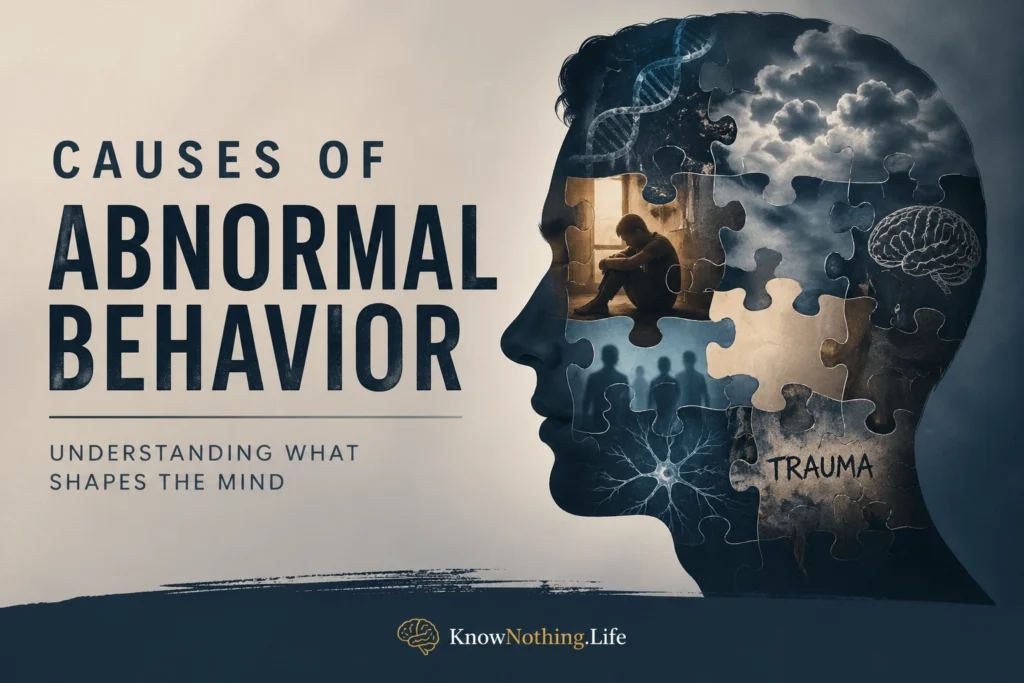
Understanding why abnormal behavior occurs has been one of the central challenges of psychology. From early philosophical speculation to contemporary neuroscience, scholars have sought to explain why some patterns of thought, emotion, and action deviate from what a given society considers typical or functional. The concept of “abnormality” itself is not fixed; it is shaped by cultural norms, historical context, and evolving scientific frameworks. What one era labels as pathology, another may reinterpret as variation, adaptation, or even creativity. Despite this complexity, modern psychology has converged on a broad consensus: abnormal behavior rarely stems from a single cause. Instead, it emerges from the dynamic interaction of biological, psychological, and social influences.
This multifactorial perspective is most clearly expressed in the biopsychosocial model, which integrates insights from genetics, brain science, learning theory, and environmental context. Researchers such as George L. Engel argued that mental disorders cannot be fully understood without considering the whole person embedded within a social world. This shift marked a departure from earlier reductionist theories that attempted to isolate singular causes, such as moral weakness or unconscious conflict. Today, the study of abnormal behavior reflects a layered understanding in which vulnerability and resilience coexist, shaped by both internal predispositions and external pressures.
Biological Causes
Biological explanations of abnormal behavior emphasize the role of genetics, brain structure, neurochemistry, and physiological processes. Advances in neuroscience have revealed that many psychological disorders are associated with measurable differences in brain function. For example, imbalances in neurotransmitters such as serotonin and dopamine have been linked to mood disorders and schizophrenia. These chemical systems regulate mood, perception, and cognition, and disruptions can lead to significant behavioral changes. As Eric Kandel observed in Principles of Neural Science, “All mental processes… derive from operations of the brain,” highlighting the biological grounding of psychological experience.
Genetic research further supports the biological perspective. Twin and family studies demonstrate that conditions such as bipolar disorder, major depression, and schizophrenia have heritable components. However, genes do not determine outcomes in a deterministic way. Instead, they create predispositions that may or may not manifest depending on environmental conditions. This concept, often referred to as gene-environment interaction, underscores the complexity of causation. A person may carry a genetic vulnerability for anxiety, but whether it develops into a disorder depends on life experiences, stress exposure, and coping mechanisms.
Brain structure and injury also play a role in abnormal behavior. Damage to specific regions, such as the frontal lobes, can impair judgment, impulse control, and emotional regulation. Neurological conditions, including traumatic brain injury and neurodegenerative diseases, often produce behavioral symptoms that resemble psychiatric disorders. These findings reinforce the idea that abnormal behavior is not merely a matter of subjective experience but is deeply rooted in the physical functioning of the nervous system.
Psychological Causes
Psychological theories focus on internal processes such as cognition, emotion, learning, and personality. One of the earliest and most influential frameworks was developed by Sigmund Freud, who proposed that abnormal behavior arises from unresolved unconscious conflicts. In works like The Interpretation of Dreams, Freud argued that repressed desires and early childhood experiences shape adult behavior in ways that are not immediately accessible to conscious awareness. Although many of his specific ideas are debated today, the broader notion that past experiences influence present functioning remains central to psychological theory.
Cognitive perspectives, advanced by thinkers such as Aaron Beck, emphasize the role of maladaptive thought patterns. According to this view, individuals with depression or anxiety often engage in distorted thinking, such as catastrophizing or overgeneralization. Beck famously wrote, “The way people interpret their experiences determines how they feel and behave.” This insight shifted the focus from hidden conflicts to observable patterns of thought, leading to the development of cognitive-behavioral therapy (CBT), one of the most widely used and empirically supported treatments for mental disorders.
Learning theories also contribute to understanding abnormal behavior. Through processes such as classical and operant conditioning, individuals can acquire maladaptive behaviors. For example, a person who experiences a traumatic event may develop a conditioned fear response to related stimuli, as demonstrated in the foundational work of Ivan Pavlov and later expanded by behaviorists like B. F. Skinner. These frameworks highlight how behavior is shaped by reinforcement, punishment, and environmental associations, suggesting that abnormal patterns can be learned—and, importantly, unlearned.
Social and Environmental Causes
No account of abnormal behavior is complete without considering the social environment. Human beings are inherently relational, and their psychological well-being is deeply influenced by family dynamics, cultural norms, socioeconomic conditions, and life events. Chronic stress, trauma, and adverse childhood experiences are among the most powerful predictors of later psychological difficulties. Studies on trauma have shown that prolonged exposure to stress can alter both brain function and emotional regulation, increasing vulnerability to disorders such as PTSD and depression.
Sociocultural factors also shape what is considered abnormal. Behaviors that are stigmatized in one culture may be accepted or even valued in another. This relativity underscores the importance of context in diagnosis and treatment. As Lev Vygotsky argued, psychological development is fundamentally embedded in social interaction. His work emphasizes that cognition and behavior cannot be separated from the cultural tools and practices that shape them.
Economic and social inequality further contribute to abnormal behavior. Poverty, discrimination, and lack of access to resources create conditions of chronic stress and limited opportunity, which can exacerbate mental health issues. Social isolation, whether due to technological changes or shifting community structures, has also been linked to increased rates of anxiety and depression. These factors highlight that abnormal behavior is not solely an individual issue but is often a reflection of broader societal conditions.
The Biopsychosocial Model
The biopsychosocial model represents an integrative approach that synthesizes biological, psychological, and social perspectives. Rather than privileging one domain over others, it emphasizes their interaction. A person with a genetic predisposition to depression may encounter stressful life events and develop negative thinking patterns, resulting in a disorder that cannot be explained by any single factor alone. This layered causation reflects the complexity of human behavior and challenges simplistic explanations.
The strength of this model lies in its flexibility and comprehensiveness. It allows clinicians and researchers to consider multiple pathways to abnormal behavior, recognizing that different individuals may arrive at similar outcomes through different routes. This perspective also informs treatment, encouraging interventions that address biological factors (such as medication), psychological processes (such as therapy), and social conditions (such as support networks).
Critics of the biopsychosocial model argue that its breadth can make it difficult to test empirically or apply consistently. However, its enduring influence suggests that it captures an essential truth about human behavior: that it is shaped by interconnected systems rather than isolated causes. As Engel emphasized, understanding illness requires “a framework that includes the patient, the social context, and the biological substrate,” a principle that continues to guide modern mental health practice.
Developmental and Lifespan Factors
Abnormal behavior often reflects patterns that unfold over time rather than appearing suddenly. Developmental psychology highlights how early experiences, particularly in childhood, can have lasting effects on mental health. Attachment theory, developed by John Bowlby, suggests that the quality of early relationships with caregivers shapes emotional regulation and interpersonal functioning. Insecure or disrupted attachments are associated with increased risk for anxiety, depression, and personality disorders.
Critical periods of development also play a role. Exposure to stress or trauma during sensitive stages can have disproportionate effects, influencing brain development and behavioral outcomes. However, development is not deterministic. The concept of plasticity—the brain’s ability to change and adapt—means that individuals can recover and grow even after adverse experiences. This perspective aligns with resilience research, which examines why some individuals thrive despite significant challenges.
Lifespan factors extend beyond childhood. Transitions such as adolescence, midlife, and aging introduce new stressors and opportunities for change. Hormonal shifts, identity formation, and social role changes can all influence behavior. Understanding abnormal behavior, therefore, requires a temporal perspective that considers how vulnerabilities and strengths evolve across the lifespan.
Conclusion
The causes of abnormal behavior are complex, multifaceted, and deeply interconnected. Biological factors provide the foundation, shaping the structure and function of the brain. Psychological processes interpret and respond to experience, influencing thoughts, emotions, and behaviors. Social and environmental contexts create the conditions in which individuals develop, adapt, and sometimes struggle. Together, these domains form a dynamic system in which no single cause is sufficient on its own.
Modern psychology’s movement toward integrative models reflects a broader recognition of this complexity. Rather than seeking simple explanations, researchers and clinicians increasingly embrace nuanced approaches that account for individual differences and contextual variability. As understanding continues to evolve, the study of abnormal behavior remains not only a scientific endeavor but also a deeply human one—concerned with alleviating suffering, promoting well-being, and recognizing the intricate interplay of forces that shape the mind.