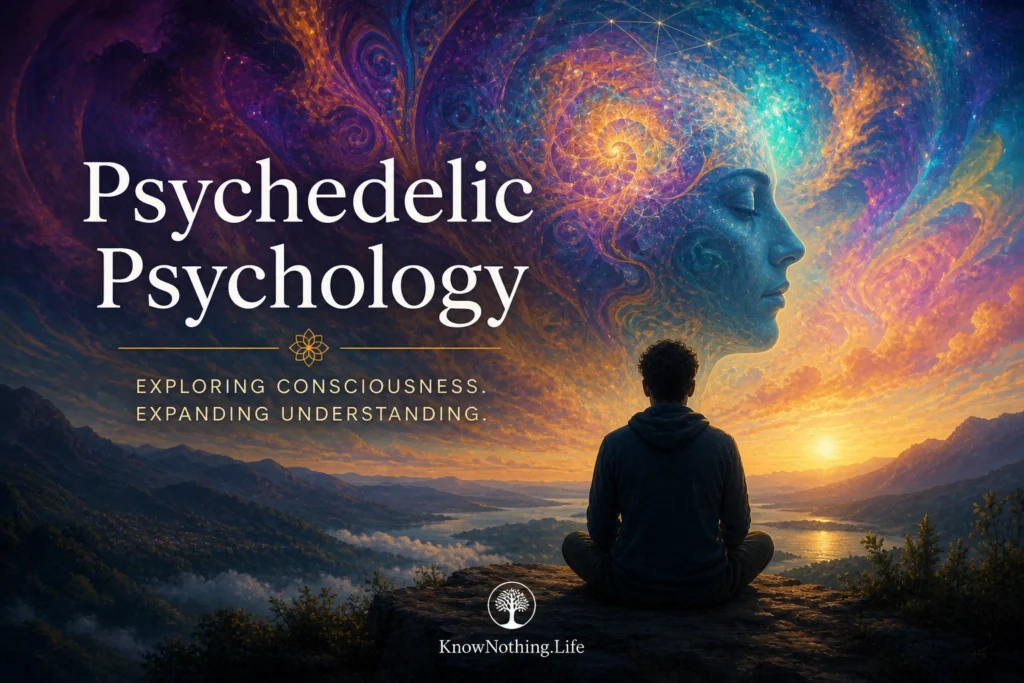
Psychedelic psychology explores how certain substances—most notably LSD, psilocybin, mescaline, and DMT—alter perception, cognition, emotion, and the sense of self. The term “psychedelic,” coined by Humphry Osmond, literally means “mind-manifesting,” reflecting the idea that these substances reveal aspects of consciousness that are ordinarily hidden. Unlike stimulants or depressants, psychedelics do not simply amplify or dampen mental activity; they reorganize it, often producing experiences that feel profoundly meaningful, symbolic, or transformative.
Interest in psychedelics has moved through cycles of enthusiasm, suppression, and renewal. In the mid-20th century, researchers investigated their therapeutic potential before legal restrictions halted most studies. In recent decades, a “psychedelic renaissance” has revived scientific inquiry, with controlled research examining their effects on mental health, cognition, and consciousness. This resurgence reflects a broader recognition that altered states induced by psychedelics can provide unique insights into the structure and function of the mind.
At its core, psychedelic psychology is not only about substances but about the nature of experience itself. As Aldous Huxley wrote in The Doors of Perception, “The mind is not only a receiver of experience; it is also a filter.” Psychedelics appear to relax this filter, allowing perceptions and associations that are normally suppressed to enter awareness. This capacity to expand or alter consciousness has made psychedelics a subject of enduring fascination and scientific importance.
Historical Foundations and Early Research
The modern study of psychedelics began in the 20th century with the synthesis of LSD by Albert Hofmann in 1938 and his subsequent self-experimentation in 1943. Hofmann’s discovery opened a new avenue for exploring consciousness, leading to a wave of research in psychiatry and psychology. Early studies investigated the use of psychedelics in treating conditions such as depression, anxiety, and addiction, as well as their capacity to model psychotic states.
During the 1950s and 1960s, researchers such as Stanislav Grof conducted extensive work with LSD, developing frameworks for understanding the experiences it produced. Grof’s research emphasized the therapeutic potential of psychedelics, particularly in accessing unconscious material and facilitating emotional release. His work suggested that psychedelic experiences could be structured and meaningful rather than chaotic or random.
At the same time, figures like Timothy Leary popularized psychedelics beyond the laboratory, advocating for their use as tools for personal and societal transformation. While Leary’s influence brought widespread attention to psychedelics, it also contributed to political backlash and the eventual prohibition of research. This period illustrates both the promise and controversy surrounding psychedelic psychology, highlighting the tension between scientific inquiry and cultural perception.
Mechanisms and Brain Activity
From a neuroscientific perspective, psychedelics exert their effects primarily through interactions with serotonin receptors, particularly the 5-HT2A receptor. Activation of these receptors leads to widespread changes in brain activity, altering how different regions communicate with one another. Rather than increasing activity in a simple way, psychedelics appear to reorganize neural networks, producing a more flexible and less constrained mode of processing.
One of the most significant findings in recent research is the effect of psychedelics on the default mode network (DMN), a system associated with self-referential thought and the sense of identity. Studies led by researchers such as Robin Carhart-Harris have shown that psychedelics reduce activity in the DMN, leading to a breakdown of rigid patterns of thought. This reduction is often associated with experiences of “ego dissolution,” in which the boundary between self and world becomes less defined.
Carhart-Harris has proposed the “entropic brain” hypothesis, suggesting that psychedelics increase the entropy, or variability, of brain activity. In this state, the brain becomes more open to novel patterns and associations, which may explain the heightened creativity and insight often reported during psychedelic experiences. This framework positions psychedelics as tools for exploring the limits of cognitive flexibility and the mechanisms underlying conscious experience.
Subjective Experience and Phenomenology
The subjective effects of psychedelics are highly variable but often share common features, including altered perception, intensified emotions, and changes in the sense of time and self. Visual experiences may include geometric patterns, enhanced colors, or complex imagery, while auditory and tactile sensations can also be amplified or distorted. These perceptual changes reflect the brain’s altered processing of sensory information.
Emotionally, psychedelic experiences can range from profound joy and awe to fear and confusion. The intensity of these emotions often depends on factors such as mindset, environment, and individual differences. As Stanislav Grof observed, the content of psychedelic experiences is not random but deeply connected to the individual’s psychological state, including unresolved conflicts and latent memories.
One of the most distinctive aspects of psychedelic experience is the alteration of self-awareness. Many individuals report a sense of unity with their surroundings or a dissolution of the boundaries that define personal identity. This phenomenon has been described in both scientific and philosophical terms, suggesting that the sense of self may be more flexible and constructed than typically assumed. Such experiences often carry a sense of meaning or significance, even when their interpretation remains ambiguous.
Therapeutic Applications
In recent years, psychedelics have gained renewed attention for their potential therapeutic applications. Clinical studies have investigated the use of substances such as psilocybin in treating depression, anxiety, post-traumatic stress disorder, and addiction. These studies often involve carefully controlled settings, with psychological support provided before, during, and after the experience.
Research has shown that psychedelic-assisted therapy can lead to significant and lasting improvements in mental health. One proposed mechanism is the disruption of maladaptive patterns of thought, allowing individuals to approach their experiences from new perspectives. The reduction of activity in the default mode network may play a role in this process, enabling a temporary release from rigid self-concepts.
Another important factor is the subjective experience itself. Many participants report that psychedelic sessions are among the most meaningful experiences of their lives, often involving insights into personal relationships, values, and life purpose. As Roland Griffiths has noted in his research at Johns Hopkins, such experiences can have enduring positive effects, suggesting that the psychological impact of psychedelics extends beyond their immediate pharmacological action.
Risks, Ethics, and Misconceptions
Despite their potential benefits, psychedelics are not without risks. Adverse experiences, often referred to as “bad trips,” can involve intense anxiety, confusion, or distress. These experiences are more likely to occur in uncontrolled settings or when individuals are unprepared for the effects. While most psychedelic experiences are not physically harmful, their psychological intensity requires careful consideration.
Ethical concerns also play a significant role in the study and application of psychedelics. Issues such as informed consent, cultural appropriation, and the commercialization of traditional practices must be addressed as research expands. Indigenous cultures have long used psychedelic substances in ritual contexts, and their knowledge and perspectives are increasingly recognized as important contributions to the field.
Misconceptions about psychedelics remain widespread, often shaped by historical stigma and sensationalized portrayals. While early research was disrupted by political factors, contemporary studies emphasize rigorous methodology and safety protocols. This shift reflects a broader effort to separate scientific understanding from cultural narratives, allowing for a more balanced assessment of both risks and benefits.
Psychedelics and the Nature of Consciousness
Psychedelic psychology offers a unique lens through which to examine consciousness. By altering the structure of experience, psychedelics reveal aspects of perception, cognition, and self-awareness that are not accessible in ordinary states. This makes them valuable tools for investigating the mechanisms underlying consciousness and its variability.
Philosophically, psychedelics challenge assumptions about the stability and objectivity of experience. If perception can be so dramatically altered, what does this imply about the nature of reality? Some thinkers have suggested that psychedelics do not simply distort perception but may reveal alternative modes of understanding. While such claims remain controversial, they highlight the profound questions raised by psychedelic experience.
The study of psychedelics also intersects with broader debates about the mind and brain. By linking changes in neural activity to changes in subjective experience, researchers can explore how consciousness arises from physical processes. Although many questions remain unanswered, psychedelics provide a powerful tool for bridging the gap between neuroscience and phenomenology.
Conclusion
Psychedelic psychology represents a rapidly evolving field that integrates insights from neuroscience, psychology, and philosophy. From the early discoveries of Albert Hofmann to the contemporary research of Robin Carhart-Harris and Roland Griffiths, the study of psychedelics has revealed new dimensions of the human mind. These substances, once marginalized, are now recognized as valuable tools for understanding consciousness and addressing mental health challenges.
The significance of psychedelic psychology lies not only in its therapeutic potential but in its capacity to expand our understanding of experience. By exploring altered states, researchers and practitioners gain insight into the flexibility of perception, the construction of identity, and the processes that shape thought and emotion.
Ultimately, psychedelics invite a reconsideration of what it means to be conscious. They reveal that the mind is not fixed but dynamic, capable of generating a wide range of experiences under different conditions. In doing so, they open new avenues for inquiry, challenging existing paradigms and offering a deeper understanding of the nature of human awareness.