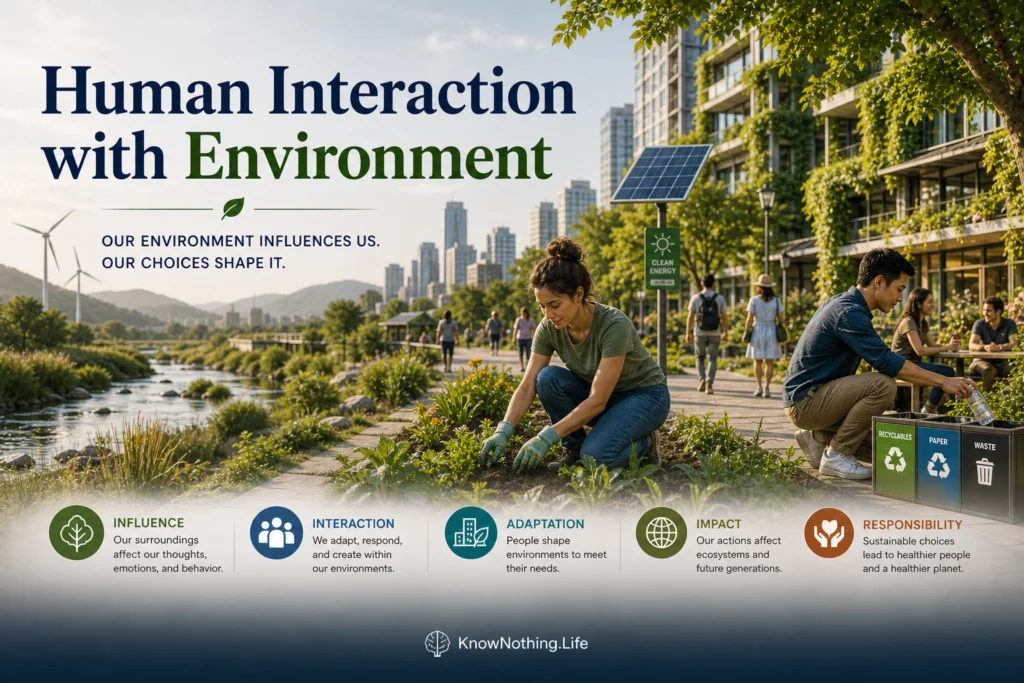
Human interaction with the environment is a foundational dimension of psychological life. From the earliest stages of development, individuals are shaped by the physical spaces they inhabit—homes, neighborhoods, natural landscapes, and built environments. These settings do not merely surround human activity; they actively influence perception, cognition, emotion, and behavior. At the same time, humans continually modify and reinterpret their environments, creating a dynamic relationship in which both parties are constantly changing. Understanding this interaction is essential for addressing issues ranging from urban design and mental health to sustainability and climate change.
The study of human–environment interaction draws from environmental psychology, geography, sociology, and ecology. Early insights from Kurt Lewin established that behavior is a function of both the person and the environment, a principle formalized in his work Field Theory in Social Science. Later thinkers such as James J. Gibson, Roger G. Barker, and Urie Bronfenbrenner expanded this perspective, emphasizing that environments provide opportunities for action, structure behavior through recurring patterns, and operate across multiple levels of context. Together, these approaches reveal that human interaction with the environment is not a simple cause-and-effect relationship but a complex system of mutual influence.
Theoretical Foundations of Interaction
At the core of human–environment interaction is the recognition that behavior cannot be understood in isolation from context. Kurt Lewin’s equation, often summarized as B = f(P, E), captures this idea by asserting that behavior arises from the interaction between personal characteristics and environmental conditions. This formulation marked a shift away from purely internal explanations of behavior, highlighting the importance of situational factors. Lewin’s work laid the groundwork for later theories that integrate psychological processes with environmental context.
Urie Bronfenbrenner further developed this perspective through his ecological systems theory, presented in The Ecology of Human Development. Bronfenbrenner described human development as occurring within nested systems, from immediate settings like family and school to broader cultural and societal influences. Each level of environment interacts with the individual, shaping development over time. This model underscores that human–environment interaction operates at multiple scales, from micro-level interactions in daily life to macro-level influences such as culture, economy, and policy.
Perception and Environmental Meaning
Human interaction with the environment is mediated by perception. Individuals do not respond to environments as objective realities but as interpreted experiences shaped by prior knowledge, expectations, and cultural frameworks. James J. Gibson introduced the concept of affordances in The Ecological Approach to Visual Perception, arguing that environments offer opportunities for action that are directly perceived by individuals. A chair affords sitting, a path affords walking, and a doorway affords passage. These affordances are not inherent properties of objects alone but emerge from the relationship between the individual and the environment.
This perspective highlights that perception is functional and action-oriented. People perceive environments in terms of what they can do within them, rather than as neutral collections of stimuli. Cultural and individual differences further shape this process, as what is perceived as an opportunity in one context may be ignored or interpreted differently in another. Environmental meaning is therefore constructed through interaction, reflecting both the physical properties of the environment and the interpretive frameworks of the individual.
Behavior Settings and Social Structure
Human behavior often occurs within structured environmental contexts that guide action in predictable ways. Roger G. Barker introduced the concept of behavior settings in his work Ecological Psychology. Barker observed that specific environments, such as classrooms, offices, or public spaces, are associated with recurring patterns of behavior that are relatively independent of the individuals present. These settings have their own norms, roles, and expectations, which shape how people act within them.
Behavior settings illustrate how environments organize social life. A library, for example, encourages quiet study, while a marketplace promotes interaction and exchange. These patterns are maintained through shared understanding and social reinforcement, often without explicit rules. Individuals entering a setting quickly adapt their behavior to align with its expectations, demonstrating the powerful influence of environmental context. This concept emphasizes that human interaction with the environment is not only individual but also collective, structured by shared practices and social norms.
Emotional and Cognitive Responses to Environment
Environments evoke emotional and cognitive responses that influence well-being and behavior. Factors such as lighting, noise, temperature, spatial arrangement, and aesthetic design can affect mood, attention, and stress levels. Research in environmental psychology has shown that poorly designed environments can contribute to anxiety, fatigue, and decreased performance, while well-designed spaces can enhance comfort, productivity, and satisfaction.
The restorative effects of natural environments provide a particularly compelling example. Rachel Kaplan and Stephen Kaplan developed Attention Restoration Theory, arguing that exposure to nature helps replenish cognitive resources depleted by sustained mental effort. Natural settings provide a form of “soft fascination” that allows the mind to recover without demanding focused attention. Similarly, Roger Ulrich demonstrated that natural views can reduce physiological stress, supporting the idea that environments play a critical role in psychological health.
Adaptation and Environmental Stress
Human interaction with the environment also involves adaptation to environmental stressors. Conditions such as crowding, noise, pollution, and extreme temperatures can place significant demands on individuals, affecting both physical and psychological well-being. Environmental stress occurs when these demands exceed an individual’s capacity to cope, leading to negative outcomes such as irritability, decreased concentration, and health problems.
Adaptation strategies may include behavioral adjustments, such as avoiding certain environments, as well as psychological mechanisms like habituation. However, adaptation is not always sufficient to mitigate the effects of chronic stress. Prolonged exposure to adverse environmental conditions can lead to cumulative strain, highlighting the importance of designing environments that minimize stressors. Robert Gifford emphasized that both objective conditions and subjective perceptions must be considered, as individuals differ in how they experience and respond to environmental challenges.
Human Impact on the Environment
While environments shape human behavior, humans also exert significant influence on the environment. Through activities such as urbanization, industrialization, and resource consumption, people transform natural landscapes and create built environments that reflect cultural values and technological capabilities. This reciprocal relationship underscores that human–environment interaction is not passive but actively constructed.
Environmental psychology examines how attitudes, beliefs, and social norms influence environmentally significant behavior. Paul Stern argued that such behavior is shaped by a combination of personal values, social influences, and structural factors. Encouraging sustainable interaction with the environment requires understanding these influences and creating conditions that support environmentally responsible choices. This perspective is increasingly important in the context of global environmental challenges, where human actions have far-reaching consequences.
Toward Sustainable Interaction
The concept of sustainability reflects an effort to balance human needs with environmental preservation. It requires rethinking how individuals and societies interact with the environment, moving from patterns of exploitation to more sustainable forms of engagement. Environmental psychology contributes to this effort by identifying factors that promote sustainable behavior, such as environmental awareness, social norms, and perceived efficacy.
Sustainable interaction also involves designing environments that support well-being while minimizing environmental impact. This includes incorporating green spaces, reducing energy consumption, and creating systems that encourage sustainable practices. The challenge is not only technical but psychological, requiring changes in attitudes, values, and behavior. By understanding the psychological dimensions of human–environment interaction, it becomes possible to develop strategies that align individual actions with broader environmental goals.
Conclusion
Human interaction with the environment is a complex and dynamic process that shapes both individual experience and collective outcomes. Environments influence perception, behavior, and well-being, while human actions transform and redefine those environments. This reciprocal relationship highlights the importance of considering both psychological and environmental factors in understanding human behavior.
As global challenges such as urbanization, climate change, and resource depletion intensify, the study of human–environment interaction becomes increasingly relevant. By integrating insights from psychology, ecology, and social science, it is possible to create environments that support human well-being while preserving the natural systems on which life depends. Ultimately, understanding this interaction is not only a matter of scientific inquiry but a foundation for building a more sustainable and harmonious relationship between humans and the world they inhabit.