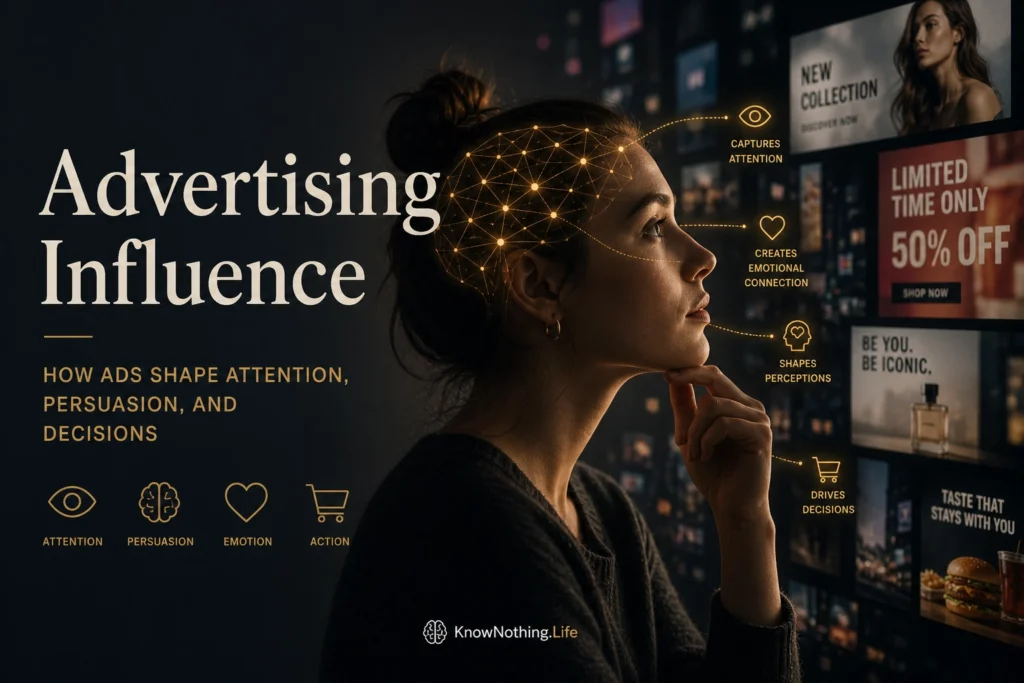
Advertising influence refers to the ways persuasive messages shape what people notice, remember, desire, believe, and eventually buy. At its simplest, advertising informs people that something exists. At its most powerful, it changes the meaning of a product, turns a brand into a symbol, and connects ordinary consumption with identity, emotion, aspiration, belonging, or fear. Advertising does not work only by presenting logical arguments. It works by directing attention, repeating associations, framing choices, creating familiarity, and linking products to human motives that often operate below full conscious awareness.
The psychology of advertising draws from consumer psychology, social psychology, behavioral economics, semiotics, communication theory, and marketing research. Scholars such as Daniel Kahneman, Robert Cialdini, Herbert Simon, Ernest Dichter, Philip Kotler, and Marshall McLuhan help explain why advertising is so influential. Kahneman’s Thinking, Fast and Slow shows that much judgment is fast, intuitive, and impression-based, while Cialdini’s Influence: The Psychology of Persuasion explains how social proof, authority, liking, scarcity, and reciprocity make messages more persuasive. Advertising influence is therefore not merely a matter of clever slogans. It is a structured attempt to shape perception before, during, and after a consumer decision.
Attention and the First Moment of Influence
Advertising begins with attention. In a crowded media environment, people are exposed to far more messages than they can consciously process, so the first challenge of advertising is not persuasion but selection. An advertisement must interrupt the flow of ordinary attention long enough to become mentally available. Color, contrast, movement, music, celebrity, humor, shock, beauty, simplicity, and emotional tension are all used to make a message stand out. William James wrote in The Principles of Psychology that attention is “the taking possession by the mind” of one object out of many. This insight remains central to advertising: what enters attention enters the possibility of influence.
Herbert Simon’s idea of attention as a scarce resource also matters. Simon famously observed that “a wealth of information creates a poverty of attention,” a statement that fits the modern advertising world with unusual force. Consumers scroll, skip, mute, filter, and ignore because attention is limited. Advertising influence therefore depends on reducing friction and increasing salience. A message must be easy to notice, easy to understand, and easy to remember. The more quickly an advertisement communicates its emotional or practical promise, the more likely it is to survive the consumer’s attention filter.
Memory, Repetition, and Brand Familiarity
Advertising often influences consumers not immediately but gradually, through repetition and memory. Repeated exposure builds familiarity, and familiarity can become trust. A person may not remember seeing a specific advertisement, yet still feel that a brand is recognizable, safe, or popular when they later encounter it in a store or search result. This is one reason advertising frequently emphasizes distinctive logos, colors, jingles, taglines, characters, and visual patterns. These cues create mental shortcuts that help consumers recognize a brand quickly.
Kevin Lane Keller’s work on customer-based brand equity emphasizes that brand power exists in what consumers have learned, felt, seen, and heard about a brand over time. Byron Sharp’s How Brands Grow similarly emphasizes mental availability: the likelihood that a brand comes to mind in a buying situation. Advertising builds mental availability by placing brand associations into memory before the consumer needs them. In this sense, an advertisement may succeed even when it does not produce an immediate purchase. It can plant a cue, strengthen recognition, or make the brand feel more familiar when a decision later arises.
Emotion and Persuasion
Emotion is one of advertising’s strongest tools because people rarely make decisions through logic alone. Advertisements often work by attaching products to feelings: happiness, security, romance, confidence, nostalgia, excitement, relief, pride, or belonging. A car commercial may sell freedom more than transportation. A perfume advertisement may sell desire more than scent. A financial services advertisement may sell peace of mind more than account features. The emotional meaning becomes part of the product’s perceived value.
Ernest Dichter, a pioneer of motivational research, argued in The Strategy of Desire that products carry hidden psychological meanings. Consumers often describe purchases in practical terms, but advertising frequently speaks to deeper motives. Daniel Kahneman’s distinction between fast and slow thinking helps explain why emotional advertising can be powerful. Fast, intuitive judgment responds to images, associations, and feelings before slow analysis begins. When an advertisement makes a product feel trustworthy, exciting, or aspirational, it can shape preference before the consumer has compared features or prices.
Social Proof, Authority, and Influence
Advertising often borrows credibility from other people. Robert Cialdini’s Influence explains that people are more likely to act when they see others acting, when an authority endorses a claim, or when a message comes from someone they like or trust. This is why advertisements use testimonials, expert quotes, influencer partnerships, customer ratings, celebrity endorsements, and popularity claims. Social proof reduces uncertainty. If many people have chosen a product, the product feels safer. If a trusted expert recommends it, the claim feels more credible.
This influence is especially strong in uncertain or crowded markets. When consumers cannot easily evaluate quality for themselves, they use external signals. A skincare product, supplement, software service, or financial platform may be difficult to judge immediately, so endorsements and reviews become psychological shortcuts. Advertising influence often depends on these shortcuts. The consumer is not simply asking, “Is this product good?” They are asking, “Who else believes it is good?” The answer can shape trust before direct experience occurs.
Framing, Anchoring, and Perceived Value
Advertising influences behavior by framing how people interpret information. A product can be framed as affordable, premium, natural, scientific, ethical, exclusive, traditional, innovative, or urgent. Each frame changes what the consumer pays attention to. A high price can be framed as luxury craftsmanship; a low price as smart savings; a limited offer as rare opportunity. The product remains the same, but the meaning shifts.
Kahneman and Amos Tversky’s research on heuristics and biases is essential here. Anchoring shows that initial information influences later judgment. In advertising, a “regular price” shown beside a sale price can make the discount feel more valuable, even if the consumer would not have independently judged the item that way. Loss aversion also plays a role: people often feel the pain of missing out more strongly than the pleasure of gaining. Limited-time offers, low-stock alerts, and “last chance” messages influence consumers by making delay feel costly. Advertising does not only present options; it shapes the psychological context in which options are evaluated.
Identity, Aspiration, and Self-Image
Some of the most powerful advertising influence occurs through identity. Consumers often buy products not only for what they do but for what they say about the buyer. Advertising connects products with lifestyles, values, and imagined selves. A brand may present its customers as adventurous, refined, rebellious, intelligent, caring, successful, youthful, ethical, or independent. The product becomes a bridge between the consumer’s current self and a desired self.
Russell Belk’s essay “Possessions and the Extended Self” argued that objects can become part of identity. His phrase “we are what we have” captures how possessions participate in self-expression. Advertising amplifies this process by giving products symbolic language. A watch becomes achievement, a sneaker becomes discipline, a phone becomes creativity, and a coffee brand becomes comfort or sophistication. The consumer is invited not merely to purchase an object but to inhabit a role. Advertising influence is strongest when the consumer recognizes that role as emotionally desirable.
Culture, Symbols, and Meaning
Advertising is also a cultural force. It reflects social values, but it also helps produce and circulate them. Advertisements teach people what beauty looks like, what success sounds like, what happiness requires, what homes should feel like, and what kinds of lives are desirable. Marshall McLuhan’s phrase “the medium is the message,” from Understanding Media, reminds us that advertising is shaped not only by content but by the form of media itself. A television commercial, billboard, magazine spread, TikTok video, podcast sponsorship, and search ad each influence attention and meaning differently.
Jean Baudrillard’s The Consumer Society adds another layer by arguing that consumer goods function as signs within a symbolic system. Advertising turns products into signs of status, naturalness, rebellion, care, taste, or authenticity. The consumer may believe they are choosing a product, but they are also choosing a meaning. This symbolic function explains why advertising can remain influential even when people know they are being advertised to. People may resist the sales pitch while still absorbing the cultural image of what is desirable.
Digital Advertising and Behavioral Targeting
Digital advertising has transformed influence by making it more personalized, measurable, and continuous. Traditional advertising often spoke to broad audiences, but digital systems can target people based on searches, browsing behavior, location, interests, purchases, demographics, and engagement patterns. This allows advertisers to show different messages to different consumers at different moments. A person who searches for running shoes, watches fitness videos, or abandons a shopping cart may encounter ads precisely timed to their behavior.
This personalization can be useful when it helps consumers find relevant products, but it also raises ethical concerns. Behavioral targeting can exploit vulnerability, impulsivity, insecurity, and emotional timing. Choice architecture, dark patterns, retargeting, countdown timers, and algorithmic recommendations can pressure consumers into action before reflection. Digital advertising influence is powerful because it follows consumers across contexts, blending into entertainment, social interaction, search, and everyday digital life. The boundary between information and persuasion becomes harder to see.
Advertising Ethics and Consumer Autonomy
Because advertising shapes attention, emotion, and desire, it carries serious ethical responsibilities. Persuasion is not automatically manipulation. Advertising can inform, entertain, introduce useful products, support competition, and help consumers make choices. But it becomes ethically troubling when it deceives, exaggerates, exploits fear, targets vulnerable groups, hides material information, or manufactures insecurity. The psychological sophistication of modern advertising makes ethical restraint more important, not less.
Ethical advertising respects consumer autonomy. It makes claims that can be supported, presents value without deception, and avoids pressuring people through artificial urgency or emotional manipulation. For consumers, understanding advertising influence creates psychological distance. Awareness of social proof, anchoring, scarcity, emotional association, and identity appeals allows people to pause and ask whether a desire is genuinely theirs, strategically activated, or socially borrowed. The goal is not to become immune to advertising, which is unlikely, but to become more reflective about how influence operates.
Conclusion
Advertising influence is powerful because it operates across the full landscape of human psychology. It captures attention, builds memory, attaches emotion, borrows social credibility, frames value, shapes identity, and circulates cultural meaning. Its effects are not limited to immediate purchases. Advertising can change what feels familiar, what seems trustworthy, what appears desirable, and what consumers imagine a product will do for their lives.
The study of advertising influence reveals that consumers are neither helpless victims nor perfectly rational decision-makers. They are meaning-making human beings moving through environments designed to guide perception and choice. Advertising works because it understands that buying is emotional, social, symbolic, and often automatic. At its best, advertising helps people discover real value. At its worst, it manipulates attention and desire. Understanding its psychology is therefore essential for marketers who want to communicate responsibly and for consumers who want to choose with greater awareness.