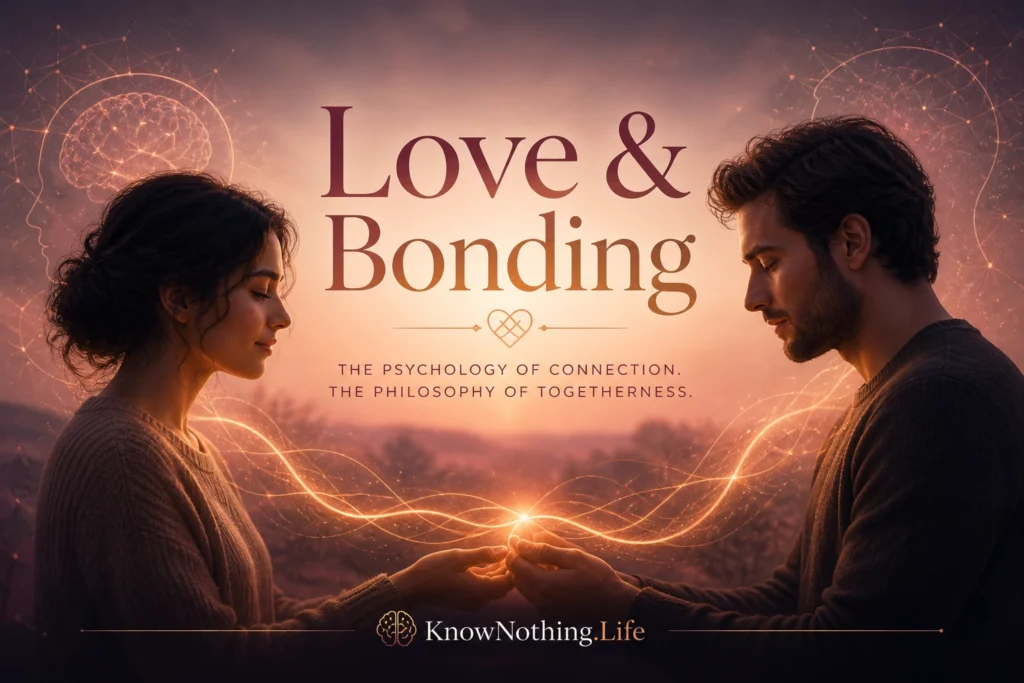
Love and bonding are among the deepest forces in human psychology. They shape how people attach, trust, commit, care, grieve, forgive, and build lives together. Love can be romantic, familial, platonic, parental, spiritual, or communal, but in every form it involves a movement beyond isolated self-interest toward connection with another. Bonding is the psychological and biological process through which that connection becomes emotionally significant and enduring. It is what makes another person matter not only as a source of pleasure or help, but as someone whose presence becomes woven into one’s sense of safety, identity, and future.
The study of love and bonding draws from attachment theory, social psychology, evolutionary psychology, neuroscience, psychoanalysis, and philosophy. John Bowlby’s attachment theory explains why human beings seek secure emotional bonds “from the cradle to the grave,” while Robert Sternberg’s triangular theory of love describes love through intimacy, passion, and commitment. Erich Fromm’s The Art of Loving treats love not merely as a feeling but as an art requiring knowledge, discipline, and practice. Helen Fisher’s research frames romantic love as a motivational system connected to reward, attraction, and mate choice. Together, these perspectives show that love is both biological and meaningful, both felt and chosen, both personal and relational.
Love as Attachment
Attachment theory provides one of the strongest foundations for understanding love and bonding. Bowlby argued that attachment is a basic survival system, not a childish dependency to be outgrown. Infants seek closeness to caregivers because proximity protects them from danger, regulates distress, and supports exploration. When a caregiver becomes reliable enough, the child develops a secure base: a relationship from which they can move outward into the world and return for comfort. Bowlby’s famous formulation that human beings are happiest when life is organized around excursions from a secure base captures the lifelong importance of attachment bonds.
Adult love often repeats this same structure in a more mature form. Romantic partners, close friends, and family members can become secure bases for one another. This does not mean healthy adults should become dependent in a helpless way. Rather, secure bonding allows people to take risks, face stress, and grow because they know they are not emotionally alone. A loving bond says, implicitly, “You can go into the world, and you can return.” Love becomes not a cage but a home base, strengthening autonomy through connection.
The Biology of Bonding
Love is deeply psychological, but it is also biological. Bonding involves brain and body systems connected to reward, stress regulation, social recognition, caregiving, and attachment. Dopamine is involved in motivation and pursuit, helping explain the intense focus and energy of early romantic love. Oxytocin and vasopressin are often discussed in relation to attachment, trust, pair bonding, and caregiving, though their effects are complex and shaped by context. Endogenous opioids also appear to play a role in the comfort of close attachment and the pain of separation. Love feels powerful because it recruits systems designed to make social connection matter.
Helen Fisher’s work is especially influential because it separates lust, attraction, and attachment into overlapping but distinct systems. In her research on romantic love, Fisher describes romantic love as a motivation system rather than merely an emotion, arguing that it helps people focus courtship energy on a preferred partner. This explains why early romantic love can feel urgent, energizing, and obsessive. The beloved person becomes motivationally salient: their messages, expressions, approval, absence, and presence carry extraordinary weight. Biology does not reduce love to chemistry; it explains why love can command attention so completely.
Intimacy, Passion, and Commitment
Robert Sternberg’s triangular theory of love remains one of the most useful psychological models because it distinguishes among intimacy, passion, and commitment. Intimacy involves closeness, trust, emotional sharing, and bondedness. Passion involves desire, attraction, arousal, and romantic intensity. Commitment involves the decision to love and the intention to maintain the relationship over time. Sternberg’s model suggests that different relationships contain different combinations of these components, producing forms such as liking, infatuation, companionate love, romantic love, and consummate love.
This model matters because it explains why love can feel incomplete when one element is missing. Passion without intimacy may be exciting but unstable. Intimacy without commitment may feel warm but uncertain. Commitment without intimacy or passion may become duty without emotional life. Long-term bonding often depends on whether partners can maintain or renew all three elements in realistic ways. Passion may change over time, but intimacy and commitment can deepen. Mature love is not the permanent preservation of first intensity; it is the ongoing cultivation of closeness, desire, loyalty, and shared meaning.
Love as Practice
Erich Fromm challenged the idea that love is simply something one “falls into.” In The Art of Loving, he argued that love is an art that requires theory and practice, much like music, medicine, or craftsmanship. This view shifts love away from passive emotion and toward active capacity. To love well requires attention, responsibility, respect, knowledge, patience, humility, and discipline. Feeling strongly is not enough. A person may feel desire, need, or attachment and still fail to love well if they cannot respect the other person’s reality.
Fromm also emphasized that love is not merely possession or dependence. One of his best-known claims is that love involves decision, judgment, and promise, not feeling alone. This does not mean love is cold or purely rational. It means that durable love includes action when feeling fluctuates. There are days when affection is easy and days when care must be chosen. Bonding becomes stronger when love is practiced through reliability, truthfulness, repair, generosity, and presence. In this sense, love is not only an emotion people have; it is a way people behave.
Trust, Safety, and Vulnerability
Bonding cannot deepen without trust. Trust allows people to reveal themselves, depend on one another, and risk emotional openness. Vulnerability is central because love requires exposure: the exposure of need, fear, longing, imperfection, grief, desire, and hope. A person who cannot risk being known may struggle to experience intimacy. Yet vulnerability is only healthy when the relationship is reasonably safe. To be vulnerable with someone who humiliates, betrays, exploits, or dismisses is not intimacy; it is exposure without protection.
Brené Brown’s work on vulnerability is often cited because it frames vulnerability as a condition of authentic connection rather than weakness. Attachment theory makes a similar point: secure bonds allow people to bring distress into relationship and receive care rather than punishment. Trust grows through repeated evidence. A person says what they mean. They repair when they harm. They respect boundaries. They remain emotionally present during difficulty. Love becomes believable not through declarations alone, but through patterns that teach the nervous system, “I am safe enough here.”
Caregiving and Mutual Responsiveness
Love is not only wanting another person; it is caring about their well-being. In attachment bonds, caregiving is the complementary system to attachment seeking. One person reaches for comfort, and the other responds. In healthy adult relationships, these roles shift back and forth. Sometimes one partner needs support; sometimes the other does. Mutual responsiveness is a core feature of bonding because it shows that each person’s inner world matters. The bond becomes a living system of noticing, responding, and repairing.
Caregiving, however, must be distinguished from control or self-erasure. Loving care supports the other person’s flourishing; it does not dominate their choices or absorb their identity. A parent who loves a child must protect without imprisoning. A partner who loves must support without managing every feeling. A friend who loves must be present without becoming responsible for another person’s entire life. Mature bonding balances care and boundaries. It says, “You matter to me,” without saying, “You belong to me.”
Conflict, Repair, and the Strength of Bonds
Love does not eliminate conflict. In fact, strong bonds often make conflict more emotionally charged because the relationship matters. The difference between healthy and unhealthy love is not whether people disagree, but whether disagreement can be repaired. John Gottman’s research on couples shows that patterns such as contempt, criticism, defensiveness, and stonewalling damage relationships, while repair attempts, emotional responsiveness, and friendship help preserve them. Conflict becomes dangerous when it communicates disgust, rejection, or domination rather than hurt, need, or difference.
Repair is one of the most important behaviors in bonding. A repair can be an apology, a softening of tone, a return after withdrawal, a clarification, or a willingness to listen again. Bonding deepens when people learn that rupture does not have to mean abandonment. The nervous system learns that conflict can be survived and connection restored. This is especially important for people with trauma or insecure attachment histories, for whom conflict may feel like the end of love. A secure bond does not promise that harm will never happen; it promises that harm will be acknowledged and addressed.
Family, Friendship, and Non-Romantic Love
Love and bonding are not limited to romantic relationships. Parent-child bonds, sibling bonds, friendships, mentorships, and community ties can be equally central to psychological life. A friendship may provide emotional safety, shared humor, moral support, and a sense of being known. A family bond may provide continuity and belonging, though families can also wound when love is mixed with control, neglect, or obligation. Communal bonds can give people identity, ritual, care, and shared purpose.
Western culture often overemphasizes romantic love as the central form of meaningful connection. Interpersonal psychology offers a broader view. Human beings need multiple forms of bonding. No single relationship can meet every emotional need. Friendship may offer forms of honesty that romance cannot. Community may provide belonging that partnership alone cannot. Family may provide history, while chosen family may provide safety. A healthy emotional life is usually supported by a network of bonds rather than a single fragile source of all connection.
Culture and Love
Culture shapes what people expect love to be. Some cultures emphasize romantic choice, personal fulfillment, and emotional expression. Others emphasize family responsibility, social compatibility, duty, and long-term stability. In some contexts, love is expected to precede commitment; in others, love is expected to grow through commitment. Neither pattern is simple or universal. Cultural models influence how people date, marry, parent, express affection, handle conflict, and understand loyalty.
Cross-cultural psychology reminds us that love is both universal and culturally patterned. Humans everywhere form bonds, grieve separation, and seek care, but the meanings of love vary. A direct verbal declaration may be valued in one culture, while practical devotion may carry more weight in another. Emotional restraint may be seen as coldness in one context and respect in another. Understanding love across cultures requires humility. The question is not only “Do people love?” but “How does this culture teach love to be shown, tested, protected, and sustained?”
Loss, Separation, and Grief
The depth of bonding is revealed by the pain of separation. Grief is love responding to absence. When someone deeply bonded to us dies, leaves, betrays, or becomes unreachable, the attachment system protests. The mind searches, remembers, replays, imagines, and aches. Bowlby’s attachment theory helps explain why grief can feel so bodily and urgent: attachment bonds are not abstract preferences; they are systems of safety and meaning. Losing an attachment figure can destabilize the world.
Grief also shows that love is not erased by absence. The bond changes form. People may continue to speak inwardly to those they have lost, live by their values, carry memories, or maintain symbolic connection. Healthy grief does not require “getting over” love. It involves integrating the loss into life. The goal is not to stop loving, but to find a way to live while loving someone who is absent, changed, or gone. Bonding is powerful because it outlasts presence.
Love, Dependency, and Freedom
A common misunderstanding is that healthy love means complete self-sufficiency. In reality, human beings are interdependent. Needing others is not automatically unhealthy. The problem is not dependency itself, but dependency without freedom, reciprocity, or selfhood. Secure love allows people to rely on each other while remaining distinct. It creates connection without fusion and autonomy without abandonment. Mature bonding strengthens the self rather than dissolving it.
Dependency becomes unhealthy when one person’s existence is organized entirely around another’s approval, when fear prevents honesty, or when control is mistaken for care. Fromm’s distinction between mature love and possessive attachment is useful here. Mature love says, “I want you to become fully yourself.” Possessive love says, “I need you to exist for me.” Healthy bonding allows both closeness and growth. It does not demand that love remove all loneliness, fear, or uncertainty. It provides a relationship strong enough to face them.
Conclusion
Love and bonding are central to human life because people are built for connection. Through love, individuals seek safety, recognition, desire, care, and meaning. Through bonding, certain relationships become emotionally significant enough to shape identity, regulate distress, and organize the future. Love involves biology, but it is not reducible to chemistry. It involves feeling, but it is not reducible to emotion. It involves choice, but it is not reducible to duty. Love is a living pattern of attachment, attraction, trust, care, vulnerability, repair, and commitment.
A mature psychology of love recognizes both its beauty and its demands. Love can heal, but it can also expose old wounds. It can create safety, but it requires responsibility. It can begin in passion, but it survives through practice. The strongest bonds are not those without conflict or fear, but those capable of repair, truth, and mutual growth. To understand love and bonding is to understand one of the deepest truths of human psychology: people become fully themselves not in isolation, but through relationships that allow them to be known, held, challenged, and free.