Manipulation and persuasion both involve influence, but they differ sharply in ethics, transparency, and respect for autonomy. Persuasion attempts to change belief or behavior through reasons, emotion, credibility, or shared values while leaving the other person’s judgment intact. Manipulation, by contrast, attempts to guide someone’s choices while hiding the real motive, distorting the facts, exploiting vulnerability, or creating emotional pressure. The difference is not merely technical; it is moral. A teacher persuades by helping students see why an idea matters. A manipulator pressures, confuses, flatters, frightens, or isolates a person until the desired choice feels like the only available option.
The study of influence reaches across psychology, philosophy, rhetoric, political theory, marketing, and social behavior. Aristotle’s Rhetoric remains one of the earliest systematic works on persuasion, organizing influence around ethos, pathos, and logos: credibility, emotion, and reason. Centuries later, Niccolò Machiavelli’s The Prince examined the strategic use of fear, appearance, and power in political life, famously arguing that a ruler must learn “how not to be good” when necessity demands it. Modern psychology adds empirical detail, showing that influence succeeds not only because people are weak, but because the human mind relies on trust, shortcuts, emotion, identity, and social cues. These traits make civilization possible, but they also create openings for deception.
Persuasion, Manipulation, and the Question of Consent
Persuasion becomes ethically sound when it preserves informed consent. A person may be moved by a powerful speech, an emotional story, or a compelling argument, but if the facts are honest and the listener remains free to disagree, the influence respects autonomy. Manipulation removes or weakens that freedom. It may do this by withholding key information, manufacturing urgency, misrepresenting consequences, exploiting guilt, or making the target feel unsafe for resisting. This is why manipulation often leaves behind confusion, shame, dependency, or regret, while healthy persuasion usually leaves behind clarity, even when the person has changed their mind.
Immanuel Kant’s moral philosophy provides one of the strongest criticisms of manipulation. In Groundwork of the Metaphysics of Morals, Kant argues that human beings should be treated as ends in themselves, never merely as means. Manipulation violates this principle because it treats another person’s mind as an instrument to be managed rather than a rational agency to be respected. The manipulator does not ask, “What would this person freely choose if they understood the situation?” Instead, they ask, “Which emotional lever will make them do what I want?”
At the same time, influence cannot be removed from human life. Every parent, leader, writer, teacher, friend, advertiser, and activist uses persuasion in some form. The ethical challenge is not to avoid influence altogether, but to distinguish influence that clarifies from influence that captures. Persuasion invites judgment; manipulation bypasses it. Persuasion can survive questions; manipulation often punishes them. Persuasion respects the other person’s “no”; manipulation treats resistance as a problem to overcome.
The Psychology of Compliance
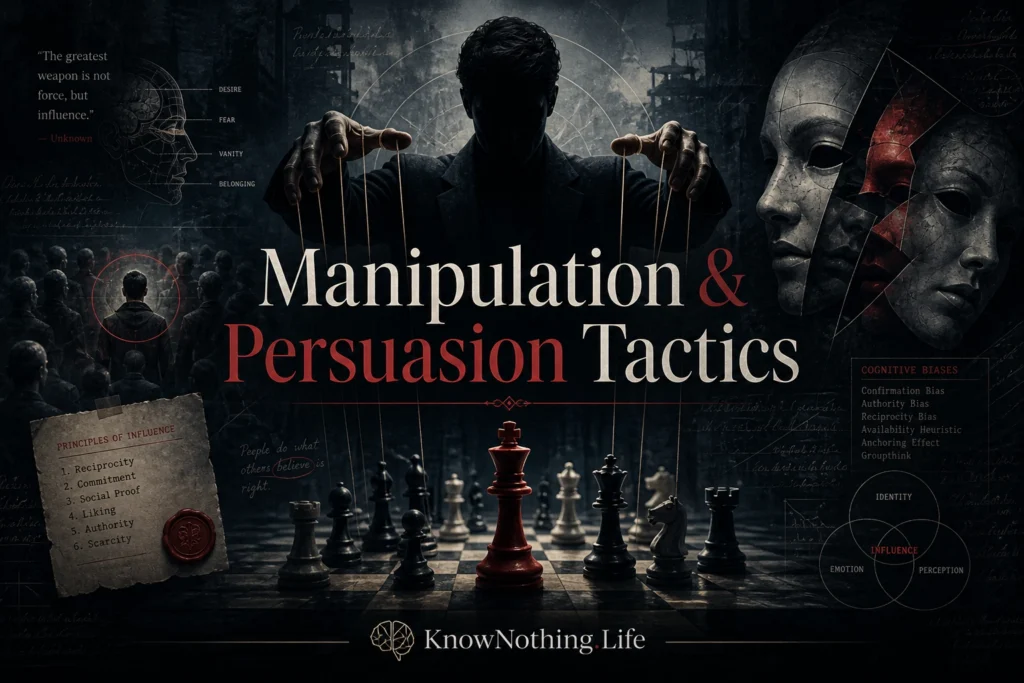
One of the most influential modern works on persuasion is Robert Cialdini’s Influence: The Psychology of Persuasion. Cialdini identified several principles that shape compliance, including reciprocity, commitment and consistency, social proof, authority, liking, scarcity, and later unity. These principles work because they are deeply tied to ordinary social life. Reciprocity helps communities function. Authority helps people rely on expertise. Social proof helps individuals navigate uncertainty. Scarcity helps people prioritize limited opportunities. In ethical hands, these principles can improve communication. In manipulative hands, they become tools of pressure.
Reciprocity is especially powerful. When someone gives us something, even a small gift, we often feel an obligation to return the favor. This can be harmless, as in everyday kindness, but it can also be engineered. A manipulator may offer attention, help, praise, or favors not out of generosity, but to create emotional debt. Once the target feels indebted, refusal becomes harder. Cialdini’s research shows that people often comply with requests not because the request is reasonable, but because the situation has activated a social rule they feel uncomfortable breaking.
Commitment and consistency can also be exploited. People want to appear stable, reliable, and true to their previous choices. A manipulator may begin with a small request, then gradually escalate. This resembles the “foot-in-the-door” technique studied by Jonathan Freedman and Scott Fraser, where agreement to a minor request increases the likelihood of agreement to a larger one. The person may not notice the shift because each step seems consistent with the last. By the time the demand becomes unreasonable, backing out feels like contradicting oneself.
Emotional Leverage and Pressure
Manipulation often succeeds by controlling emotional conditions rather than facts. Fear, guilt, shame, admiration, anxiety, loneliness, and hope can all narrow judgment. When emotions are intense, people tend to seek relief quickly. A manipulator understands this and creates discomfort that only compliance seems to resolve. The target may agree not because they are convinced, but because they want the emotional pressure to stop.
Guilt-tripping is one of the most common emotional tactics. It reframes a boundary as cruelty, independence as betrayal, or disagreement as personal rejection. Instead of addressing the issue directly, the manipulator makes the target responsible for the manipulator’s emotional state. Phrases like “after everything I’ve done for you” or “I guess you don’t care about me” shift attention away from the actual request and toward the target’s fear of seeming selfish. This tactic is powerful because most people want to see themselves as kind and loyal.
Fear-based persuasion can be legitimate when the danger is real and honestly presented. Public health warnings, safety instructions, and legal consequences may all involve fear without being manipulative. The tactic becomes manipulative when fear is exaggerated, fabricated, or used to shut down thought. Daniel Kahneman’s Thinking, Fast and Slow helps explain why this works. Under emotional pressure, people rely more heavily on fast, intuitive judgments. Urgency, danger, and uncertainty push the mind toward immediate reaction, leaving less room for careful evaluation.
Gaslighting and Distortion of Reality
Gaslighting is a manipulation tactic that attacks a person’s trust in their own perception. The term comes from the play Gas Light, in which a husband manipulates his wife into doubting her sanity. In psychological terms, gaslighting involves persistent denial, contradiction, minimization, blame reversal, and selective rewriting of events. The goal is not simply to win a disagreement, but to make the target less confident in their memory, judgment, and interpretation of reality.
A gaslighter may deny saying something they clearly said, accuse the other person of being too sensitive, insist that obvious behavior was imagined, or reinterpret events so that the victim becomes the problem. Over time, the target may begin asking, “Am I overreacting?” or “Maybe I remembered it wrong.” This uncertainty benefits the manipulator because a person who doubts themselves becomes easier to control. They may begin relying on the manipulator to define what happened, what matters, and what is reasonable.
Gaslighting is especially harmful because it damages the inner authority of the self. Erich Fromm’s Escape from Freedom is useful here because Fromm explored why people may surrender autonomy when freedom becomes frightening. A manipulated person may cling to the manipulator not because the relationship is healthy, but because their independence has been systematically weakened. Once self-trust erodes, even obvious mistreatment can feel ambiguous.
Social Proof, Group Pressure, and Conformity
Human beings are social learners. We look to others for cues about what is normal, safe, desirable, or correct. Social proof is useful when we lack information, but it also makes people vulnerable to herd behavior. If a manipulator can create the impression that “everyone agrees,” “everyone is doing it,” or “everyone will judge you,” resistance becomes psychologically harder. The person may comply to avoid exclusion, embarrassment, or conflict.
Solomon Asch’s conformity experiments famously showed that people may give obviously wrong answers when group pressure is strong enough. Participants often conformed to an incorrect majority judgment about simple line lengths, revealing how deeply social pressure can influence perception and expression. The lesson is not that people are foolish, but that belonging exerts a powerful force. Many individuals would rather doubt their own eyes than stand alone against a group.
Group pressure becomes especially dangerous in cultic, authoritarian, or highly controlled environments. Robert Jay Lifton’s Thought Reform and the Psychology of Totalism examined how ideological systems can reshape identity through confession, loaded language, purity demands, and control of communication. In such settings, persuasion is no longer ordinary argument. It becomes an environment where dissent is punished, language is narrowed, and the group’s reality replaces individual judgment.
Authority, Expertise, and Obedience
Authority is one of the most powerful persuasion cues because human society depends on specialized knowledge. Doctors, teachers, judges, engineers, scientists, and leaders often know things that nonexperts do not. Respect for authority can be rational. However, authority can also be imitated, exaggerated, or abused. A uniform, title, credential, confident tone, technical language, or institutional setting can make people comply before they have evaluated the substance of the request.
Stanley Milgram’s obedience experiments remain among the most famous and controversial studies in social psychology. In Obedience to Authority, Milgram showed that ordinary people could be led to administer what they believed were painful electric shocks when instructed by an authority figure. Milgram concluded that obedience is not only a matter of personal cruelty; it can emerge from social structure, role expectations, and the transfer of responsibility. His work remains disturbing because it suggests that many people underestimate how strongly authority can override conscience.
Manipulators often exploit borrowed authority. They may cite vague experts, misuse scientific language, invoke institutions, or present themselves as uniquely enlightened. This tactic appears in scams, extremist recruitment, pseudoscience, abusive relationships, and toxic workplaces. The target is encouraged to stop asking, “Is this true?” and start thinking, “Who am I to question this?” Healthy authority welcomes scrutiny within reasonable limits. Manipulative authority treats questions as disloyalty.
Scarcity, Urgency, and Manufactured Pressure
Scarcity increases perceived value. When something appears limited, people fear losing the opportunity. This principle is common in sales, negotiation, romance, politics, and social media. Scarcity is not always deceptive; limited seats, deadlines, and rare items can be real. It becomes manipulative when scarcity is manufactured to bypass reflection. The target is rushed so that they do not compare options, seek advice, read details, or notice inconsistencies.
Urgency works because it compresses decision-making time. Phrases like “this offer ends today,” “you must decide now,” or “someone else will take your place” create pressure. In emotional relationships, urgency may appear as “prove you love me right now” or “if you leave, everything will fall apart.” In scams, it may appear as a fake emergency. In politics, it may appear as constant crisis language. The shared goal is to make delay feel dangerous.
A useful defense is the simple habit of slowing down. Manipulation often weakens when the target says, “I need time to think.” Genuine opportunities can usually survive a reasonable pause. Manipulative pressure often cannot. When someone becomes angry because you want clarity, time, or independent advice, that reaction itself becomes information.
Love Bombing, Intermittent Reinforcement, and Dependency
Love bombing is the use of excessive affection, praise, attention, or promises to create rapid emotional attachment. It can appear in romantic relationships, cult recruitment, manipulative friendships, or exploitative mentorships. The target may feel uniquely seen, chosen, or rescued. The intensity is flattering, but it often functions as bait. Once attachment forms, the manipulator may withdraw affection, introduce criticism, or demand loyalty as proof of gratitude.
Intermittent reinforcement makes this bond stronger. B. F. Skinner’s work on reinforcement showed that behavior can become highly persistent when rewards are unpredictable. In human relationships, inconsistent affection can create a powerful chase. The target keeps hoping the warmth will return and may blame themselves when it disappears. This cycle can make an unhealthy relationship feel emotionally addictive.
The tactic works because the target is not attached only to the manipulator as they are, but to the idealized version shown at the beginning. They keep trying to recover the earlier kindness, intensity, or admiration. A healthy relationship becomes steadier with time. A manipulative one often becomes more confusing, with affection used as a reward and withdrawal used as punishment.
Language, Framing, and Narrative Control
Words shape perception. A skilled persuader understands that the way an issue is framed often determines how it is judged. Calling the same action “firm leadership” or “authoritarian control,” “security” or “surveillance,” “discipline” or “abuse,” can change emotional response before the facts are even considered. Framing is not always dishonest; every explanation requires some frame. It becomes manipulative when language is chosen to conceal reality rather than clarify it.
George Orwell’s essay “Politics and the English Language” remains one of the classic warnings about corrupted language. Orwell argued that political language can be designed to make “lies sound truthful and murder respectable.” His insight applies beyond politics. Manipulators often use vague, inflated, or reversed language to avoid accountability. Cruelty becomes “honesty.” Control becomes “care.” Silence becomes “peace.” Obedience becomes “loyalty.”
Narrative control is the broader version of framing. The manipulator tries to define who is the victim, who is unreasonable, what happened, what matters, and what the target is allowed to feel. Once the manipulator controls the story, they control the meaning of every event inside it. This is why independent perspective is so important. Talking to someone outside the manipulative system can restore ordinary language and break the spell of the imposed narrative.
Defending Against Manipulation
The first defense against manipulation is recognition. People are most vulnerable when they do not know what is happening. Warning signs include pressure to act immediately, punishment for asking questions, exaggerated flattery, repeated boundary testing, isolation from trusted people, blame reversal, inconsistent stories, and emotional consequences for disagreement. A persuasive person may be disappointed by refusal, but a manipulative person often treats refusal as betrayal.
The second defense is boundary clarity. Boundaries do not require long explanations. A simple “I’m not comfortable with that,” “I need time,” or “No, that does not work for me” can reveal the nature of the interaction. Respectful people adjust. Manipulative people escalate, guilt-trip, mock, threaten, or intensify charm. Their response shows whether they wanted agreement or control.
The third defense is reality testing. Write things down. Compare claims with evidence. Ask trusted outsiders for perspective. Avoid making major decisions under fear, urgency, exhaustion, or emotional intoxication. Manipulation thrives in isolation and speed; resistance grows through time, clarity, and connection. The goal is not to become cynical or distrustful, but to become difficult to rush, confuse, or emotionally corner.
Final Thoughts
Manipulation and persuasion tactics reveal both the power and vulnerability of the human mind. Aristotle, Kant, Cialdini, Kahneman, Asch, Milgram, Skinner, Lifton, Fromm, Machiavelli, and Orwell each help illuminate a different part of influence: rhetoric, autonomy, compliance, cognition, conformity, obedience, reinforcement, thought reform, freedom, power, and language. Together, their work shows that influence is never merely about words. It is about emotion, identity, pressure, trust, and the structure of choice.
Persuasion is not the enemy. Honest persuasion is part of education, leadership, love, art, politics, and moral life. The danger begins when influence becomes hidden control. Manipulation turns another person’s psychology into a tool, weakening their freedom while making compliance appear voluntary. It does not simply change what someone chooses; it changes the conditions under which choosing happens.
To understand manipulation is to become more protective of the mind’s independence. The strongest defense is not suspicion toward everyone, but disciplined clarity: asking what is true, what is being hidden, who benefits, and whether refusal is allowed. Where persuasion respects freedom, manipulation fears it. That difference is the line between influence that enlightens and influence that controls.