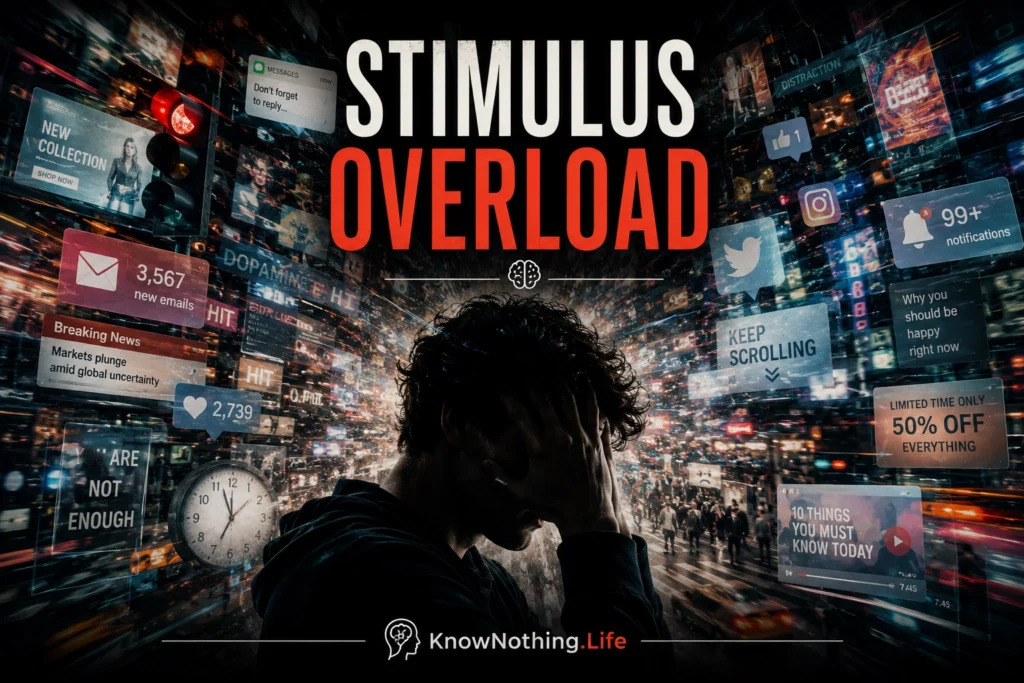
Stimulus overload is the psychological and physiological state that occurs when the mind receives more sensory, social, emotional, or informational input than it can comfortably process. Human beings are constantly surrounded by stimuli: sounds, lights, smells, textures, conversations, screens, alerts, crowds, advertisements, decisions, memories, worries, and bodily sensations. Under ordinary conditions, the brain filters this flood of input so that attention can settle on what matters. Stimulus overload begins when the filtering system is overwhelmed. The person may feel tense, distracted, irritable, anxious, exhausted, numb, or desperate to escape. The world becomes “too much.”
The idea is central to modern psychology because contemporary life often increases stimulation faster than the mind can adapt. Dense cities, digital devices, constant communication, open-office workspaces, traffic, social media, multitasking, and information abundance all place heavy demands on attention and self-regulation. William James, in The Principles of Psychology, wrote that attention is the mind taking possession of one object “out of what seem several simultaneously possible objects.” Stimulus overload shows the strain behind that act. To focus on one thing, the mind must suppress many others. When too many things compete at once, attention fragments and the person loses a sense of control.
The Psychology of Overstimulation
The brain is not a passive receiver of the world. It actively selects, organizes, and interprets sensory information. At any moment, the nervous system must decide what is relevant, what is dangerous, what is familiar, what can be ignored, and what requires action. This process is usually automatic. A person can walk through a room without consciously processing every shadow, sound, object, and movement. But when input becomes intense, unpredictable, emotionally charged, or prolonged, the system has to work harder. Stimulus overload is not merely “having a lot around you”; it is the breakdown of efficient filtering.
Donald Broadbent’s early filter model of attention, developed in Perception and Communication, helped establish the idea that attention acts as a selective gateway. Because the human mind cannot fully process everything at once, it must filter information before deeper processing occurs. Later theories complicated Broadbent’s model, but the basic insight remains useful: attention has limits. Stimulus overload happens when the volume, speed, novelty, or emotional intensity of input exceeds those limits. The person may then experience confusion, fatigue, agitation, shutdown, or impulsive attempts to reduce stimulation.
Sensory Overload and the Body
Stimulus overload is often felt in the body before it is understood intellectually. Bright lights may become painful, background noise may feel intrusive, clothing textures may become irritating, and ordinary conversation may seem too demanding. The body may respond with muscle tension, faster breathing, headaches, nausea, restlessness, sweating, or a strong urge to leave. This is because sensory processing is tied to the autonomic nervous system, which regulates arousal, threat detection, and readiness for action. When stimulation becomes excessive, the body may interpret the environment as unsafe even when no obvious danger is present.
Hans Selye’s work on stress is relevant here. In The Stress of Life, Selye described stress as the body’s nonspecific response to demands placed upon it. Stimulus overload can be understood as a demand on the nervous system. The problem is not always one single stimulus, but the accumulation of many small demands: fluorescent lights, noise, notifications, clutter, social pressure, deadlines, and emotional tension. Each may be tolerable alone, but together they create overload. The person may say, “I do not know why I feel overwhelmed,” because no single cause seems large enough. The cause is the total load.
Cognitive Load and Mental Fatigue
Stimulus overload is closely related to cognitive load, the amount of mental effort required to process information and perform tasks. John Sweller’s cognitive load theory, originally developed in educational psychology, argued that learning suffers when working memory is overloaded. Working memory can only hold and manipulate a limited amount of information at one time. When too many instructions, distractions, choices, or details arrive at once, comprehension breaks down. This principle applies far beyond classrooms. A person trying to cook while answering texts, listening to a podcast, supervising a child, and worrying about work may suddenly feel unable to think clearly.
Mental fatigue appears when cognitive demands remain high for too long. The person may reread the same sentence repeatedly, forget simple tasks, lose patience, or struggle to make decisions. Daniel Kahneman, in Thinking, Fast and Slow, described attention as a limited resource that can be allocated to effortful mental activities. Stimulus overload drains that resource by forcing the mind to continually monitor, switch, inhibit, and react. Multitasking is especially costly because the brain is often not doing several complex tasks at once; it is rapidly switching between them. Each switch has a price.
Urban Life and Environmental Overload
The modern study of stimulus overload was strongly shaped by environmental psychology and urban sociology. Georg Simmel, in “The Metropolis and Mental Life,” argued that city life exposes people to an intensified “nervous stimulation” created by rapid impressions, social density, money relations, and constant change. He believed that urban dwellers often develop a blasé attitude as a defensive adaptation. When too much happens too quickly, the person protects themselves by becoming emotionally distant or indifferent. This remains one of the classic insights into modern overstimulation.
Stanley Milgram also explored urban overload, especially in his essay “The Experience of Living in Cities.” Milgram argued that city residents face more input than they can respond to, so they adapt by filtering, ignoring, rushing, and limiting social engagement. A person in a crowded city may appear rude, but that behavior may function as psychological self-protection. If one responded fully to every stranger, sound, request, advertisement, and event, one would be overwhelmed. Urban overload therefore changes social behavior. It teaches people to narrow attention, reduce eye contact, avoid involvement, and preserve limited mental resources.
Digital Stimulus Overload
Digital life has created one of the most intense forms of stimulus overload. Phones, computers, streaming platforms, news feeds, email, social media, messages, alerts, and recommendation systems generate constant novelty. The digital environment is not merely busy; it is designed to capture attention. Notifications interrupt thought, feeds refresh endlessly, and platforms deliver emotional triggers in rapid sequence: outrage, humor, desire, fear, envy, curiosity, and social validation. The mind is pulled again and again into reaction.
Nicholas Carr, in The Shallows, argued that the internet encourages habits of skimming, scanning, and interruption rather than sustained attention. His concern fits directly with stimulus overload. The brain adapts to the environments it repeatedly inhabits. If a person spends hours moving through fragmented digital input, deep focus may begin to feel slow, uncomfortable, or even unnatural. Marshall McLuhan’s famous statement in Understanding Media that “the medium is the message” is relevant because digital platforms affect cognition not only through content, but through form. Speed, interruption, and endless availability become part of how the mind experiences reality.
Emotional Overload and Social Overstimulation
Stimulus overload is not only sensory or informational. It can also be emotional and social. A person may become overwhelmed by other people’s needs, conflicts, moods, expectations, and judgments. Crowded social situations, family tension, workplace pressure, public performance, and constant online interaction can overload the emotional system. The person may begin to feel emotionally saturated, unable to respond with patience or empathy. This does not necessarily mean they lack care. It may mean their capacity to process social-emotional input is temporarily depleted.
Arlie Hochschild’s The Managed Heart is useful for understanding emotional overload in social and work life. Hochschild described emotional labor as the process of managing feelings to meet social or occupational expectations. Many people must smile, remain calm, perform warmth, suppress anger, or absorb the emotions of others as part of daily life. Over time, this can become overstimulating and exhausting. In caregiving, teaching, customer service, healthcare, parenting, and leadership, emotional input can be relentless. Stimulus overload often appears when the person has no private space to recover from the demands of being socially available.
Overload, Anxiety, and Irritability
Stimulus overload can easily resemble anxiety because both involve heightened arousal and difficulty settling attention. When the environment feels too loud, too fast, too crowded, or too demanding, the nervous system may enter a defensive state. The person becomes more vigilant, scanning for escape routes, mistakes, threats, or interruptions. Small problems feel larger because the mind has fewer resources left to evaluate them calmly. This is why overstimulated people may snap at others, cry unexpectedly, freeze, or withdraw. Irritability is often the emotional surface of overload.
Sigmund Freud’s early work on anxiety treated the mind as a system vulnerable to excess excitation, and while modern psychology has moved far beyond Freud’s original framework, the basic idea that the psyche can be flooded remains important. Overload can feel like an invasion of the self by the world. The person cannot maintain boundaries between inner life and outer demand. In practical terms, this means that reducing stimulation is not avoidance in every case. Sometimes it is regulation. A quiet room, dimmer light, silence, a walk, or time away from screens may allow the nervous system to return to balance.
Sensitivity, Neurodiversity, and Individual Differences
People differ greatly in how much stimulation they can tolerate. What feels energizing to one person may feel unbearable to another. Personality, sensory sensitivity, trauma history, sleep, stress level, age, health, and neurodiversity all affect stimulus thresholds. Elaine Aron’s work on high sensitivity, especially The Highly Sensitive Person, popularized the idea that some people process sensory and emotional information more deeply and may become overstimulated more easily. While the concept has been debated and refined, it captures a real psychological truth: nervous systems vary.
Stimulus overload is also highly relevant to autism, ADHD, anxiety disorders, PTSD, migraine conditions, and sensory processing differences. For some autistic people, sensory overload can be intense and disabling, leading to shutdowns or meltdowns when the environment becomes too bright, loud, unpredictable, or socially demanding. For people with ADHD, overload may come from difficulty filtering competing stimuli and sustaining attention amid distraction. For trauma survivors, ordinary stimuli may become tied to threat detection. A crowded room, a smell, a sound, or a sudden movement can carry emotional weight that others do not perceive. Understanding overload requires respect for individual nervous systems.
Coping With Stimulus Overload
Managing stimulus overload begins with recognizing it early. Many people notice overload only after they become irritable, exhausted, or panicked. Earlier signs may include difficulty concentrating, shallow breathing, impatience, muscle tension, sensitivity to noise, or the urge to escape. Once recognized, overload can often be reduced by lowering input: turning off notifications, dimming lights, reducing noise, closing extra tabs, stepping outside, simplifying the environment, taking breaks between tasks, or creating transition time after intense social situations. The goal is not to eliminate all stimulation, but to regulate the amount and intensity.
Attention Restoration Theory, developed by Rachel and Stephen Kaplan, offers a helpful framework. The Kaplans argued that natural environments can restore directed attention through “soft fascination,” a gentle form of interest that holds the mind without demanding effort. A walk under trees, time near water, gardening, watching clouds, or sitting in a quiet park can help recover from overload because the environment engages attention without forcing constant filtering. This is why nature often feels different from digital entertainment. It does not merely distract the mind; it allows attention to soften and reorganize.
Designing Less Overloading Lives
Stimulus overload is not only a personal problem; it is also a design problem. Homes, schools, workplaces, cities, apps, and public spaces can either respect or violate human limits. Open offices, harsh lighting, constant alerts, cluttered interfaces, noisy classrooms, crowded schedules, and always-on communication norms create environments where overload becomes predictable. Better design includes quiet zones, natural light, acoustic control, visual simplicity, reasonable notification systems, flexible work rhythms, restorative green spaces, and respect for uninterrupted focus.
The deeper issue is cultural. Many societies equate busyness with importance, availability with responsibility, and stimulation with productivity. But the human mind does not become wiser by being constantly activated. It needs rhythm: focus and rest, connection and solitude, novelty and familiarity, effort and recovery. Stimulus overload teaches that mental health depends partly on boundaries. To protect attention is not laziness. It is a necessary condition for clear thought, emotional regulation, creativity, and humane relationships.
Final Thoughts on Stimulus Overload
Stimulus overload reveals the limits of the human nervous system in a world that often ignores those limits. The mind is powerful, but it is not infinite. It can select, filter, interpret, and respond to astonishing complexity, but only when it has enough space to organize experience. Too much input, too quickly, for too long, can turn ordinary life into pressure. The result may be anxiety, irritability, fatigue, numbness, distraction, or withdrawal.
The major thinkers on attention, stress, and modern life help explain why overload matters. William James shows that attention is selective; Broadbent shows that filtering is necessary; Selye explains the bodily cost of demand; Simmel and Milgram reveal how urban life intensifies stimulation; Kahneman shows that attention is limited; Carr and McLuhan explain how media environments reshape cognition; Hochschild reveals emotional labor as a hidden source of overload; the Kaplans show why restorative environments matter. Stimulus overload is not weakness. It is a signal that the mind and body are receiving more than they can integrate. To understand it is to understand one of the central psychological pressures of modern life.