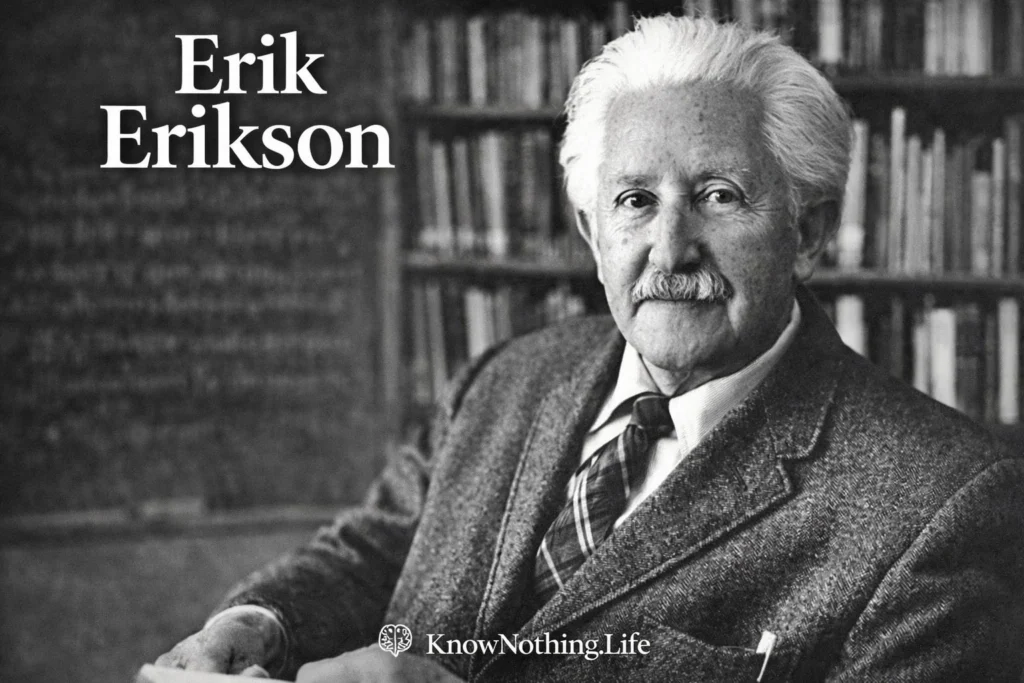
Among the most influential thinkers in developmental psychology, Erik Erikson stands apart for fundamentally changing how psychology understands human growth, identity, and personal development across the entire lifespan. While many earlier psychologists focused primarily on childhood development, Erikson argued that psychological growth does not end in adolescence or early adulthood. Instead, he proposed that human beings continue evolving psychologically from infancy through old age, constantly confronting developmental challenges that shape personality, relationships, and self-understanding.
Erikson’s work became one of the foundations of modern developmental psychology through his theory of psychosocial development, a framework describing eight major stages individuals navigate throughout life. His ideas expanded upon psychoanalytic theory while introducing a far more socially oriented understanding of human development than that offered by Sigmund Freud. Concepts such as identity crisis, ego development, generativity, and psychological maturity entered mainstream culture largely because of Erikson’s work. His influence extends far beyond psychology into education, parenting, sociology, leadership studies, and modern discussions surrounding personal identity and self-discovery.
Early Life and Questions of Identity
Erik Homburger Erikson was born on June 15, 1902, in Frankfurt, Germany, under circumstances that deeply shaped the questions he would later spend his life exploring. His biological father abandoned the family before Erikson was born, and he was raised by his mother before eventually being adopted by his stepfather, physician Theodor Homburger. Growing up, Erikson struggled profoundly with questions surrounding personal identity, belonging, and social acceptance. Tall, blond, and physically distinct from his Jewish family, he often felt like an outsider both within his home and in the broader cultural environment around him.
These early experiences created a lifelong fascination with identity formation and the internal conflict individuals experience while trying to understand who they are. Unlike many psychologists who developed theories through abstract academic work alone, Erikson’s intellectual interests emerged from deeply personal psychological struggles. His own life repeatedly forced him to confront the exact identity questions that later became central to his theories.
As a young man, Erikson initially resisted traditional academic paths. He studied art rather than science and spent several years traveling through Europe, uncertain about his future direction. During this period, he experienced prolonged personal uncertainty, searching for purpose and struggling with career identity. This phase of self-exploration later informed one of his most famous concepts: the identity crisis, a period of uncertainty during which individuals actively construct their sense of self.
Encounter with Psychoanalysis
Erikson’s life changed dramatically when he encountered Anna Freud, daughter of Sigmund Freud and an influential psychoanalyst in her own right. While teaching art at a progressive school in Vienna, Erikson became closely connected with psychoanalytic circles and began formal training in child psychoanalysis under Anna Freud’s guidance.
Through this experience, Erikson developed deep respect for psychoanalytic theory while simultaneously recognizing its limitations. Freud had argued that early childhood experiences and unconscious sexual drives largely determine adult personality. Erikson accepted many aspects of this framework but believed Freud focused too narrowly on biological development while underestimating the enormous influence of social relationships, culture, institutions, and life experiences beyond childhood.
This intellectual divergence became the foundation of Erikson’s greatest contribution. He believed the ego—the conscious sense of self—is not merely a mediator between unconscious desires and social reality, as Freud proposed. Instead, Erikson argued the ego actively develops throughout life as individuals engage with increasingly complex social challenges. Human development, he believed, is a lifelong process rather than something largely completed in childhood.
The Theory of Psychosocial Development
Erikson’s most important contribution was his theory of psychosocial development, first fully presented in his landmark 1950 book Childhood and Society. The theory proposed that every human being passes through eight distinct developmental stages across the lifespan, with each stage presenting a central psychological conflict requiring resolution. Successful navigation strengthens personality, while unresolved conflicts may create future difficulties.
The first stage, trust versus mistrust, occurs in infancy when children learn whether the world is safe and caregivers are dependable. The second stage, autonomy versus shame and doubt, involves developing independence during early childhood. As children grow, they confront initiative versus guilt and later industry versus inferiority, shaping confidence, competence, and early self-belief.
Adolescence introduces perhaps Erikson’s most famous stage: identity versus role confusion. During this period, individuals actively struggle to construct personal identity while determining values, relationships, beliefs, and future direction. Adulthood continues development through stages involving intimacy versus isolation, generativity versus stagnation, and finally integrity versus despair during old age. Erikson believed psychological growth continues throughout life, with every stage shaping the next.
The Identity Crisis Concept
Perhaps Erikson’s most culturally influential contribution was popularizing the concept of the identity crisis. He observed that adolescence and early adulthood often involve profound internal uncertainty as individuals attempt to answer essential questions about who they are and how they fit into society. Rather than viewing this confusion as pathological, Erikson believed identity struggle is a necessary developmental process.
According to Erikson, healthy identity formation requires experimentation. Young people test beliefs, values, careers, relationships, and social roles before gradually constructing coherent self-understanding. Problems emerge when individuals prematurely accept identities imposed by family, culture, institutions, or social expectations without genuine self-exploration.
Erikson famously wrote, “In the social jungle of human existence, there is no feeling of being alive without a sense of identity.” The statement reflected his conviction that psychological health depends fundamentally upon developing an internally coherent sense of self. Without identity, individuals experience disorientation, anxiety, and vulnerability to external influence.
Society, Culture, and Human Development
One of Erikson’s most important intellectual departures from Freud involved the role of society itself. Freud emphasized unconscious drives rooted largely in biology. Erikson believed culture and social environment profoundly shape psychological development. Identity, morality, confidence, relationships, and maturity all emerge within social structures rather than purely internal psychological processes.
This perspective led Erikson to study cultures outside Western society, particularly Native American communities, where he observed how different social structures influence child development and identity formation. These cross-cultural observations reinforced his belief that human development cannot be understood apart from the social world individuals inhabit.
His work emphasized that psychological development always occurs through interaction with family systems, educational institutions, cultural expectations, historical circumstances, and political environments. Identity is never formed in isolation. Individuals become themselves through participation in society, and society profoundly shapes the developmental challenges people face at every stage of life.
Major Works and Intellectual Contributions
Erikson’s most influential work, Childhood and Society (1950), introduced psychosocial development theory and became one of the foundational texts of developmental psychology. The book radically expanded psychology’s understanding of human growth by arguing development continues across the lifespan rather than ending after childhood.
His later book Identity: Youth and Crisis (1968) further explored identity formation during adolescence and popularized the term identity crisis within mainstream culture. The work became enormously influential during periods of major cultural change in the 1960s, when younger generations increasingly questioned traditional social structures and values.
Another major contribution came through Gandhi’s Truth (1969), where Erikson applied psychological theory to the life of Mahatma Gandhi. The book examined how personal identity, morality, and historical leadership interact psychologically. It won both the Pulitzer Prize and National Book Award, demonstrating Erikson’s remarkable ability to connect psychology with history, culture, and political transformation.
Criticism and Scientific Debate
Despite his enormous influence, Erikson’s theories have faced criticism. Some psychologists argued his developmental stages are too generalized and may oversimplify the complexity of individual development. Human growth rarely unfolds in neat sequential stages, and many individuals revisit developmental conflicts repeatedly throughout life.
Others argued his theory reflects Western cultural assumptions about independence, identity formation, and individual development that may not apply universally across collectivist cultures emphasizing community over individual self-definition. Researchers have also debated whether developmental stages are as distinct and predictable as Erikson proposed.
Yet even critics acknowledge the extraordinary influence of Erikson’s ideas. His theory remains central in developmental psychology because it provided one of the first comprehensive frameworks linking childhood development with adult identity, relationships, aging, and lifelong psychological growth.
Legacy and Lasting Influence
Erik Erikson permanently transformed psychology by expanding human development beyond childhood and emphasizing identity as one of life’s central psychological tasks. His work shaped modern education, parenting theory, adolescent psychology, counseling practice, leadership development, and identity research across multiple disciplines.
His ideas strongly influenced later thinkers studying human growth, including Abraham Maslow and Carl Rogers, both of whom shared Erikson’s belief that development involves movement toward greater self-understanding and fulfillment. Modern discussions surrounding identity politics, adolescence, self-concept, and life transitions continue drawing heavily upon his theoretical framework.
Erikson once wrote, “Life doesn’t make any sense without interdependence. We need each other, and the sooner we learn that, the better for us all.” This reflected his belief that identity is never purely individual. Human beings develop psychologically through connection, relationship, and participation in larger communities.
Final Thoughts
To study Erik Erikson is to understand that becoming oneself is one of life’s most complicated and lifelong psychological processes. His work revealed that development does not end with childhood but continues across every stage of life as individuals repeatedly confront questions involving trust, identity, intimacy, purpose, and meaning.
His legacy remains powerful because modern life continually forces individuals to confront precisely the identity struggles he spent his career examining. In explaining how personality evolves through lifelong interaction between self and society, Erikson gave psychology one of its most comprehensive theories of human development. More importantly, he reminded us that identity is not something discovered once and permanently fixed. It is something continuously shaped, challenged, and refined throughout the entire human experience.