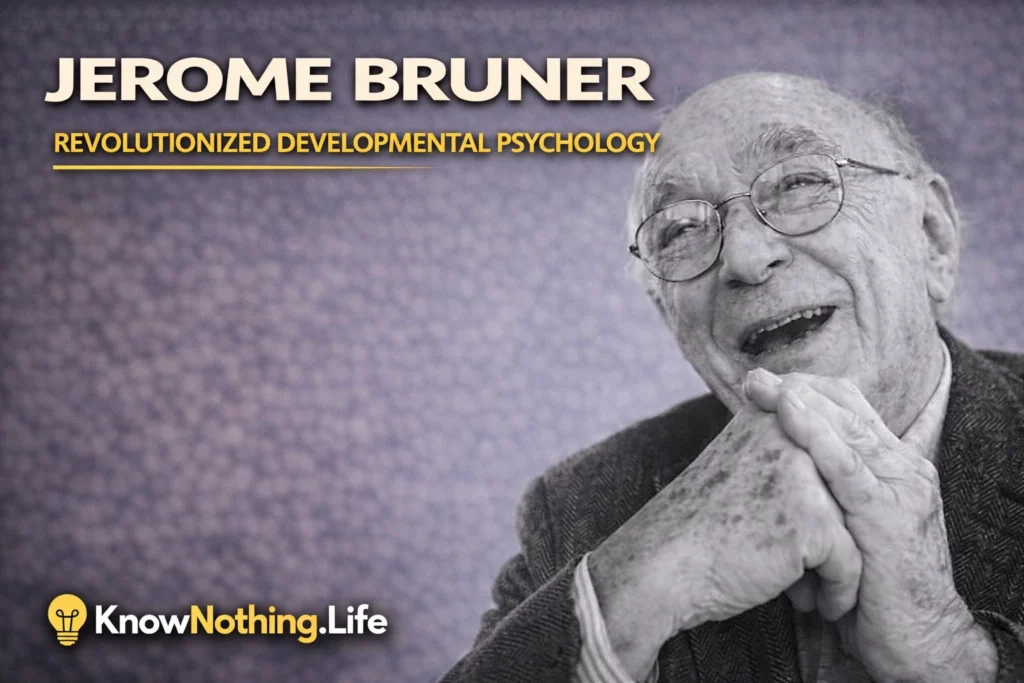
Jerome Seymour Bruner was born on October 1, 1915, in New York City, and became one of the most influential psychologists of the twentieth century. His career helped transform psychology from a science focused mainly on behavior into a science of mind, meaning, learning, and culture. Bruner was born blind because of cataracts, and his sight was restored after surgery when he was still very young. That early story is often treated as more than a biographical detail, because Bruner later became one of psychology’s great theorists of perception: he understood that seeing is not simply receiving the world, but interpreting it.
Bruner studied at Duke University, graduating in 1937, and earned his Ph.D. in psychology from Harvard University in 1941. During World War II, he worked in psychological warfare for the U.S. Army, an experience that deepened his interest in communication, propaganda, belief, and interpretation. After the war, he returned to Harvard, where he became a professor and helped build the intellectual environment that would become the cognitive revolution. From the start, Bruner resisted any psychology that treated people as passive responders to stimuli. Human beings, he believed, actively organize experience, form categories, tell stories, and construct meaning.
The New Look in Perception
Bruner’s early work helped create what became known as the “New Look” in perception. In research with Cecile Goodman, he showed that children’s perceptions could be influenced by needs, values, and social conditions. One famous line of research suggested that poorer children overestimated the size of coins more than wealthier children did, indicating that perception was not a neutral copy of the external world. The mind did not simply record reality like a camera. It selected, organized, emphasized, and interpreted.
This work was important because it challenged the idea that perception could be fully explained from the bottom up, as if the senses alone determined what people experience. Bruner argued that perception is shaped by expectation, motivation, culture, and prior knowledge. That insight would echo through the rest of his career. Whether he was studying concept formation, education, narrative, or law, Bruner returned to the same basic theme: people do not merely absorb the world. They make sense of it through mental structures, social tools, and shared meanings.
A Study of Thinking and the Cognitive Revolution
In 1956, Bruner, Jacqueline Goodnow, and George Austin published A Study of Thinking, one of the landmark works in the rise of cognitive psychology. The book examined how people form concepts, test hypotheses, and sort information into categories. At a time when behaviorism still dominated much American psychology, Bruner and his colleagues insisted that the mind’s internal processes could be studied scientifically. They did not treat thinking as a mysterious private event, but as an organized activity that could be observed through problem-solving behavior.
Bruner’s role in the cognitive revolution became even more visible in 1960, when he co-founded Harvard’s Center for Cognitive Studies with George Miller. The center became a symbolic home for a new kind of psychology, one that studied language, memory, problem solving, representation, and meaning. Bruner helped make cognition respectable again. He showed that mental life could be rigorous without being reduced to mechanical stimulus-response chains. In that sense, his work helped reopen psychology’s oldest questions: how do people know, learn, remember, imagine, and understand?
The Process of Education
Bruner’s most influential educational book, The Process of Education, was published in 1960 and became a major force in curriculum reform. Its most famous claim was bold: “Any subject can be taught effectively in some intellectually honest form to any child at any stage of development.” Bruner did not mean that children can master advanced subjects exactly as adults do. He meant that the deep structure of a subject can be introduced in forms appropriate to the learner’s development. A child can begin to grasp scientific, mathematical, historical, or literary ideas long before mastering their technical language.
This idea supported the spiral curriculum, in which students return to fundamental concepts repeatedly, each time at a more complex level. Education, for Bruner, was not the dumping of facts into memory. It was the gradual deepening of understanding. He emphasized discovery learning, structure, readiness, and the teacher’s role in helping students move from action to image to symbol. The learner was not a container but an active thinker. Good teaching did not merely simplify knowledge; it preserved the intellectual honesty of a subject while making it reachable.
Representation, Language, and Development
Bruner’s theory of cognitive development proposed three major modes of representation: enactive, iconic, and symbolic. Enactive representation is based on action. Iconic representation is based on images. Symbolic representation is based on language and abstract systems. This framework helped explain how children move from doing, to picturing, to using symbols. It also gave educators a practical sequence for instruction: begin with activity, support understanding with images, then move toward language, notation, and formal reasoning.
Unlike Jean Piaget, Bruner was less committed to fixed developmental stages that strictly limit what children can understand. He believed instruction could lead development when it was properly structured. This made his theory especially attractive to educators who wanted to challenge children without overwhelming them. Bruner’s later work on language development, including Child’s Talk, emphasized that children learn language through social interaction, routines, and shared attention. Learning is not solitary mental growth; it is participation in a cultural world.
Narrative, Culture, and Meaning
In the later part of his career, Bruner became increasingly concerned that the cognitive revolution had drifted too far toward computational models of the mind. In Actual Minds, Possible Worlds and Acts of Meaning, he argued that psychology must study not only how people process information, but how they create meaning. Human beings understand life through stories. They explain themselves, their memories, their relationships, their failures, and their hopes through narrative forms. A life is not merely a sequence of events; it is an interpreted story.
This shift did not abandon cognitive psychology. It broadened it. Bruner distinguished between paradigmatic thought, which seeks logical categories and general principles, and narrative thought, which organizes experience through time, intention, conflict, and meaning. Both are essential. Science gives explanation, but stories give human intelligibility. In The Culture of Education, he extended this argument into schools, insisting that education is always embedded in culture. A classroom is not simply a place where information is transferred; it is a community where children learn how to interpret the world.
Law, Major Works, and Later Career
Bruner’s later career took him into law, culture, and narrative justice. After leaving Harvard, he taught at the University of Oxford, later at the New School for Social Research, and eventually at New York University School of Law. At NYU, he explored how law depends on storytelling, interpretation, intention, and cultural assumptions. His books Minding the Law and Making Stories: Law, Literature, Life showed how far his psychology had traveled while still remaining true to its original question: how do people construct reality?
His major works include A Study of Thinking, The Process of Education, On Knowing: Essays for the Left Hand, Toward a Theory of Instruction, Actual Minds, Possible Worlds, Acts of Meaning, The Culture of Education, Minding the Law, and Making Stories. Across these works, Bruner’s subject was not merely cognition in a narrow laboratory sense. It was the full human act of understanding. He studied how people categorize, learn, speak, teach, remember, narrate, and justify. Few psychologists have moved so easily between experiment, education, philosophy, culture, and law.
Legacy and Lasting Importance
Jerome Bruner died on June 5, 2016, at the age of 100. By then, his influence had spread across cognitive psychology, developmental psychology, education, linguistics, cultural psychology, and legal theory. He helped overthrow behaviorism’s narrow view of the mind, advanced the study of concept formation, changed educational theory, and restored meaning and narrative to the center of psychology. His work helped generations of teachers see children not as passive recipients, but as active makers of knowledge.
Bruner’s lasting importance lies in his refusal to shrink the human mind. He believed people are biological, cognitive, social, cultural, and narrative beings all at once. We learn through action, image, language, dialogue, story, and participation in shared worlds. His psychology was therefore both scientific and humanistic. It asked how the mind works, but also why meaning matters. Jerome Bruner changed psychology by showing that to understand thought, we must understand learning; to understand learning, we must understand culture; and to understand culture, we must understand the stories people use to make life intelligible.