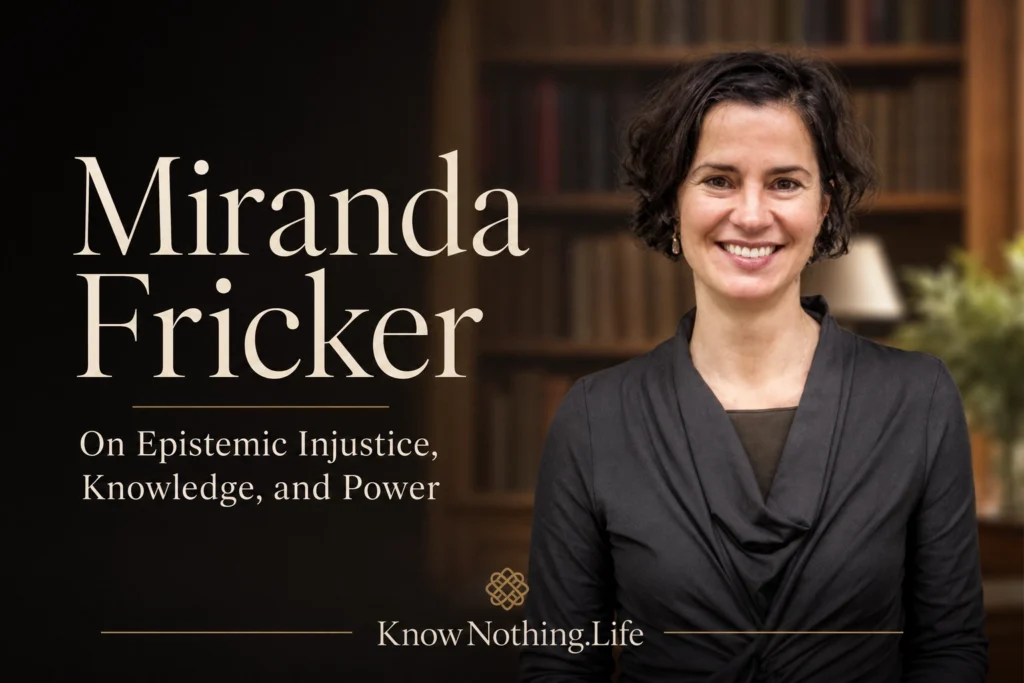
Miranda Fricker is one of the most influential philosophers working at the intersection of epistemology, ethics, feminist philosophy, and social philosophy. Her career is most closely associated with the concept of epistemic injustice, a term that names the ways people can be wronged not only economically, politically, or socially, but specifically as knowers. This idea changed contemporary philosophy because it revealed that power does not operate only through laws, institutions, or material resources. It also operates through credibility, interpretation, listening, silence, and whose experiences are treated as intelligible.
Fricker studied philosophy and modern languages at Pembroke College, Oxford, later earned an M.A. in Women’s Studies from the University of Kent, and completed her doctorate in philosophy at the University of Oxford in 1996. Her intellectual formation joined analytic philosophy’s concern for clarity with feminist philosophy’s attention to power, exclusion, and lived experience. That combination became the signature of her work. She did not reject traditional epistemology; she widened it. She asked what happens when the ordinary practices of knowledge—telling, listening, interpreting, doubting, believing—are distorted by social inequality.
Academic Career and Philosophical Setting
Fricker taught for many years at Birkbeck, University of London, where she became a prominent figure in British philosophy. She later held a professorship at the University of Sheffield and became Distinguished Professor at the Graduate Center, CUNY. In 2022, she joined New York University as Julius Silver Professor of Philosophy and became Co-Director of the New York Institute of Philosophy. She has also served as moral philosopher on the United Kingdom’s Spoliation Advisory Panel, a role that reflects the practical reach of her work beyond academic epistemology into questions of historical wrong, ownership, responsibility, and repair.
Her philosophical setting is important because her work emerged against a background in which Anglo-American epistemology often focused on individual belief, justification, skepticism, reliability, and evidence. Those questions remain important, but Fricker argued that they can obscure the social and ethical dimensions of knowing. Human beings do not acquire knowledge as isolated minds. We listen to testimony, depend on shared concepts, inherit social images, and use collective interpretive resources. This means that injustice can enter knowledge practices at very basic levels.
Epistemic Injustice
Fricker’s defining work, Epistemic Injustice: Power and the Ethics of Knowing, was published by Oxford University Press in 2007. The book’s central claim is that there is a distinctively epistemic kind of wrong: a wrong done to someone “in their capacity as a knower.” That short phrase became one of the most important ideas in twenty-first-century social philosophy. It gave a name to harms people had long experienced but that philosophy had often failed to classify.
The power of the concept lies in its precision. Fricker did not merely say that ignorance and prejudice are bad. She showed that prejudice can damage the very exchange of knowledge. A person may speak truthfully, yet not be believed because of race, gender, class, accent, disability, age, sexuality, poverty, or other identity markers. Another person may struggle to explain an experience because the available social language does not yet contain the needed concepts. In both cases, the harm is not only practical or emotional. It is epistemic: it concerns the ability to give, receive, and make sense of knowledge.
Testimonial Injustice
The first major form Fricker identified is testimonial injustice. She defines it as occurring when prejudice causes a hearer to give a speaker less credibility than they deserve. This can happen in obvious cases, such as a police officer disbelieving a witness because of racial prejudice, or a doctor dismissing a patient’s account because of gendered assumptions. It can also happen subtly, through tone, hesitation, interruption, condescension, or unconscious credibility judgments that are shaped by social stereotypes.
Fricker’s insight was that credibility is not a neutral substance distributed by pure reason alone. It is often filtered through what she calls identity power. People are heard through social imagination: images and expectations about who is rational, emotional, dangerous, trustworthy, competent, naïve, authoritative, or confused. When those images are prejudicial, a speaker may be treated as less of a knower. The wrong is deep because testimony is one of the basic ways human beings share knowledge. To be unfairly disbelieved is not merely to lose an argument; it is to be diminished in one’s standing as a participant in truth.
Hermeneutical Injustice
The second major form is hermeneutical injustice. This occurs when a gap in shared interpretive resources places someone at an unfair disadvantage in making sense of their own social experience. Fricker’s famous example is sexual harassment before the concept was widely available. People could suffer the experience but lack the public language needed to name it, criticize it, and communicate it clearly to others. The problem is not simply private confusion. It is a collective interpretive failure shaped by unequal social power.
Hermeneutical injustice shows that power affects not only who is believed, but what can be understood. A society’s vocabulary is not politically innocent. If dominant groups control institutions, law, media, medicine, scholarship, and public language, then the experiences of marginalized groups may remain poorly interpreted or misinterpreted. Fricker’s concept helped philosophers see that silence is sometimes produced not by lack of experience, but by lack of shared concepts. People may know that something is wrong before the social world gives them the language to say what it is.
Virtue, Listening, and Epistemic Justice
Fricker’s project is not only diagnostic. It also asks what intellectual and ethical virtues are needed to resist epistemic injustice. In the case of testimonial injustice, she emphasizes the need for a virtue of testimonial justice: a cultivated sensitivity to the possibility that one’s credibility judgments are being distorted by prejudice. This does not mean automatically believing everyone. It means listening with reflective awareness of how social identity can affect perception, confidence, and doubt.
In the case of hermeneutical injustice, she points toward a virtue of hermeneutical justice. A listener may need to recognize that another person’s difficulty in explaining an experience is not evidence that the experience is unreal or confused. The problem may lie in the shared interpretive tools available to both speaker and hearer. This is one of the most humane aspects of Fricker’s philosophy. It asks people to listen not only for polished explanations, but also for the social conditions that make explanation difficult.
Major Works and Broader Influence
Although Epistemic Injustice is her most famous book, Fricker’s work extends across moral philosophy, feminist philosophy, social epistemology, group knowledge, blame, forgiveness, political philosophy, and the ethics of interpretation. She co-edited The Cambridge Companion to Feminism in Philosophy with Jennifer Hornsby, co-authored and edited Reading Ethics with Sam Guttenplan, co-edited The Epistemic Life of Groups with Michael Brady, and co-edited The Routledge Handbook of Social Epistemology with Peter Graham, David Henderson, and Nikolaj Pedersen. These works show the breadth of her philosophical concerns: knowledge is social, moral life is interpretive, and responsibility often depends on how we understand one another.
Her influence has spread far beyond academic philosophy. Epistemic injustice is now discussed in law, medicine, education, political theory, artificial intelligence, disability studies, race theory, gender studies, psychiatry, journalism, public policy, and organizational ethics. The concept is useful because it names something many institutions produce: people being disbelieved, misread, excluded from expert status, denied interpretive tools, or treated as data rather than as knowers. Fricker gave these harms a philosophical structure.
Later Work and Continuing Importance
Fricker’s more recent work has turned increasingly toward moral philosophy, including blame, apology, forgiveness, institutional distrustworthiness, and the ethical philosophy of Bernard Williams. This development is not a departure from her earlier work. It continues the same concern with moral relations between persons. To blame, forgive, listen, trust, doubt, or apologize is to participate in practices that shape human standing. Fricker’s philosophy asks how those practices can be corrupted by power and how they might be repaired by virtue.
Miranda Fricker’s lasting importance lies in the fact that she changed what epistemology could see. Before her, many philosophers studied knowledge as if credibility, interpretation, and social identity were secondary matters. Fricker showed that they are central. Her work reminds us that injustice does not only silence people by force. It can silence them by disbelief, by conceptual poverty, by stereotypes, and by failures of listening. She made knowledge a moral and political subject without reducing truth to politics. That balance is her achievement: she showed that truth matters, but so does the justice of the human practices through which truth is heard.